Key Takeaways
- Social buffering: the brain lowers its threat response near a trusted person, countering social pain.
- Social Baseline Theory: default expectation is proximity; a reliable relationship becomes a cost-lowering shared resource.
- The landmark hand-holding study: women anticipating shock showed reduced threat activation, largest in closest relationships.
- Oxytocin from safe contact dampens amygdala reactivity and, with social support, blunts the cortisol rise.
- Co-regulation is the developmental root of self-regulation, a resilience mechanism, not a soft extra.
Connection steadies the brain under pressure because your nervous system was never built to manage threat alone. When someone you trust is genuinely present, the brain offloads part of the work of staying safe onto that relationship, and measurable activity in the amygdala and the stress-hormone system falls. The same threat costs your brain less to face.
What Is Social Buffering, and Why Does the Brain Treat Connection as a Resource?
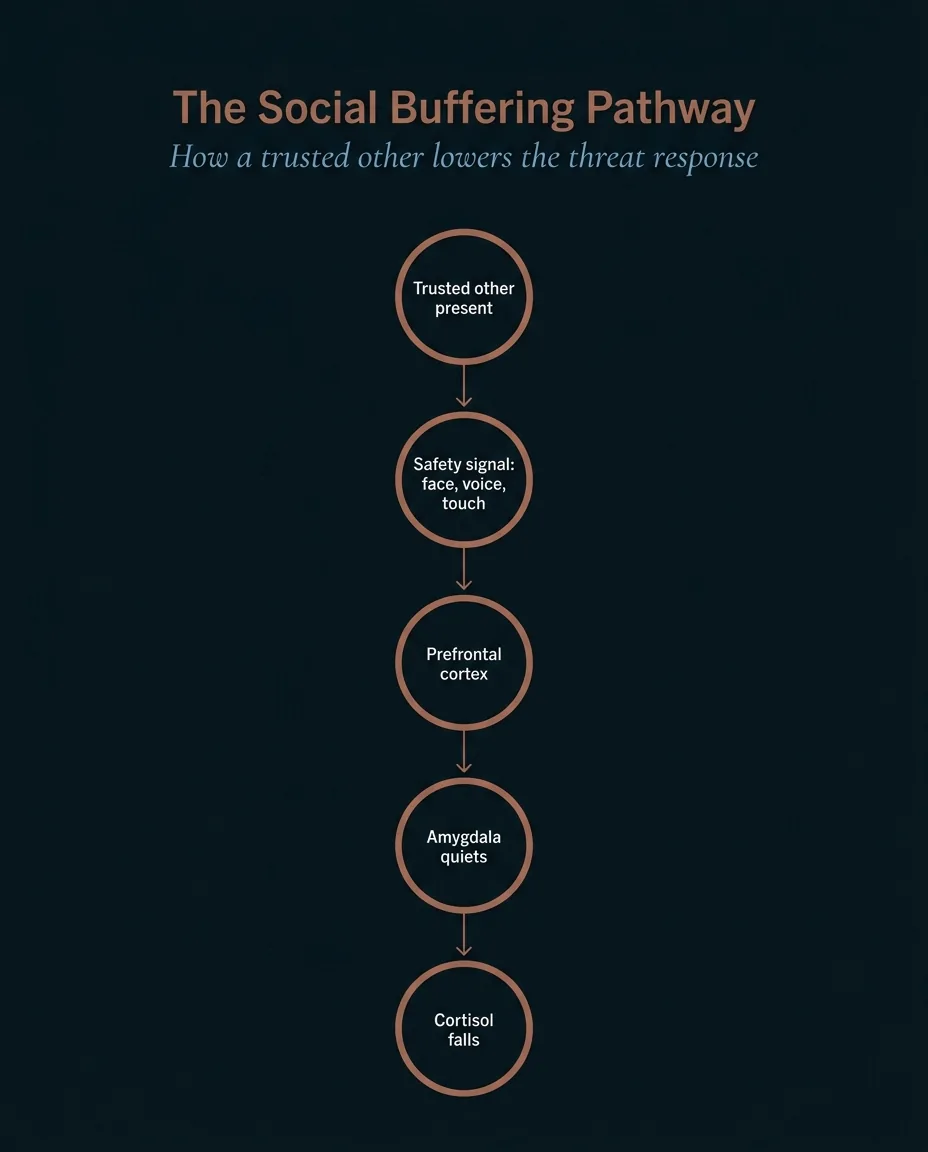
Social buffering is the measurable reduction in the brain’s threat and stress response that occurs when a trusted other is present. It is the inverse of social pain: the same circuits that fire as an alarm when connection is missing grow quieter when connection is reliably there. The presence of the right person is not emotional comfort alone. It changes what the brain has to compute.
The clearest account of why comes from Social Baseline Theory, developed by the neuroscientists James Coan and Lane Beckes. Their argument is that the human brain runs on an assumption of proximity. Across the long arc of our evolution, a person was almost never truly alone, and the brain came to treat reliable relationships the way it treats any other resource that lowers risk and conserves energy. Close others are folded into the brain’s representation of the self, so that facing a steep demand alongside someone is encoded, quite literally, as less costly than facing it by yourself. The technical terms are load sharing and risk distribution, and they are not metaphors. They describe how the brain budgets its limited resources.
This reframes what isolation actually does. If proximity is the baseline, then being on your own is the deviation the brain has to work to compensate for, which is why solitude registers as increased vigilance and effort rather than as a neutral state. That is the same machinery I describe in our explainer on why the brain treats loneliness as a survival threat. Buffering and loneliness are two readings of one system: when the social signal is present, the threat budget shrinks; when it is absent, the brain spends more to keep you safe. The articles in our hub on social resilience and connection map both sides of that ledger.
What Happens in the Brain When Someone You Trust Is Near?
The threat response quiets. In a now-classic experiment, women lying in an fMRI scanner under threat of a mild electric shock showed markedly less activation across the brain’s threat network while holding their husband’s hand than while facing the same threat alone. The relationship did part of the regulating that the brain would otherwise have done by itself.
That study, led by James Coan with Hillary Schaefer and Richard Davidson, is the canonical demonstration of social buffering in the human brain. The detail that matters most is the gradient. Holding a stranger’s hand reduced the threat response somewhat. Holding a husband’s hand reduced it more. And the higher a woman rated the quality of her marriage, the larger the calming effect in the regions that track bodily alarm and anticipated harm. The brain was not responding to touch as a generic sensation. It was responding to the specific safety the relationship signaled, which is exactly what you would predict if the brain treats a trusted other as a resource. You can read the original report of this social regulation of the neural response to threat in Psychological Science.
This is the mechanism the existing literature on disconnection only shows in negative. When I explain why social rejection registers as physical pain, the point is that the brain runs social experience through circuits it also uses for survival. Buffering is the upside of that same wiring. A nervous system that can be wounded by exclusion can also be settled by belonging, and the settling is not a mood. It is a drop in the neural cost of being under pressure.

How Does Oxytocin Quiet the Threat System?
Oxytocin lowers the brain’s threat signal mainly by dampening the amygdala, the structure that launches the body’s alarm. Released during warm and trusted contact, it acts as a modulator on the circuits that decide how dangerous a moment is, turning the volume down rather than switching anything off. It is best understood as a context-dependent dial, not a calm switch you can simply flip.
The neural evidence is direct. When researchers gave healthy volunteers intranasal oxytocin and then showed them frightening images and faces, oxytocin reduced amygdala activation and loosened the amygdala’s coupling to the brainstem regions that drive the physical machinery of fear, the racing heart and the freeze. That study by Peter Kirsch and colleagues, on how oxytocin modulates the neural circuitry for social cognition and fear in humans, gives a clean picture of the pathway: less amygdala output means less downstream alarm. On the hormonal side, men who faced a demanding public-speaking stress test with both a supportive friend and oxytocin produced the lowest cortisol of any group and reported the most calm, a finding reported as the way social support and oxytocin interact to suppress cortisol. Support and the neuropeptide worked together; each amplified the other.
This is also why the stress response is not only fight or flight. The psychologist Shelley Taylor proposed that under stress we also draw on an affiliative response, a tend-and-befriend pattern she first characterized in women, that recruits oxytocin and the attachment system and pulls us toward others rather than away. I want to be precise here, because this is where popular writing overreaches. Oxytocin is not a love hormone you can bottle, and its effects depend heavily on context and on whether the relationship is genuinely safe. What the science supports is narrower and more useful: in the presence of real trust, oxytocin is part of how the brain converts closeness into a lower threat response. The chemistry that does this in committed bonds is the same system I unpack in our guide to the oxytocin chemistry of bonding.
What Is Co-Regulation, and How Does One Nervous System Settle Another?
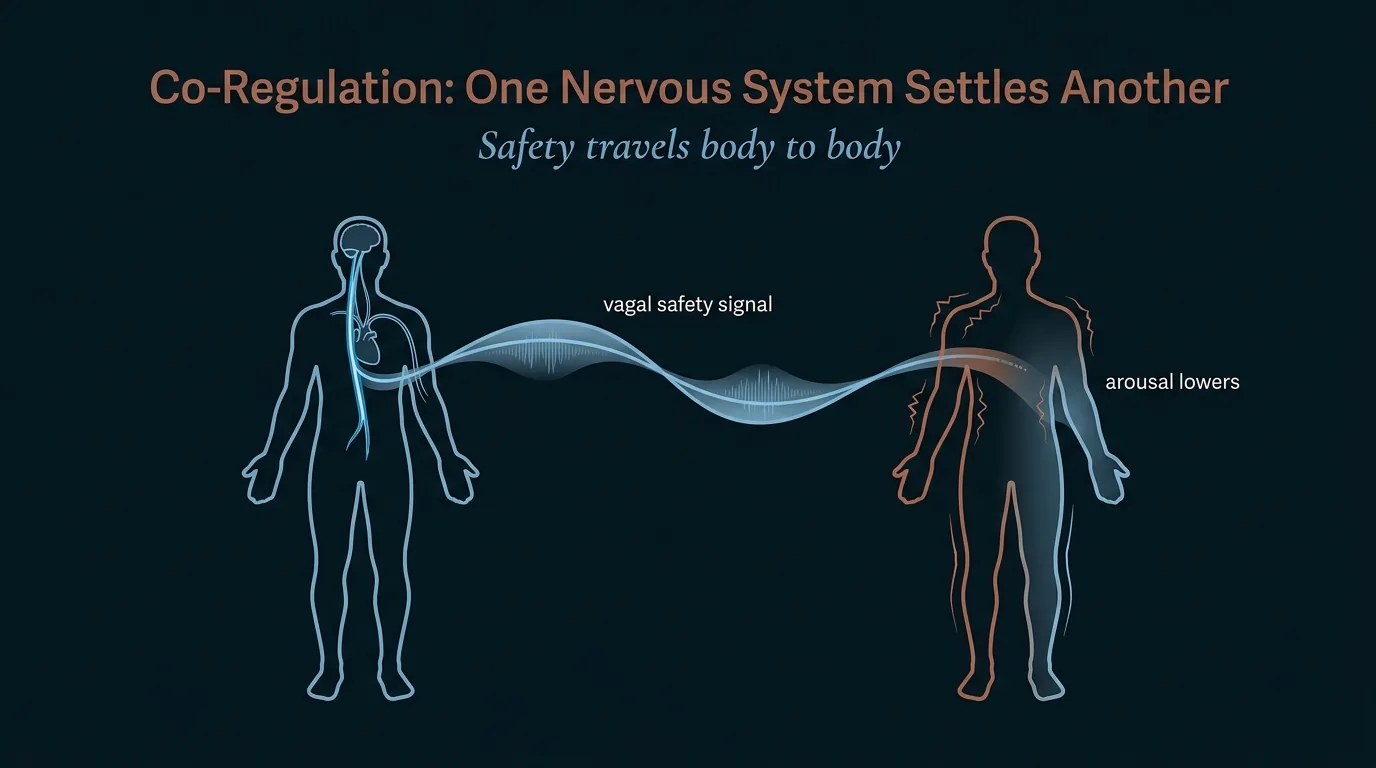
Co-regulation is the process by which one person’s settled physiology helps bring another’s back toward baseline. A calm nervous system in the room is not just reassuring to look at. Through tone of voice, facial expression, breathing, and touch, it sends a continuous stream of safety signals that the other brain reads and partly entrains to, lowering arousal without a single conscious decision.
This is not a soft idea grafted onto hard science. It is where self-regulation comes from in the first place. An infant cannot manage its own cortisol or arousal, so a caregiver’s regulated nervous system does it on the child’s behalf, thousands of times. The capacity to self-soothe is built by internalizing those episodes. In adulthood, the wiring does not disappear; it goes quiet until a trusted other reactivates it. The researchers David Sbarra and Cindy Hazan described how, in close adult bonds, two partners’ physiologies become interwoven, so that the felt security of the relationship is something the pair regulates together rather than something each person manufactures alone.
The body’s main channel for this is the vagus nerve, which carries the parasympathetic brake that slows the heart and signals safety. A warm social cue raises vagal tone and eases the body out of high alert. Stephen Porges’s polyvagal model proposes that cues of safety from a familiar face and voice route through a dedicated vagal pathway to switch the body from defense into a state of social engagement. Parts of that model remain debated among neuroscientists, so I hold the specific claims loosely, but the broad pattern it points to is well supported: safety read from another person travels through the nervous system as a physical down-shift, not merely as a thought. Learning to drive that shift on purpose is the heart of shifting the nervous system from high alert back to a settled state, and it is far easier to do with another regulated brain nearby than alone.
Regulation is not only something you do to yourself. It is something nervous systems do for each other, and the brain has counted on that arrangement since before you could speak.
Why Isolation Quietly Raises the Cost of Everything
If connection lowers the brain’s threat budget, chronic disconnection raises it, and the cost is paid everywhere at once. A brain that never receives the co-regulation signal runs its threat system slightly hotter all day, which drains the same resources you need for focus, judgment, and recovery. This is the pattern I see most often in the people who least expect it.
In more than twenty-six years of working with people in high-stakes roles, the most consistent hidden driver of dysregulation I encounter is not workload. It is isolation. The accomplished professional who has optimized everything except connection arrives convinced the problem is discipline or strategy, when the underlying issue is a nervous system carrying its full threat load with no one to share it. They have, without realizing it, removed the brain’s oldest and most powerful regulator and then wondered why willpower keeps running out. I call what they are missing borrowed regulation, the capacity to draw on another steady nervous system rather than spending your own reserves to hold the line.
This is why the relationship itself, not just the information exchanged inside it, is part of how change happens. When a brain is flooded, it defends its old patterns; when it feels safe, it can revise them. A trusted, regulating presence is what moves a nervous system from the first state into the second, which is the precondition for any durable rewiring. The same buffering that quiets a threat response in a scanner is what makes a person able to think clearly and choose differently under real pressure. It connects directly to how the brain meets stress, holds steady, and returns to baseline, and it is reinforced by the wider web of bonds the research on cortisol co-regulation within families describes.
| Dimension | The unbuffered threat response (facing it alone) | The buffered threat response (a trusted other present) |
|---|---|---|
| Amygdala activity | Runs high; the alarm stays sensitive | Dampened; the same cue reads as less dangerous |
| Cortisol | Larger and more prolonged stress-hormone rise | Blunted rise, especially when support and oxytocin combine |
| Brain’s resource budget | Carries the full threat load alone, draining reserves | Load is shared, so less energy is spent staying safe |
| Capacity to think and change | Defends old patterns under flooding | Regulated enough to revise patterns and decide clearly |
Understanding that connection regulates the brain is the first step. Building the specific relationships and nervous-system habits that actually lower your threat load is where steadier performance begins. A strategy call maps where your regulation is running on empty and designs a plan around how your brain actually settles.
If you carry pressure well in public but feel your reserves draining in private, the missing variable is often co-regulation, not discipline. Book a Strategy Call with Dr. Sydney Ceruto to explore a neuroscience-based path to a more resilient, better-supported nervous system.
What is social buffering in simple terms?
Social buffering is the way the presence of a trusted person lowers your brain’s stress and threat response. When someone safe is genuinely with you, the brain treats the situation as less dangerous, so activity in the amygdala and the stress-hormone system falls and the same challenge becomes easier to face. It is the biological reason that hard things feel more manageable in good company, and it is the positive counterpart to the alarm the brain raises when you are isolated.
Does having someone hold your hand really reduce stress in the brain?
Yes, and it has been measured directly. In fMRI research, women anticipating a mild electric shock showed less activation in the brain’s threat network while holding a partner’s hand than while facing the threat alone. The effect was strongest for those in the highest-quality relationships and weaker with a stranger, which shows the brain is responding to the safety the relationship signals, not to touch by itself.
Is oxytocin a calming hormone I can take to feel less stressed?
Not in that simple sense. Oxytocin can dampen amygdala reactivity and, together with social support, blunt the cortisol response to stress, but its effects depend heavily on context and on whether the relationship around you is genuinely safe. It works as part of a trusting connection, not as a standalone supplement. Treating it as a bottled calm switch overstates what the science actually shows.
What is the difference between co-regulation and self-regulation?
Self-regulation is managing your own arousal and emotion from the inside. Co-regulation is when another person’s settled nervous system helps bring yours back toward baseline through tone, expression, breathing, and presence. Co-regulation comes first developmentally: a caregiver regulates an infant who cannot yet self-soothe, and self-regulation is built by internalizing thousands of those moments. Throughout life, the two work together, and a regulated other makes self-regulation far easier.
Why do I feel more stressed and depleted when I am isolated, even if nothing is wrong?
Because the brain’s baseline assumption is proximity to others. When that social signal is missing, the brain runs its threat system slightly hotter to compensate, which quietly drains the resources you need for focus, judgment, and recovery. Isolation is not a neutral state to the nervous system; it reads as increased risk and effort. Restoring genuine connection is one of the most direct ways to lower that ongoing load.
References
- Coan, J. A., Schaefer, H. S., & Davidson, R. J. (2006). Lending a hand: Social regulation of the neural response to threat. Psychological Science, 17(12), 1032-1039. https://doi.org/10.1111/j.1467-9280.2006.01832.x
- Kirsch, P., Esslinger, C., Chen, Q., Mier, D., Lis, S., Siddhanti, S., … & Meyer-Lindenberg, A. (2005). Oxytocin modulates neural circuitry for social cognition and fear in humans. Journal of Neuroscience, 25(49), 11489-11493. https://doi.org/10.1523/JNEUROSCI.3984-05.2005
- Heinrichs, M., Baumgartner, T., Kirschbaum, C., & Ehlert, U. (2003). Social support and oxytocin interact to suppress cortisol and subjective responses to psychosocial stress. Biological Psychiatry, 54(12), 1389-1398. https://doi.org/10.1016/S0006-3223(03)00465-7
- Coan, J. A., & Sbarra, D. A. (2015). Social Baseline Theory: The social regulation of risk and effort. Current Opinion in Psychology, 1, 87-91. https://doi.org/10.1016/j.copsyc.2014.12.021
- Taylor, S. E., Klein, L. C., Lewis, B. P., Gruenewald, T. L., Gurung, R. A. R., & Updegraff, J. A. (2000). Biobehavioral responses to stress in females: Tend-and-befriend, not fight-or-flight. Psychological Review, 107(3), 411-429. https://doi.org/10.1037/0033-295X.107.3.411
- Sbarra, D. A., & Hazan, C. (2008). Coregulation, dysregulation, self-regulation: An integrative analysis and empirical agenda for understanding adult attachment, separation, loss, and recovery. Personality and Social Psychology Review, 12(2), 141-167. https://doi.org/10.1177/1088868308315702