

Key Takeaways
- In Gabriele Oettingen’s studies, people who had more positive fantasies about a goal tended to put in less effort and get weaker results
- In lab experiments, picturing an ideal outcome lowered systolic blood pressure, a sign of how much energy the body is ready to spend
- Mental contrasting, which pairs a goal with the obstacles in the way, raised commitment when people believed they could succeed
- Rehearsing the steps in your mind has improved performance in studies of students and novice surgeons
When you vividly imagine achieving a goal (the promotion, the transformed body, the standing ovation), your body can respond as if part of the work is already done. Psychologists Heather Barry Kappes and Gabriele Oettingen tested this in the lab. Women who pictured an idealized scene (wearing a perfect pair of high heels and being admired for it) showed a drop in systolic blood pressure, the top number in a blood pressure reading. Women whose daydream questioned that ideal showed no drop. The researchers read the drop as a sign of lower energization, the body’s readiness for effort. That drop is part of the answer to why visualization doesn’t work. In my practice, I’ve watched this mechanism undermine some of the most capable people I work with, not because they lack discipline, but because their brains have been trained to treat fantasy as progress.
Can Visualization Make You Feel Worse?
Over time, it can. In four studies led by Oettingen, adults and schoolchildren who had more positive fantasies about the future reported fewer symptoms of depression at the time. Up to seven months later, the same people reported more symptoms. In the study of college students, part of the link ran through grades: the students who fantasized more did less well in school.
I worked with a young professional who had adopted a daily visualization practice from a popular self-help book. Every morning, she spent twenty minutes imagining a confident, accomplished version of herself delivering presentations and closing deals. Within three months, her anxiety had measurably worsened. The visualization wasn’t motivating her. It was creating a daily experience of falling short: a gap between the person she imagined and the person who showed up at her desk each morning.
How Does the Gap Between Fantasy and Reality Become a Source of Distress?
The research points to effort and results. In Oettingen’s studies, people with more positive fantasies tended to put in less effort and achieve less. In the study of college students, lower grades explained part of the later rise in symptoms of depression.
Dopamine often gets the blame for this letdown. Dopamine is a brain chemical that helps you learn what to expect and pushes you toward rewards. Schultz, Dayan, and Montague described how the cells that make dopamine in monkeys track the gap between the reward they expect and the reward they get. The cells fire less when an expected reward fails to arrive. That work studied real rewards. The fantasy studies on this page measured blood pressure, effort and results, not dopamine. A dopamine dip after a daydream is an idea worth testing, and no one has shown it yet in the studies cited here.
Does Positive Visualization Actually Work?
Positive visualization means vivid mental pictures of the outcome you want, without a plan to get there. It does not reliably produce the motivation people expect. In a review of her research, Gabriele Oettingen concluded that positive fantasies about the future can harm effort and success.
A small early study by Oettingen and Wadden shows the pattern. Among 25 women in a year-long weight-loss program, those who expected to reach their goal weight lost more. Those who had more positive fantasies about it tended to lose less. Expecting success and daydreaming about it pulled in opposite directions.
What Does Blood Pressure Reveal About Positive Fantasy?
Kappes and Oettingen ran four experiments with college students. In two of them they measured systolic blood pressure, a common marker of energization. After a positive fantasy, systolic blood pressure fell. After a fantasy that questioned the ideal future, it did not. In the other studies, people felt less energized after a positive fantasy than after a negative or neutral one. In one small study, students who wrote positive fantasies about the coming week said a week later that they had gotten less done.
What Is Mental Contrasting and Why Is It Better Than Visualization?
Mental contrasting pairs a desired outcome with the specific obstacles standing in the way. In four experiments by Oettingen, Pak, and Schnetter, people who used it made stronger commitments to goals they expected to reach than people who only fantasized. When they did not expect to succeed, their commitment was weaker. Oettingen counts that as useful too, since it lets people let go of goals they are unlikely to reach.
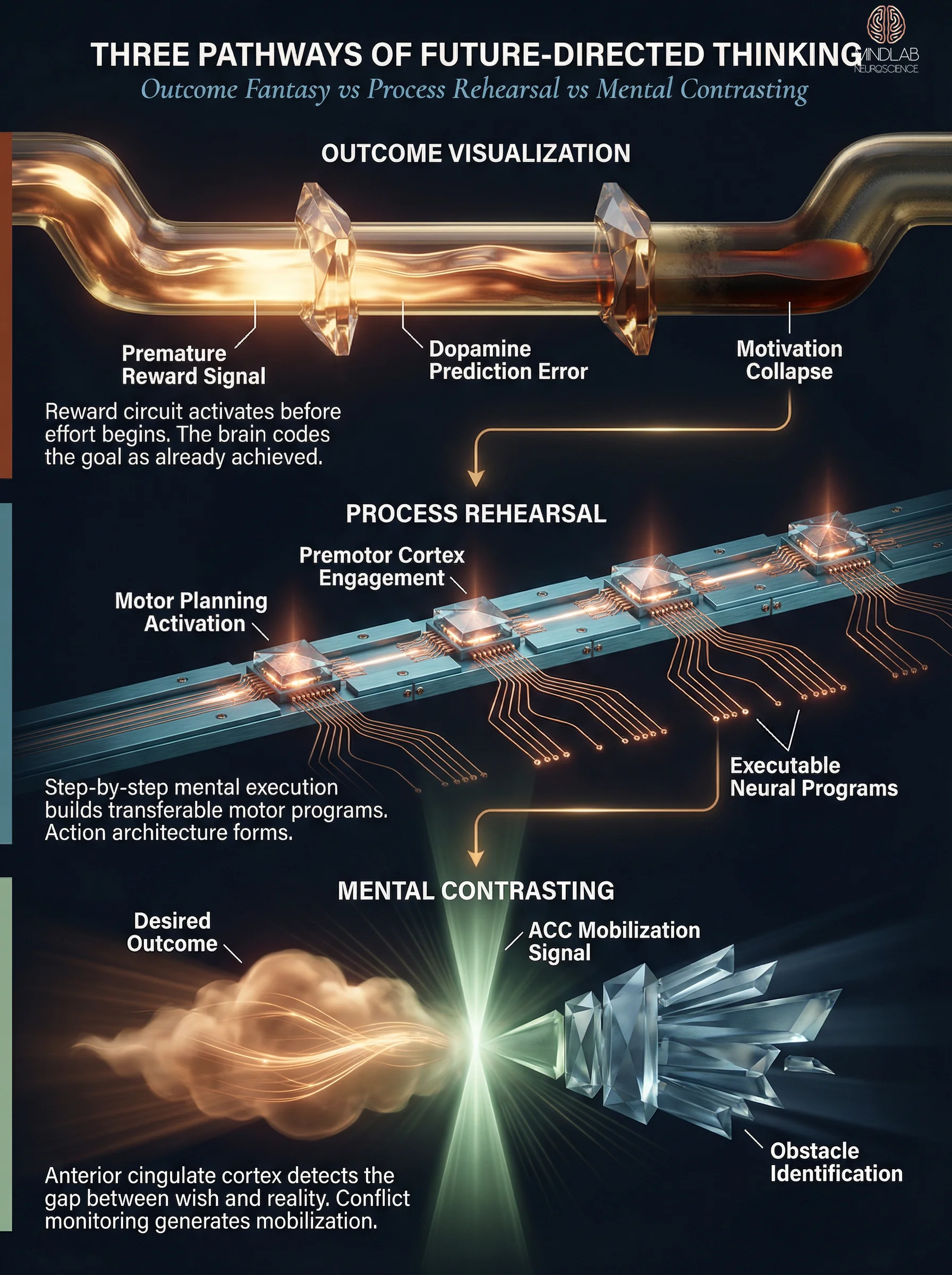
The structured version, called WOOP (Wish, Outcome, Obstacle, Plan), comes from Oettingen’s book Rethinking Positive Thinking. You identify a wish, imagine the best outcome, name the main obstacle inside you, and make an if-then plan (“If this happens, then I will do that”). A review of 21 studies with almost 16,000 people found that pairing mental contrasting with if-then plans helps people reach goals by a small to medium amount. The authors caution that unpublished studies with no effect may make the result look larger than it is.
How Does the WOOP Technique Restructure Mental Rehearsal?
I observed this mechanism clearly with an individual managing three competing domains: family logistics, a nonprofit board, and a partner’s career transition. She had been practicing outcome visualization for “calm”, imagining herself moving through her day with ease and composure. The result was deepening overwhelm, because the calm she imagined each morning made the actual chaos feel like failure by comparison.
We replaced the outcome visualization with mental contrasting. Instead of imagining calm, she identified the specific obstacle: the moment each afternoon when competing demands converged and she had the least left to give. The if-then plan was concrete and executable. Within weeks, her reported overwhelm had decreased.

Can Visualization Backfire or Have Negative Effects?
Yes. Oettingen and Mayer followed job seekers, students facing an exam and people having hip replacement surgery. Some were tracked for up to two years. People with more positive fantasies put in less effort and did worse. People with positive expectations, who simply judged success likely, put in more effort and did better.
Why Does a Pleasant Daydream Drain Your Drive?
Kappes and Oettingen explain it this way. A positive fantasy lets you enjoy the goal in your mind right now. That takes away some of the pressure to act, so your drive can fade before the work starts.
How the brain does this is less clear. One brain-imaging study by Gerlach and colleagues found that imagining reaching a personal goal engaged reward-processing regions. Imagining the steps engaged regions that control planning. Brain scans of this kind track blood flow, not dopamine, so they cannot say whether a daydream releases it.
For a complete framework on understanding and resetting your dopamine reward system, I cover the full science in my book The Dopamine Code (Simon & Schuster, June 2026).
What Happens in the Brain During Process Rehearsal vs. Outcome Fantasy?
Process rehearsal means walking through the steps of a task in your mind. A review of 75 brain-imaging studies found that imagining a movement uses a network of movement-planning areas that overlaps with the areas used when you move. Outcome fantasy, picturing only the end result, leans more on reward-processing regions, as the Gerlach study above found.
The popular word “visualization” lumps both kinds of thinking together, which hides the difference that decides whether mental rehearsal helps. Research on motor imagery and neural activation shows that practicing a skill in your mind changes how well you perform it. A review of mental practice studies found a positive effect on performance, larger for some kinds of tasks than others.
How Does Step-by-Step Mental Execution Differ From Outcome Imagery?
A competitive musician preparing for an audition shows the difference. Outcome visualization means imagining the applause, the judges’ faces and the feeling of success, the kind of positive fantasy that lowered energy in Oettingen’s studies. Process rehearsal means mentally playing each passage, feeling the finger positions, hearing the changes in tone and recovering from a deliberate mistake. It draws on the brain’s movement-planning network. The brain areas engaged during process rehearsal overlap with those used during actual performance.
Rehearsing the steps has also helped in school and in surgery. In a study by Pham and Taylor, college freshmen pictured the steps of studying for a midterm. They studied more and earned better grades, helped by better planning and less anxiety. In a trial by Arora and colleagues, novice surgeons mentally rehearsed an operation before each practice run on a virtual-reality simulator. They performed better than surgeons who watched an online lecture instead.
This connects to what I work with in Real-Time Neuroplasticity™, which works on specific challenges rather than on imagined outcomes. The broader implications for mental rehearsal and visualization extend across the full spectrum of elite performance systems, from athletic preparation to high-stakes decision-making.
In 26 years of practice, I’ve found that the individuals who struggle most with visualization are often the most vivid imaginers. Their capacity for rich mental imagery is precisely what makes outcome fantasy so powerful, and precisely what makes the transition to process rehearsal so immediately effective.

What the First Conversation Looks Like
When someone reaches out after years of visualization practices that never delivered, the first conversation is often one of relief. I hear some version of the same realization: “I thought I wasn’t doing it right.” You were doing it exactly as instructed. The instruction was the problem. In our initial conversation, I map which form of future-directed thinking your brain defaults to, outcome fantasy or process rehearsal. We identify the specific goals, decisions, or high-stakes moments where structured mental rehearsal would replace the passive imagery that has been quietly undermining your follow-through. It begins with understanding why your brain has been treating imagination as achievement, and what happens when we redirect that capacity toward rehearsing the steps that get you there.
Can visualization make your mood worse over time?
It can. In studies led by Gabriele Oettingen, people who had more positive fantasies about the future reported fewer symptoms of depression at first. Up to seven months later, they reported more. In college students, lower grades explained part of that link. Picturing the steps works differently: freshmen who rehearsed how they would study for an exam felt less anxious and earned better grades.
What is the difference between outcome visualization and process visualization?
Outcome visualization means imagining the end state of a goal. Process visualization means mentally carrying out the specific steps required. Imagining movements uses a network of movement-planning areas that overlaps with the areas used to move. A review of mental practice studies found that it improves performance, and a trial with novice surgeons found the same. Positive fantasies about the end result, by contrast, have been linked to lower energy and weaker results.
Does the WOOP mental contrasting technique work better than positive thinking?
Often, yes. WOOP stands for Wish, Outcome, Obstacle, Plan. In Oettingen’s experiments, pairing a wished-for outcome with its obstacles produced stronger commitment than fantasy alone, as long as people expected they could succeed. A review of 21 studies found that mental contrasting with if-then plans improves goal attainment by a small to medium amount.
Can too much visualization actually make you less motivated?
Positive fantasy can. In Kappes and Oettingen’s experiments, picturing an idealized future lowered systolic blood pressure and left people feeling less energized. In one small study, people who fantasized about the week ahead said they got less done. The research tested how positive the fantasies were, not how many minutes people spent on them, so no safe amount is known. The studies cited here did not test whether rehearsing the steps has this effect.
How does dopamine affect visualization and goal pursuit?
Dopamine helps the brain predict rewards and drives the wish to pursue them. Berridge and Robinson found that rats that had lost almost all the dopamine in key reward areas still showed normal pleasure reactions to sweet tastes. That points to dopamine driving wanting more than liking. The firing of the cells that make dopamine drops when an expected reward fails to arrive. Whether a daydream about success changes dopamine has not been measured in the studies on this page, which tracked blood pressure, effort and results.
References
- Arora, S., Aggarwal, R., Sirimanna, P., Moran, A., Grantcharov, T., Kneebone, R., Sevdalis, N., and Darzi, A. (2011). Mental practice enhances surgical technical skills: A randomized controlled study. Annals of Surgery, 253(2), 265-270. https://doi.org/10.1097/SLA.0b013e318207a789
- Berridge, K. C., and Robinson, T. E. (1998). What is the role of dopamine in reward: Hedonic impact, reward learning, or incentive salience? Brain Research Reviews, 28(3), 309-369. https://doi.org/10.1016/S0165-0173(98)00019-8
- Driskell, J. E., Copper, C., and Moran, A. (1994). Does mental practice enhance performance? Journal of Applied Psychology, 79(4), 481-492. https://doi.org/10.1037/0021-9010.79.4.481
- Gerlach, K. D., Spreng, R. N., Madore, K. P., and Schacter, D. L. (2014). Future planning: Default network activity couples with frontoparietal control network and reward-processing regions during process and outcome simulations. Social Cognitive and Affective Neuroscience, 9(12), 1942-1951. https://doi.org/10.1093/scan/nsu001
- Hétu, S., Grégoire, M., Saimpont, A., Coll, M.-P., Eugène, F., Michon, P.-E., and Jackson, P. L. (2013). The neural network of motor imagery: An ALE meta-analysis. Neuroscience and Biobehavioral Reviews, 37(5), 930-949. https://doi.org/10.1016/j.neubiorev.2013.03.017
- Kappes, H. B., and Oettingen, G. (2011). Positive fantasies about idealized futures sap energy. Journal of Experimental Social Psychology, 47(4), 719-729. https://doi.org/10.1016/j.jesp.2011.02.003
- Oettingen, G. (2012). Future thought and behaviour change. European Review of Social Psychology, 23(1), 1-63. https://doi.org/10.1080/10463283.2011.643698
- Oettingen, G. (2014). Rethinking positive thinking: Inside the new science of motivation. Current.
- Oettingen, G., and Mayer, D. (2002). The motivating function of thinking about the future: Expectations versus fantasies. Journal of Personality and Social Psychology, 83(5), 1198-1212. https://doi.org/10.1037/0022-3514.83.5.1198
- Oettingen, G., Mayer, D., and Portnow, S. (2016). Pleasure now, pain later: Positive fantasies about the future predict symptoms of depression. Psychological Science, 27(3), 345-353. https://doi.org/10.1177/0956797615620783
- Oettingen, G., Pak, H., and Schnetter, K. (2001). Self-regulation of goal-setting: Turning free fantasies about the future into binding goals. Journal of Personality and Social Psychology, 80(5), 736-753. https://doi.org/10.1037/0022-3514.80.5.736
- Oettingen, G., and Wadden, T. A. (1991). Expectation, fantasy, and weight loss: Is the impact of positive thinking always positive? Cognitive Therapy and Research, 15(2), 167-175. https://doi.org/10.1007/BF01173206
- Pham, L. B., and Taylor, S. E. (1999). From thought to action: Effects of process-versus outcome-based mental simulations on performance. Personality and Social Psychology Bulletin, 25(2), 250-260. https://doi.org/10.1177/0146167299025002010
- Schultz, W., Dayan, P., and Montague, P. R. (1997). A neural substrate of prediction and reward. Science, 275(5306), 1593-1599. https://doi.org/10.1126/science.275.5306.1593
- Wang, G., Wang, Y., and Gai, X. (2021). A meta-analysis of the effects of mental contrasting with implementation intentions on goal attainment. Frontiers in Psychology, 12, 565202. https://doi.org/10.3389/fpsyg.2021.565202