Key Takeaways
- Only one of these three professions requires a license. The other two do not.
- Therapy works on conditions. Coaching works on behavior. Advising works on decisions.
- “Executive coach” and “performance advisor” are unprotected titles anyone may use.
- Behavior shifts quickly. The structural change that makes a shift hold takes repetition.
- A fourth kind of practice exists: doctoral neuroscience applied to the pathway itself.
The difference is jurisdiction, not quality. The people we call therapists practice under a state license, most often as psychologists, clinical social workers, marriage and family therapists, mental health counselors, or psychiatrists. That license both authorizes and limits what they may do. An executive coach works on how a person leads, decides, delegates, and communicates, and holds no license at all. A performance advisor is the most directive of the three, brought in to lift one specific measurable result, and the title itself carries no standard qualification behind it.
Most people choose from that map correctly. What sends them looking again a year later is that the problem they described was not the problem that was running.
What is the difference between an executive coach, a therapist, and a performance advisor?
Three different jobs. A therapist is licensed to evaluate and work with mental health conditions. An executive coach works on how you lead, decide, delegate, and communicate, and does not enter clinical territory. A performance advisor brings deep expertise in one arena and tells you what to change to move a specific number by a specific date.
| Dimension | Executive coach | Therapist | Performance advisor |
|---|---|---|---|
| What they work on | How you lead, decide, delegate, communicate | Mental health conditions, emotional history, relational patterns | One measurable outcome: a negotiation, a launch, a quarter |
| What qualifies them | Private certifications, which vary widely in rigor. No license required | A state license, with a defined scope and supervised training hours | Domain expertise. No standard credential and no defined training |
| Who supplies the answer | You do. The coach asks until you find it | The process is the method, guided by clinical training | They do. You are hiring their judgment |
| Time orientation | Forward | Present and past | Immediate |
| Where they stop | Clinical material, which the major coaching bodies require their members to refer out | Business strategy and operating decisions | Anything below the surface of the result |
If you want one line to hold onto: a coach works on how you operate, an advisor works on what you should do, and a therapist works on what is underneath both.
The confusion is not the reader’s fault. Two of the three titles are unregulated, so they get used interchangeably by people who mean very different things by them.
In my practice I ask every new client what they have already tried. The most common answer is two of these three, in sequence, and the second was chosen to correct what the first one missed.
None of this ranks them. A licensed clinician is the correct and only correct choice for a mental health condition. A coach is the correct choice for a leadership skill someone has not built yet. The map is accurate. The trouble starts when the problem a person presents and the problem driving it are not the same thing.
Which of the three is licensed, and does it matter?
Only the therapist. In the United States the titles that carry a license include psychologist, clinical social worker, marriage and family therapist, mental health counselor, psychiatric nurse practitioner, and psychiatrist, who practices under a medical license. “Executive coach” and “performance advisor” are not protected titles. Anyone may begin using either one tomorrow.
That is a scope boundary, not a quality ranking, and it is narrower than it sounds. An unprotected title does not mean an unregulated activity: advertising law and contract law still apply, and the major coaching bodies bind their own members to an ethics code. What a license adds is a defined scope of practice and a body that can revoke the right to work. It says nothing about whether a particular person is any good.
Across 26 years, the credential that has told me the most about what a practitioner was trained to see is not the certification. It is what the degree was in.
What that means, practically, is that on the unlicensed side of the map the work of verification moves to you. Ask what a degree is actually in, not just whether there is one. Doctorates in organizational psychology, in medicine, in philosophy, and in neuroscience are four genuinely different trainings, and they will read the same problem in four different ways. None of them is the wrong answer. They are answers to different questions, and it is worth knowing which question you are asking.
Why do people who chose correctly still end up looking again?
Because the problem a person can name is rarely the problem holding the pattern in place. The role they hired was correct for the difficulty they described. It was aimed one level above what was generating that difficulty, so the work landed, produced real change, and then did not hold under load.

Someone comes to me after a year of work on delegation. They read the books, they ran the exercises, they built the systems, and the delegation did not hold. What was actually running was a threat response: the amygdala registering evaluation as danger and driving the physiological reaction before any of it reaches words. The amygdala is not running that alone. Cortisol, a prefrontal appraisal tied to identity, and a loss of control are part of the same response. For some it is a clean fear-circuit reflex; for others a learned survival pattern tied to identity or past experience. Delegation was simply where it surfaced first. Nothing about the work they did was wrong.
I see the same shape from the other direction. Someone spends two years working on a worry that will not settle. The worry is downstream of a decision they have not made and will not make, because making it would cost them something they have not admitted they care about. When the decision moves, the worry tends to lose its fuel.
The problem a person can name is the one they can see. The one they can see is almost never the one holding the pattern in place.
Why does a behavior change and then come back?
Because changing what someone does and changing what produces it are two different operations, running on two different timescales. The functional shift is fast and genuine. The structural consolidation that makes it survive pressure is slow, takes repetition, and is a separate biological process that a good conversation does not complete on its own.
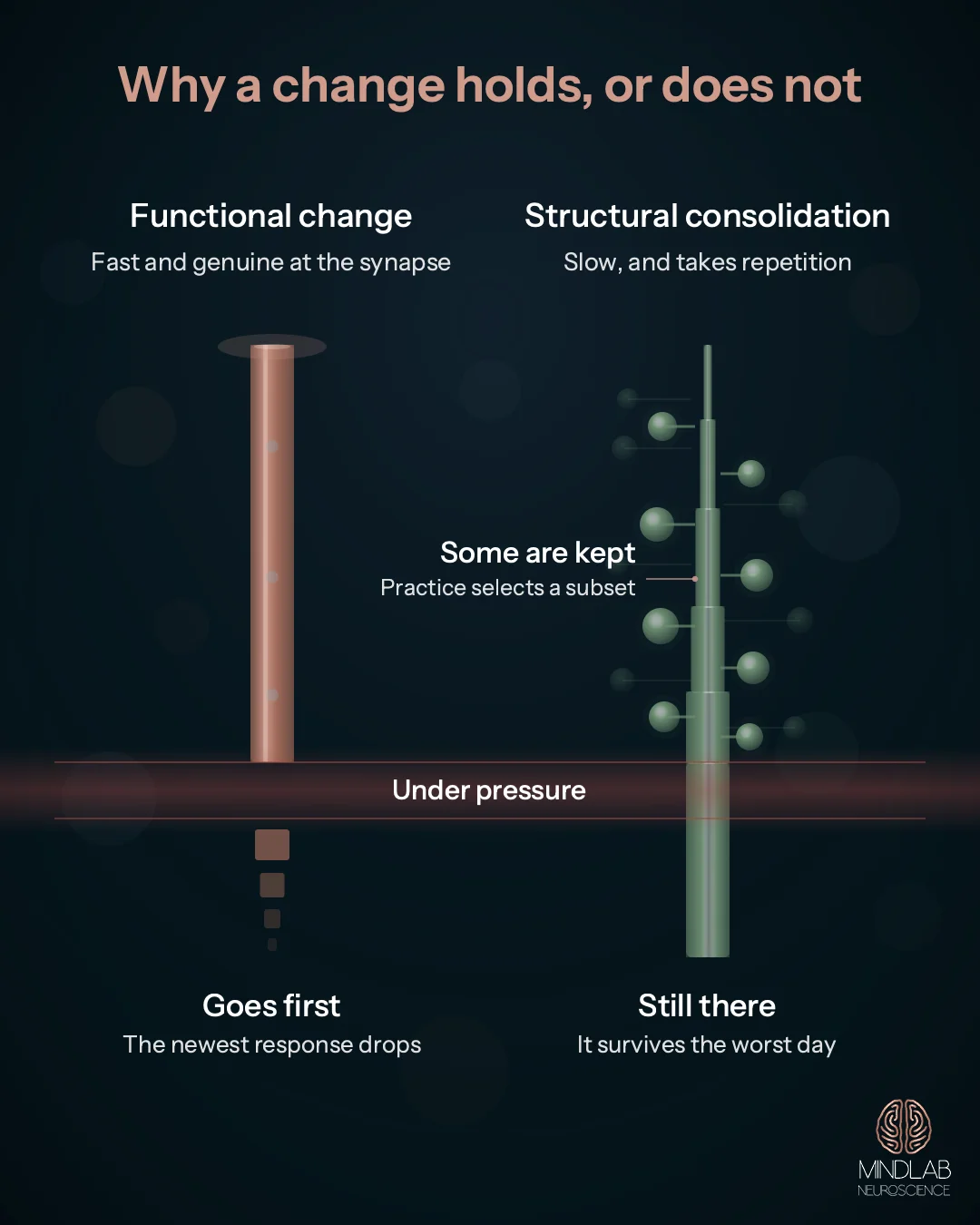
Text version of this diagram
| Dimension | Functional change | Structural consolidation |
|---|---|---|
| Pace | Fast and genuine at the synapse | Slow, and takes repetition |
| What happens | Arrives at full strength | Builds in steps; practice selects a subset that is kept |
| Under pressure | Goes first. The newest response drops | Still there. It survives the worst day |
Synaptic strengthening is the mechanism behind learning. Its best-understood form, long-term potentiation, is the leading synaptic model of memory, and the most studied version of it depends on the NMDA receptor (Bliss and Collingridge, 1993). The fast part happens at the synapse within minutes. The durable part is physical: the potentiated dendritic spine head enlarges (Matsuzaki et al., 2004), and across subsequent practice only a subset of newly formed spines is selectively stabilized and kept (Xu et al., 2009; Yang et al., 2009).
Rewiring is also reallocation rather than addition. New connections are formed and stabilized while others are eliminated, and the competition between them is part of the mechanism. This is why insight alone so often does not hold. Understanding why you do something is a functional change, not yet a structural one.
Pressure makes the gap visible. Under stress, catecholamine signaling (norepinephrine at alpha-1 receptors and dopamine at D1 receptors) rapidly weakens prefrontal cortex connectivity, with cortisol magnifying that effect rather than causing it (Arnsten, 2015). The prefrontal cortex is where the newly built response lives. The older pathway does not need it, which is why the thing you just learned is the first thing to go on the worst day.
What is a neuroscience-based advisory practice?
A neuroscience-based advisory practice is a private practice in which a neuroscientist works directly with one person on the neural pathway driving a behavior, while that pathway is active. The unit of work is the circuit, not the calendar. The training behind it is a doctorate in neuroscience, and the roster is deliberately small enough to make real-time access possible.
That is the work at MindLAB Neuroscience. I embed into the situations where a pattern actually fires, which are rarely scheduled hours and almost never calm ones, and I work on the pathway in the moment it is running. The method is Real-Time Neuroplasticity™: identifying the circuit driving a behavior and intervening while it is active, then building the repetition that turns a functional change into a structural one.
The qualification behind that is a specific one, and it is worth checking for in anyone who claims this territory.
PhD in Behavioral & Cognitive Neuroscience, New York University
Master’s degrees in Clinical Psychology and Business Psychology, Yale University
Lecturer, Wharton Executive Development Program, University of Pennsylvania
Author, The Dopamine Code (Simon & Schuster, June 2026), The Dopamine Code Workbook (Simon & Schuster, October 2026), and Rewire for Resilience (MindLAB Press)
I have 26+ years of founding and leading MindLAB Neuroscience. The plainest description of the work is neuroscience advisor for high-stakes moments.
How do you choose?
Start with what is actually happening, not with the category you think you need. The four situations below map cleanly onto the four kinds of help, and the only one that is genuinely urgent to get right is the first: when a mental health condition may be in play, that is a licensed clinician’s call and nothing else substitutes.
If a mental health condition is in play, or if you are not certain whether one is, start with a licensed clinician. Nothing on this page substitutes for that.
If there is a skill you have genuinely not built yet, and building it is the job, a coach is a sound use of money. Often an excellent one.
If you need someone with deep expertise in your particular arena to tell you what to change before a fixed date, that is what an advisor is for.
And if you have already done one or two of those, done them properly, and the pattern came back anyway, the thing to look at next is the pathway underneath it. That is a different question, and it takes a different training to answer.
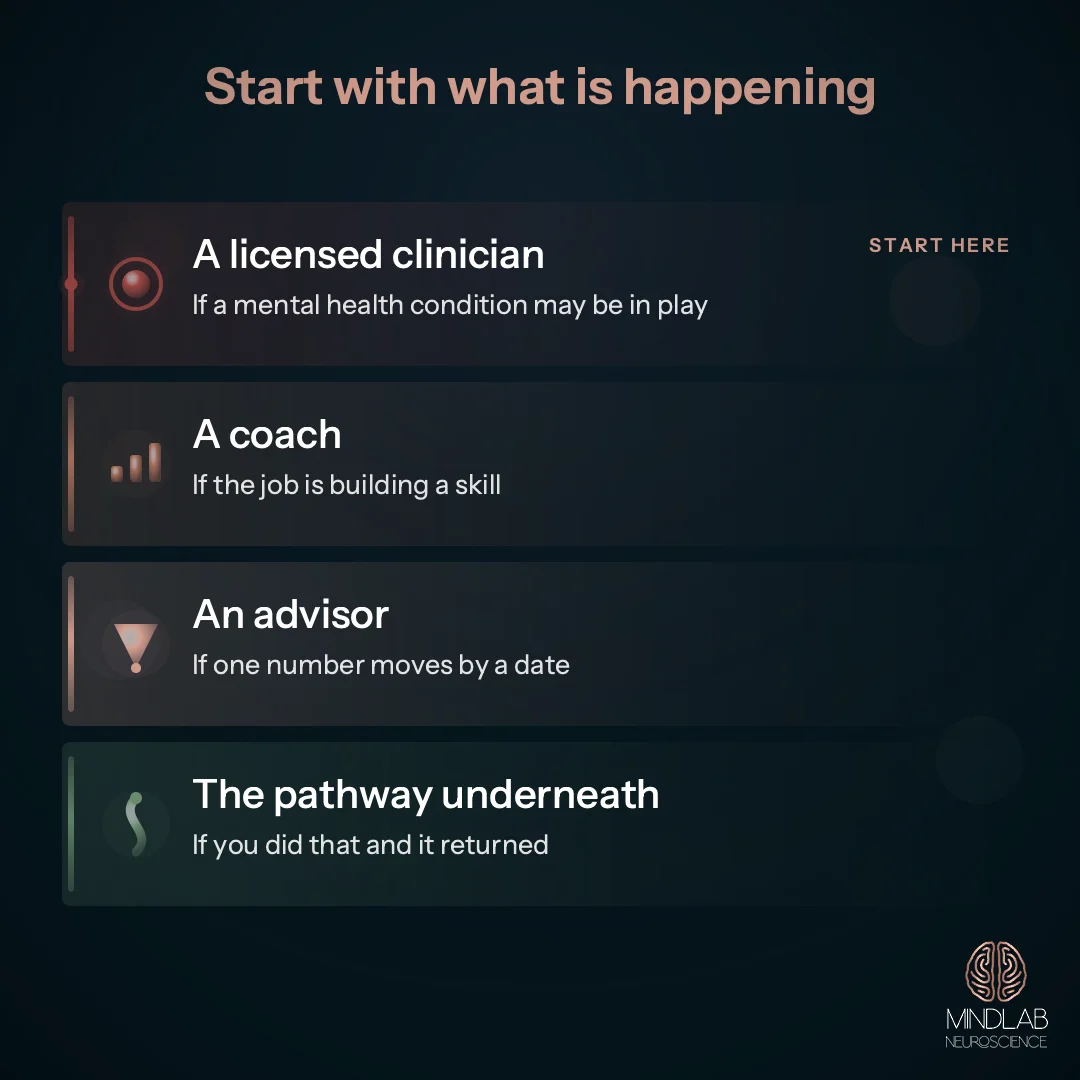
Text version of this diagram
| If this is what is happening | The kind of help |
|---|---|
| A condition may be in play, or you are not certain | A licensed clinician. Start here; nothing else substitutes |
| The job is building a skill you have not built | A coach |
| One measurable outcome has to move by a date | An advisor |
| You did one or two of those properly and it came back | The pathway underneath |
This article explains the neuroscience underlying behavior change and how it differs across professional roles. For personalized neurological assessment and intervention, contact MindLAB Neuroscience directly.
References
- Bliss TVP, Collingridge GL (1993). A synaptic model of memory: long-term potentiation in the hippocampus. Nature 361(6407):31-39. https://doi.org/10.1038/361031a0
- Matsuzaki M, Honkura N, Ellis-Davies GCR, Kasai H (2004). Structural basis of long-term potentiation in single dendritic spines. Nature 429(6993):761-766. https://doi.org/10.1038/nature02617
- Xu T, Yu X, Perlik AJ, Tobin WF, Zweig JA, Tennant K, Jones T, Zuo Y (2009). Rapid formation and selective stabilization of synapses for enduring motor memories. Nature 462(7275):915-919. https://doi.org/10.1038/nature08389
- Yang G, Pan F, Gan WB (2009). Stably maintained dendritic spines are associated with lifelong memories. Nature 462(7275):920-924. https://doi.org/10.1038/nature08577
- Arnsten AFT (2015). Stress weakens prefrontal networks: molecular insults to higher cognition. Nature Neuroscience 18(10):1376-1385. https://doi.org/10.1038/nn.4087
If what you have been carrying is a pattern rather than a condition, and the usual routes have not moved it, the next conversation is about the mechanism producing it. Whether or not we move forward, you’ll walk away with something tangible.
No. A therapist holds a state license to evaluate and work with mental health conditions, and that license defines and limits their scope of practice. An executive coach holds no license and works on leadership behavior, communication, and decision-making. The two are not interchangeable, and the major coaching bodies require their members to refer clinical material out rather than work on it.
No. “Executive coach” is not a protected title in the United States, so no license is required and no board can take the title away. Private certifications exist and vary widely in rigor, from multi-year supervised programs to weekend courses, but none is legally required to practice or to advertise. That places the work of checking a coach’s training on the person hiring them.
A directive specialist hired to raise one measurable outcome, usually against a deadline. The qualification is expertise in that specific arena rather than a standard credential, and the title carries no defined training behind it. An advisor observes what you are doing, identifies where the result is being lost, and tells you what to change. Where a coach draws the answer out of you, an advisor hands you one.
Whenever a mental health condition may be in play, and whenever you are not sure. That determination is a licensed clinician’s to make, and no unlicensed practitioner of any kind can make it for you. Coaching and advisory work start somewhere else. They assume a person who is functioning and wants to operate differently. If what is happening is a condition rather than a pattern, the licensed route is the correct one and nothing here substitutes for it.
Training, and what each one is looking at. A coach works on the behavior. A neuroscientist with a doctorate in the field works on the neural pathway producing it, and reads a presenting problem as a circuit question rather than a skill gap. Both can be the right call. If the credential matters to your decision, ask what any doctorate is actually in: neuroscience, organizational psychology, medicine, and philosophy are four different trainings that read the same problem differently.