Key Takeaways
- Betrayal is neurological, not just emotional: the threat-detection system reads attachment rupture as survival threat.
- The sociometer generates an automatic post-betrayal identity audit, searching for explanatory deficits below conscious awareness.
- Processing betrayal and rebuilding identity architecture are neurologically distinct: one does not accomplish the other.
- Durable recovery requires identity independence from relationship status, threat-assessment recalibration, and post-betrayal identity construction.
- Durable recovery does not restore who you were; it builds an identity including the rupture.
Does Being Cheated On Lower Your Self-Esteem?
Being cheated on measurably lowers self-esteem through neurological disruption, not emotional weakness. Betrayal activates the amygdala, anterior cingulate cortex, and prefrontal attachment systems identically to physical threat responses. For many people, infidelity sets off self-worth declines that can persist long after the discovery, with cortisol dysregulation reinforcing negative self-perception at the biological level.
Dr. Sydney Ceruto works with people who have survived the neuroscience of infidelity and are trying to understand why they cannot simply reason their way out of the damage. They are often highly intelligent, professionally accomplished, and deeply frustrated that knowledge of what happened does not translate into recovery. The answer is always neurological. And the path forward is architectural: rebuilding trust after betrayal the identity structures and attachment circuitry that the betrayal disrupted, not layering coping strategies on top of an unaddressed wound. While this article addresses the experience primarily through the lens of women navigating infidelity, reflecting the query this content serves, the neuroscience of betrayal trauma operates identically regardless of gender. The mechanisms described here apply to anyone whose attachment bond has been violated.
Does Cheating Cause Trauma or PTSD?
Infidelity triggers measurable trauma responses in a significant subset of betrayed partners. Researchers have documented PTSD-equivalent responses (including intrusive memories, hypervigilance, and emotional dysregulation) in approximately 45% of individuals following discovered cheating. The brain’s threat-detection system, particularly the amygdala, processes attachment betrayal as a survival-level threat, producing neurobiological stress responses professionally comparable to post-traumatic stress responses. For the mechanism behind this, see the brain science of you cant move on from a relationship.
Betrayal activates the amygdala and prefrontal attachment systems identically to physical threat responses, driving cortisol dysregulation that reinforces negative self-perception biologically.
In the women I work with, the physiological signature of betrayal is unmistakable: cortisol reactivity stays elevated and the prefrontal threat-appraisal circuitry remains switched on for a year or more after discovery, long after the conscious mind insists it has moved on. The body has not been told the threat is over, because at the level of attachment architecture, it is not.
Attachment theory, formalized by John Bowlby and later mapped onto neurobiological systems by researchers including James Coan and Lane Beckes, establishes that the brain treats close partnership as an extension of the self’s regulatory system. A committed partner is not just emotionally important: the brain literally incorporates them into its threat-assessment architecture. Their presence reduces cortisol. Their responsiveness signals safety. The brain comes to rely on that external regulation as part of its baseline operating condition.
When infidelity is discovered, the disruption is therefore dual: the relationship is damaged, and the brain’s regulatory architecture is destabilized simultaneously. The result, professionally, is not grief in the clean sense. It is disorientation. The systems that normally process “am I safe” and “am I adequate” are receiving contradictory signals at high volume, under sustained activation, without the usual capacity for resolution. Professional observation consistently identifies this presenting as a pervasive but diffuse fragility: people who are functioning at work, managing logistics, holding life together, while experiencing an underlying dissolution of the felt sense of self that they cannot fully articulate. How deep relational insecurity reshapes identity and attachment after betrayal explains why this felt dissolution persists long after the initial shock has passed.
What you experience as a collapse of self-worth is the predictable output of specific neurological disruption.
This is not weakness. It is the predictable consequence of specific neurological disruption.
Why Does Cheating Hurt Your Self-Worth So Deeply?
Cheating damages self-worth because the brain’s threat-detection system, centered in the amygdala, interprets romantic rejection as evidence of personal inadequacy. Many betrayed partners report persistent self-questioning despite intellectually knowing the infidelity reflects their partner’s choices. This cognitive dissonance activates the same neural pathways as physical pain, making self-doubt feel involuntary and inescapable. The underlying research is covered in the neural patterns behind is dating hard neuroscience rejection.
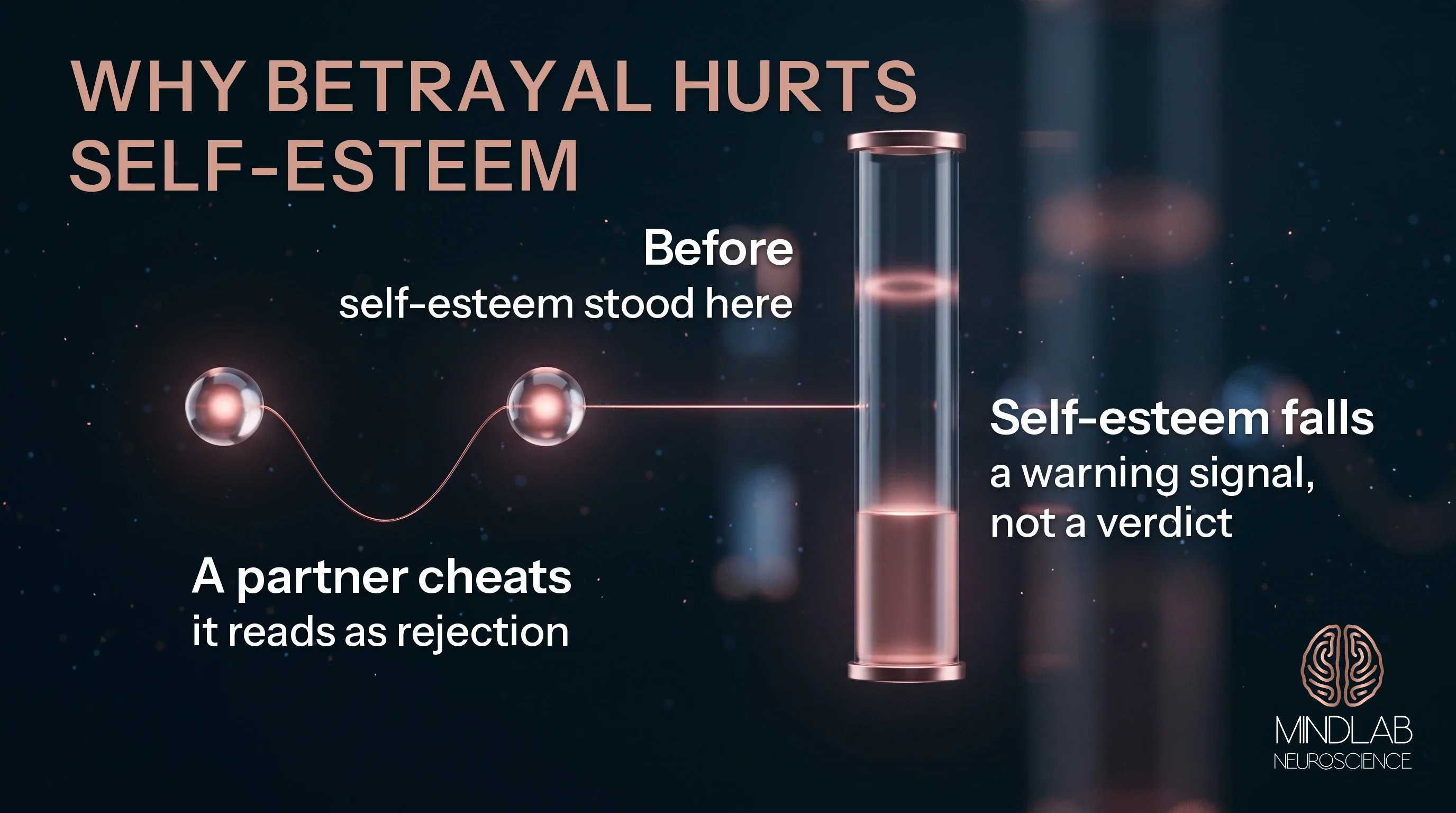
What the illustration shows, step by step
| Stage | What happens |
|---|---|
| The cue | A partner's infidelity reads as a cue of lowered relational value, even though the choice, and the failure, were the partner's. |
| The gauge | Sociometer theory proposes that self-esteem is part of a system that monitors relational value and warns when it seems to fall. |
| The drop | So self-esteem falls as a warning signal, not as an accurate verdict on the person's worth. |
| Social pain | Rejection recruits some of the same brain regions as physical pain. The overlap is shared, not identical. |
Research by Mark Leary on sociometer theory proposes that self-esteem functions as a social acceptance gauge: a continuous, largely automatic neural signal tracking how acceptable and valued we appear to be within our most important emotional intelligence in relationships. The sociometer is not calibrated to logical argument. It is calibrated to behavioral evidence from people whose evaluation we have internalized as significant. A partner’s sexual investment in someone else registers on the sociometer as rejection evidence, regardless of what we consciously believe about its meaning.
The result is what clinicians describe as an identity audit that runs without permission. The brain, facing apparent rejection evidence from a high-significance source, systematically reviews the self for explanatory deficits. It is trying to generate a model of what failed so it can prevent future rejection. The problem is that the model it generates is wrong, locating the failure internally when the failure was external, and yet the audit persists because the brain is optimizing for future safety, not for accurate self-assessment.
| Neural System Disrupted | Normal Function | After Betrayal | Recovery Requirement |
|---|---|---|---|
| Attachment system (prefrontal-limbic) | Co-regulation with partner reduces baseline cortisol and threat sensitivity | Regulatory architecture destabilized: brain loses external regulation source | Building internal regulatory capacity independent of relationship status |
| Sociometer (anterior cingulate) | Continuous monitoring of social acceptance from high-significance figures | Registers partner’s infidelity as rejection evidence: triggers automatic identity audit | Recalibrating the sociometer to weight behavioral evidence over single events |
| Threat detection (amygdala) | Baseline threat assessment calibrated to relationship safety signals | Chronic hyperactivation: trust signals from any source now flagged as potentially deceptive | Gradual recalibration through repeated safe experiences with consistent behavioral evidence |
| Identity architecture (default mode network) | Coherent self-narrative incorporating relationship role and partner evaluation | Self-concept fractures at connection points between identity and relationship status | Constructing identity structures that include but are not dependent on relationship outcomes |
| Memory consolidation (hippocampus) | Encodes relationship memories with appropriate emotional weighting | Intrusive replay of betrayal moments: threat system replaying event to extract protective data | Completing the arousal cycle so memories encode as processed rather than active threats |
In professional observation, people with pre-existing identity structures that were strongly coupled to relationship success are particularly vulnerable to this pattern. Not because they are weaker, often the opposite is true, but because their neural architecture has more connection points between “relationship status” and “self-evaluation.” The disruption has more surface area to damage. This connects directly to the Relationship Intelligence pillar.
What Does the Research Actually Say About Recovery, and What Does It Miss?
Research on infidelity recovery confirms that recovery is achievable and that specific factors improve outcomes. Gordon, Baucom, and Snyder’s forgiveness-based models, alongside Tedeschi and Calhoun’s post-traumatic growth framework, identify emotional processing, social support, and narrative construction as key predictors. However, this literature, which expanded significantly after 2000, largely omits neurobiological mechanisms underlying betrayal trauma.
What professional observation reveals that the research underweights is the importance of distinguishing between two categories of work that look similar but are neurologically distinct: processing the betrayal and rebuilding the identity architecture that the betrayal damaged.
Processing the betrayal (understanding what happened, working through the emotional sequence, arriving at some version of making sense of it) is necessary. It is not sufficient. Clients who remain stuck years after infidelity are not people who have not processed the event. They have processed it extensively, often with substantial support and professional guidance. What they have not done is address the underlying identity structures that the betrayal destabilized and that remain, unexamined and unrebuilt, as the source of continued fragility.
This distinction, between processing an event and rebuilding a structure, is the core of how I approach recovery work. The event processing is the archaeology. The identity reconstruction is the architecture.
Can You Rebuild Self-Esteem After Being Cheated On?
Yes, self-esteem rebuilds after infidelity, but standard recovery frameworks (process emotions, practice self-care, rebuild confidence gradually) address these responses rather than underlying neural architecture. Many betrayed partners report recurring self-worth instability years post-infidelity, suggesting surface-level interventions fail to restructure the threat-response patterns the prefrontal cortex and amygdala encode during betrayal trauma. This pattern is examined in the Relationship Patterns & Partner Selection hub.
Here is what professional observation reveals. A woman discovers infidelity, engages in the recommended recovery practices, experiences periods of genuine improvement, and then encounters a trigger (a social media post, a passing resemblance, an anniversary, a new relationship) and finds that the underlying fragility is still there, apparently undiminished. She concludes she is not doing recovery correctly, or that more time is needed, or that she is fundamentally damaged. None of these conclusions are accurate.

What is happening, and the distinction between genuine structural growth and surface-level coping is one the post-traumatic growth literature has documented since Tedeschi and Calhoun’s foundational work, is that the practices addressed the emotional presentation of the wound rather than the protest behaviors and structural disruption beneath it. Self-care supports emotional regulation. It does not rebuild identity architecture. Positive affirmations address the surface narrative. They do not reorganize the neural circuits that were disrupted when the brain’s sociometer received betrayal-level input from a primary attachment figure.
What actually drives durable recovery, in professional observation, involves three structural elements, and this three-part architecture is formalized in the Trust Reconstruction Protocol™, which addresses betrayal at the neural level rather than the emotional narrative level.
First, establishing a clear and stable self-concept that is not defined relationally: one that exists independently of partnership status and that the brain can access as a stable reference point when the sociometer is under pressure. This is not achieved through affirmations. It is achieved through deliberate, repeated engagement with who you are in contexts that have nothing to do with the relationship, until that identity is neurologically consolidated.
Second, reconstructing the brain’s threat-assessment around attachment: specifically, interrupting the pattern where relationship uncertainty automatically activates threat circuitry and identity audit. This is where Real-Time Neuroplasticity™ operates: not in a professional setting reviewing the past, but in the live moments where the brain encounters attachment cues and has the opportunity to build new response architecture. This requires more than reassurance. It requires new behavioral evidence, accumulated over time, that attachment can exist without the threat of catastrophic rupture.
Third, and this is what proves most consistently undervalued in standard recovery frameworks, building what is described as a post-betrayal identity that is explicitly more complete than the pre-betrayal one. Not despite the experience but incorporating it.
Women who achieve durable recovery don’t return to who they were before the infidelity. They build something that includes the rupture as evidence of their own capacity to survive and reconstruct.
Women who achieve durable recovery do not return to who they were before the infidelity. They build something that includes the rupture as evidence of their own capacity to survive and reconstruct. That incorporation changes the brain’s relationship to the memory. It is no longer evidence of inadequacy. It becomes evidence of capability.
Why Forgiving Too Soon Can Make Recovery Harder
One of the most common pieces of advice given to betrayed partners (forgive, for your own sake) is neurologically backwards when it arrives too early. In my practice I see the cost of premature forgiveness repeatedly: the person grants it because they have been told it will set them free, and instead they feel diminished, less certain of who they are, quietly ashamed in a way they cannot name. The research on what is called the doormat effect explains why. Forgiveness restores self-respect and self-concept clarity only when the offending partner has signaled, through genuine amends and changed behavior, that the forgiver will be safe and valued. When that signal is absent, forgiving the same act erodes self-concept clarity rather than repairing it.
Neurologically, this makes sense. Self-concept clarity is maintained by the brain’s capacity to predict how it will be treated. Forgiving without evidence of safety asks the brain to override its own threat data: to act as if the danger has passed when nothing has actually changed. The sociometer keeps registering the unaddressed rejection, the threat-detection system stays primed, and the conscious decision to forgive sits on top of an architecture that has been given no reason to stand down. The result is internal contradiction, which the brain experiences as instability of the self.
This is why I never treat forgiveness as the goal of recovery, and never as its starting point. The work is to rebuild the betrayed person’s internal regulatory capacity and identity stability first, so that forgiveness, if it comes, is offered from a position of strength rather than extracted as a condition of moving on. A self that is structurally secure can forgive without cost. A self still dependent on the relationship for its own coherence cannot, no matter how sincerely it tries.
Is It Possible to Trust Again After Being Cheated On?
One of the most common questions in professional practice is about trust: not whether trust in a specific person can be rebuilt, but whether the capacity for trust itself survives betrayal. Whether the brain, having registered attachment rupture at that magnitude, can return to a state where intimacy feels safe rather than threatening.
The neurobiological answer is yes, with the appropriate understanding of what needs to change. Researcher James Coan‘s social baseline theory establishes that the brain expects and requires attachment relationships to function at full capacity. Isolation is neurologically costly. The pull toward attachment is not a vulnerability or a flaw. It is the brain operating according to its design.
What changes after betrayal is the brain’s threat-threshold for attachment-related cues. Behaviors that previously read as neutral (a partner who is momentarily unavailable, a conversation that lacks full transparency, unexplained schedule changes) now trigger threat responses calibrated to the worst-case scenario the brain has previously experienced. This is the hypervigilance that many people describe in relationships following infidelity. It is not paranoia. It is threat-detection circuitry that has been recalibrated by experience.
Recalibrating it requires two things simultaneously: new attachment experiences that consistently fail to confirm the threat model, accumulated over sufficient time to produce structural updating, and an explicit cognitive architecture around what constitutes reasonable evidence of safety versus what constitutes threat-detection trained on old data. That distinction, between genuine red flags and pattern-matching from a prior wound, is something I spend considerable time helping clients build. Understanding the neuroscience of sexual attraction can also clarify which signals are genuine compatibility indicators versus trauma-response activation.
What Durable Recovery Actually Looks Like
Durable recovery from infidelity betrayal produces measurable neurological and behavioral markers that most professional frameworks overlook. These markers show up as three consistent indicators: restored prefrontal cortex regulation of threat response, reduced amygdala hyperreactivity to relational cues, and rebuilt capacity for secure attachment, outcomes distinct from simple surface-level improvement.
Durable recovery is not the absence of pain when thinking about the betrayal. It is the presence of a stable self-concept that does not require the memory to mean something different than it does. The betrayal happened. The pain was real. The disruption was real. Durable recovery means that none of those facts determine current self-evaluation.
Durable recovery is not the restoration of trust to a pre-betrayal baseline. It is the construction of a more conscious, more explicit relationship with trust: one that is based on behavioral evidence and honest assessment rather than assumption, and that therefore is more, not less, reliable than the automatic trust that preceded the rupture.
Durable recovery is not returning to who you were. It is becoming someone whose identity is large enough to contain the experience without being defined by it.
The path there is not linear and it is not quick. At MindLAB Neuroscience, Dr. Sydney Ceruto works with clients over extended engagements because structural identity reconstruction requires sustained, consistent input, not periodic insight. But the destination is reachable, and it is more specific than “healing.” It is the construction of a self that the betrayal could not ultimately reach. Related reading: the neuroscience of lying exploring the neuroscience behind it.
How long does it take to recover self-esteem after being cheated on?
Timeline varies based on the depth of identity disruption, not just the severity of the betrayal. Processing the event typically takes months. Rebuilding the identity architecture, which is the work that produces durable recovery, requires sustained engagement over three to twelve months in professional observation. The critical variable is whether the work addresses structural identity reconstruction or only emotional processing.
Why do I blame myself for being cheated on?
Self-blame after infidelity is the sociometer running an identity audit. The brain, having received rejection evidence from a high-significance attachment figure, automatically searches for internal explanations. This audit is optimizing for future threat prevention, not accuracy. It generates the model “something about me caused this” because that model, if true, would give you control over preventing recurrence. The audit is wrong about the cause. It is doing exactly what it was designed to do.
Can a relationship survive infidelity?
Some relationships do survive and eventually strengthen after infidelity. The neurological conditions required include: the offending partner demonstrating consistent behavioral change over sustained time (the brain needs repeated evidence, not a single apology), both partners’ nervous systems being able to return to co-regulated states together, and the betrayed partner building an identity stable enough that the relationship’s continuation is not required for self-concept. Without those conditions, the relationship may persist but the underlying dysregulation continues.
Does being cheated on cause PTSD?
Betrayal can produce responses that parallel PTSD: intrusive memories, hypervigilance, avoidance, emotional numbing, and sleep disruption. The mechanism is similar: the amygdala has encoded a threat event and is now running a heightened surveillance pattern. Whether this meets formal assessment criteria depends on the individual. What is professionally relevant is that the neural architecture of the response is real and requires structural intervention, not just time.
How do you stop the intrusive thoughts after infidelity?
Intrusive thoughts after betrayal are the brain’s threat-detection system replaying the event to extract useful protective information, and why the brain loops on betrayal memories even when the person wants to stop. Suppression strengthens them. What reduces their frequency is completing the arousal cycle: allowing the memory to arise without escape-seeking behavior, processing the associated emotions through full completion, and building new neural evidence that the threat has been addressed structurally. This is a practiced skill, not a willpower exercise.
How does betrayal in a relationship affect self-esteem on a neurological level?
Betrayal triggers a surge of cortisol and activates the brain’s threat-detection circuits, and sustained stress can erode the neural pathways associated with self-worth and confidence. Over time, repeated activation of these stress responses reshapes how the brain processes identity and personal value.
What are the first steps toward rebuilding self-esteem after being cheated on?
The first step involves recognizing that the betrayal reflects the other person’s choices rather than your inherent worth. Engaging in deliberate self-affirming activities helps the brain form new neural connections that reinforce a positive self-concept.
Can the emotional pain of infidelity cause lasting changes in brain function?
Yes, prolonged emotional distress from infidelity can alter the brain’s default mode network, leading to persistent rumination and negative self-referential thinking. However, neuroplasticity allows these patterns to be reversed through intentional mental practices and new experiences.
How long does it typically take to regain confidence after experiencing betrayal?
The timeline varies significantly based on the individual’s neurobiological resilience, support systems, and active engagement in self-development practices. Most people begin noticing meaningful shifts in self-perception within three to six months of consistent effort toward rewiring their thought patterns.
References
- Eisenberger, N. I., Lieberman, M. D., & Williams, K. D. (2003). Does rejection hurt? An fMRI study of social exclusion. Science, 302(5643), 290–292. doi.org/10.1126/science.1089134
- Leary, M. R. (2005). Sociometer theory and the pursuit of relational value: Getting to the root of self-esteem. European Review of Social Psychology, 16(1), 75–111. doi.org/10.1080/10463280540000007
- Luchies, L. B., Finkel, E. J., McNulty, J. K., & Kumashiro, M. (2010). The doormat effect: When forgiving erodes self-respect and self-concept clarity. Journal of Personality and Social Psychology, 98(5), 734–749. pubmed.ncbi.nlm.nih.gov/20438221
- Shrout, M. R., & Weigel, D. J. (2018). Infidelity’s aftermath: Appraisals, mental health, and health-compromising behaviors following a partner’s infidelity. Journal of Social and Personal Relationships. doi.org/10.1177/0265407517704091
- Gordon, K. C., Baucom, D. H., & Snyder, D. K. (2004). An integrative intervention for promoting recovery from extramarital affairs. Journal of Marital and Family Therapy, 30(2), 213–231. doi.org/10.1111/j.1752-0606.2004.tb01235.x
From Reading to Rewiring
Infidelity consistently lowers self-esteem because betrayal activates the same anterior cingulate pain circuits as physical injury while simultaneously triggering a cortisol-mediated threat appraisal of personal adequacy. Neuroimaging research shows the medial prefrontal cortex encodes social rejection as a deficit in self-relevant information, directly degrading self-referential processing and confidence in evaluative contexts for months afterward.
One hour with Dr. CerutoStrategy Call
If you have processed the betrayal but the structural fragility remains, if you understand what happened but the identity architecture is still disrupted, that distinction is exactly what a strategy call is designed to map. Dr. Sydney Ceruto identifies which level of the architecture needs work and builds the plan from there.