

Gaslighting and the Brain: How Manipulation Affects Memory and Trust During Infidelity
Key Takeaways
- The studies cited here did not scan anyone’s brain while they were being gaslighted, so they show no gaslighting-specific brain signature
- Other people’s false accounts can change what we remember, even when our first memory was strong and accurate
- Ongoing stress can make memory and thinking less flexible, and in one study stress-related changes in prefrontal function eased after a month of lower stress
- DARVO, a deny, attack and reverse-the-roles pattern, led people in experiments to see the victim as less believable
- People who recovered from gaslighting in one survey often stressed separation from the partner and healthier relationships
Gaslighting effects on the brain are a fair question, because gaslighting targets your memory and your trust in your own perception. Gaslighting is a pattern of psychological abuse that pushes a person to doubt what they saw, heard or felt. It can show up around infidelity, when a partner denies what you know you witnessed. The studies cited here did not scan anyone’s brain while they were being gaslighted. What research has measured is closer to daily life. Other people’s versions of events can change what we remember. Ongoing stress can make memory and thinking less flexible. Those two findings may help explain how gaslighting can work, and the stress research gives some reason for hope about recovery.
What does gaslighting actually do to the brain?
Gaslighting works by pressing a person, again and again, to doubt their own perception. Sociologist Paige Sweet (2019) describes it as psychological abuse aimed at making victims seem or feel “crazy.” In her study of domestic violence, abusers used gender stereotypes and other social inequalities to wear down their partners’ sense of reality. This piece sits within the infidelity and trust architecture hub, which looks at how betrayal and manipulation affect the brain.
A 2025 review by Darke, Paterson and van Golde found that different fields define and measure gaslighting in different ways, and that the research lacks a strong guiding theory.
Ermolova and colleagues (2024) reviewed newer theories of gaslighting. They describe how the people closest to us shape how we see ourselves and the world around us. In their reading, that special position is what gives a gaslighter power over the victim.
What does stress do to the prefrontal cortex?
The prefrontal cortex is the part of the brain behind the forehead. It supports cognitive control, the ability to keep a goal in mind and hold back an automatic response. In their review, Friedman and Robbins (2021) describe how this control depends on the prefrontal cortex and the brain networks linked to it. They also discuss problems with cognitive control as a possible cause of some psychiatric symptoms.
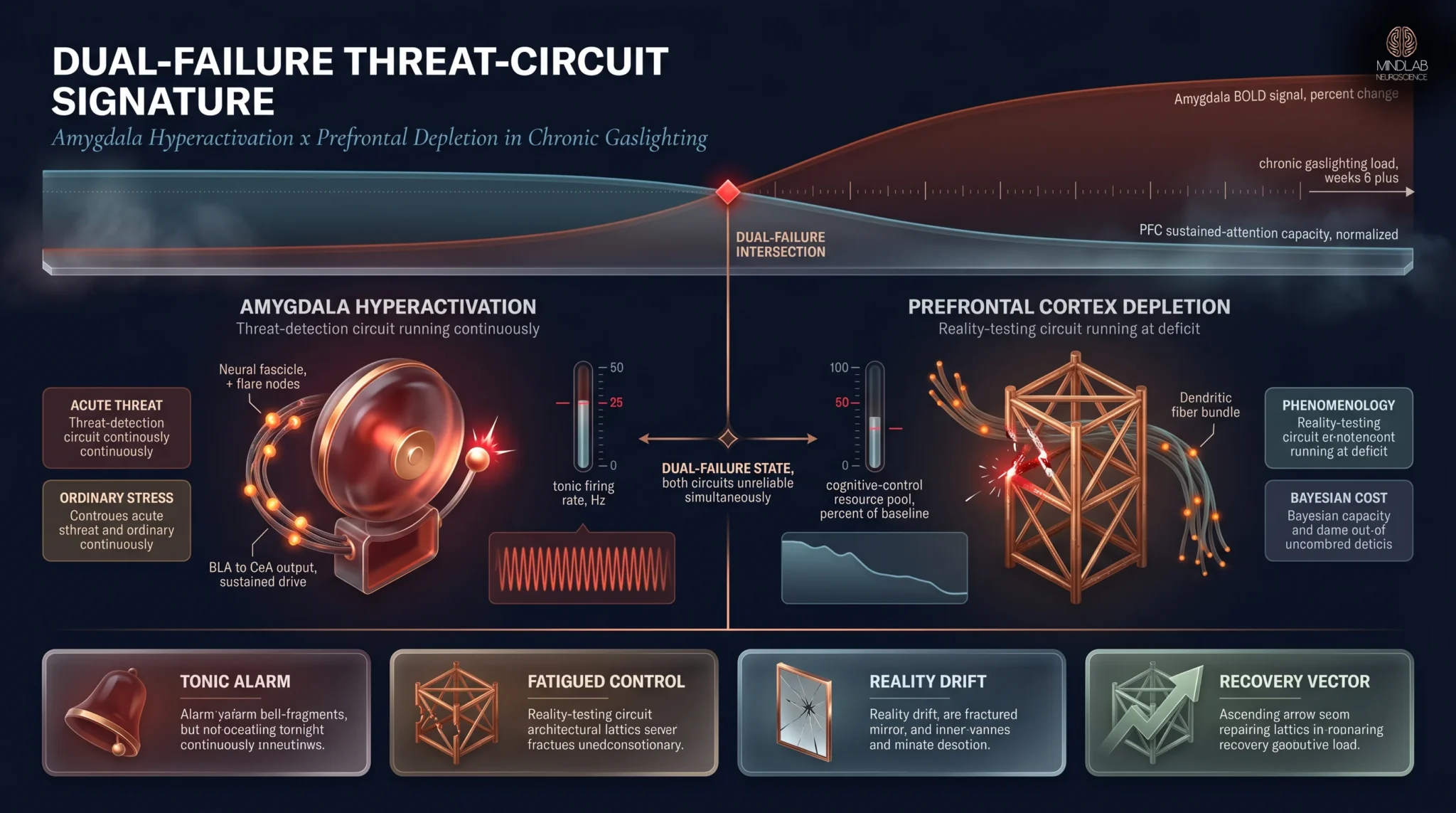
Stress matters here. Arnsten and Shanafelt (2021), writing about burnout in doctors, sum up brain research showing that uncontrollable stress impairs the prefrontal cortex. Uncontrollable stress is stress you cannot end by your own actions. Stress you can control did not have the same effect. Under chronic stress, connections in the prefrontal cortex are lost, and they can be restored when the stress is relieved. Gaslighting looks like stress a person cannot control, because doing the right thing does not make it stop. None of the research they review studied gaslighting itself.
What I consistently observe in my practice is that by the time someone recognizes they are being gaslighted, the cost has already been absorbed. They arrive not with a list of incidents but with a pervasive uncertainty about their own perception: “I don’t know what I saw anymore.” That sentence is not emotional weakness.
Can gaslighting cause permanent brain damage?
The studies cited here give no evidence that gaslighting causes permanent brain damage. None of them scanned the brains of people being gaslighted, so they cannot show a brain pattern that belongs to gaslighting. What stress research does show is that some stress-related changes ease. In a study by Liston, McEwen and Casey (2009), 20 healthy adults went through a month of high life stress, confirmed with a rating scale. They did worse on a task that required shifting attention, and brain scans showed weaker connections in a network that helps shift attention. After a month of lower stress, the same people no longer differed from a low-stress comparison group.
Gaslighting can go on far longer than a month, and the studies cited here did not follow anyone through it. So the studies cited here do not show whether gaslighting leaves lasting harm. The stress research gives some reason for hope, because the changes in that study did not last.
Being constantly on guard after betrayal is covered in our article on hypervigilance after betrayal. This article covers memory and trust in your own perception.
Why do people who are gaslighted say they feel “crazy”?
Feeling “crazy” is something survivors of gaslighting describe. Philosopher Joyce Mok (2026) notes that people who have been gaslighted describe a feeling of going crazy and a loss of voice and self. In a survey of 65 people who said a romantic partner had gaslighted them, by Klein, Li and Wood (2023), people described a weaker sense of self and less trust in others after being gaslighted.
These are survivors’ own reports, gathered in a written survey. No brain scans were involved. The reports fit what gaslighting aims at, which is a person’s trust in their own judgment.
“Gaslighting victims describe feeling ‘crazy.'”
Why do I doubt my own memory after being gaslighted?
Memories can change after the fact, and hearing someone else’s version of an event is a well-studied way this happens. In a study by Gabbert, Memon and Allan (2003), pairs of people each watched a different video of the same crime, then talked about it. Later, 71% of those who had talked recalled details they had only heard about from their discussion partner. Younger adults (18 to 30) and older adults (60 to 80) were equally affected.
This is part of a larger body of work. In a review of about 30 years of research, Elizabeth Loftus (2005) describes the misinformation effect, in which misleading information after an event impairs memory for it. These studies tested strangers and short events. A partner who repeats a false account over months is a different situation, and the studies cited here did not test it. Ermolova and colleagues argue that the people closest to us carry special weight in how we see reality. If so, a partner’s account may be harder to set aside than a stranger’s, though the studies cited here did not test that.
Does the hippocampus actually change under this pressure?
The hippocampus is a brain area with a central role in memory. No study cited here measured it in people being gaslighted. Stress research gives some clues. A review by Vogel and Schwabe (2016) reports that stress around the time of learning can strengthen memory formation, while stress makes it harder to recall memories. Newer evidence they cite suggests stress may also make it harder to update memories in light of new information, and may shift learning from flexible toward rigid, habit-like patterns. Their review covers stress in general, such as exams and conflict, not gaslighting. This article belongs to the relationship intelligence pillar, which maps the neuroscience underlying relationships.
One brain-imaging study comes closer to the gaslighting question. In a study by Edelson and colleagues (2011), people saw wrong recollections from other members of their group. Many went along with them, even when their own first memory had been strong and accurate. Stronger activity in the amygdala, a brain area involved in emotion, and a stronger link between the amygdala and the hippocampus went with the errors that lasted. That study tested group pressure in a lab, not a partner’s lies. James and colleagues (2023) reviewed research on stress, the stress hormone cortisol and thinking in animals and people, and they describe the findings as mixed.

A high-capacity partner I worked with managed an extended family system, a community foundation, and three children with complex schedules, executing at full capacity in every external domain, while quietly telling me, across multiple sessions, that she could no longer trust her own memory of what had been said in her own kitchen the night before. She had begun writing down conversations the moment they ended, saving voicemails, checking calendar entries against her recall. The data-gathering was not paranoia. It was the last reality-test she had left. Intrusive replay of the betrayal after it comes to light is covered in our article on intrusive thoughts after infidelity. What she described came earlier, while the gaslighting was still going on.
How is gaslighting during an affair different from regular lying?
Gaslighting during an affair differs from an ordinary lie in what it targets. A lie hides a fact. Gaslighting during an affair can use a pattern called DARVO, which stands for Deny, Attack, and Reverse Victim and Offender. DARVO goes after the questioner’s credibility and their sense of being the injured party.
In two experiments with university students, Harsey and Freyd (2020) asked people to read scenarios in which a perpetrator used DARVO. Readers who saw DARVO judged the victim as less believable and more responsible, and the perpetrator as less abusive. Learning about DARVO reduced some of this effect. A later study by Harsey, Adams-Clark, and Freyd (2024) found links, small in a student sample, between using DARVO when confronted, reporting that they had sexually harassed others and accepting rape myths. In the infidelity context, DARVO can follow a specific sequence. The unfaithful partner denies the affair. Then they attack the questioner’s character or evidence-gathering. Then they cast themselves as the true victim, of distrust, of surveillance, or of the relationship’s emotional tone. The person asking now faces a second question on top of the first: am I the wronged party, or am I the problem?
How does closeness to the partner play into this?
As Ermolova and colleagues note, close partners help shape how we see ourselves and the world. Mok argues that gaslighting succeeds by exploiting vulnerabilities that arise from common features of close relationships. In her account, each gaslighting tactic does its harm through the particular vulnerability it exploits, and the same framework points to ways to heal.

In 26 years of working with people navigating intimate betrayal, I consistently observe that high-capacity partners are slow to accept that their self-doubt is not a failure of discernment. Their entire operating model assumes they can reason their way to the correct answer. What they eventually arrive at is that the reasoning machinery itself was the target. You cannot out-reason a manipulation that is aimed at your reasoning. The recognition is often the first moment they have space to begin recovering.
How long does it take to recover from gaslighting brain effects?
The studies cited here did not track how long recovery from gaslighting takes, so this page does not give a timeline. Two lines of research help. In the stress study by Liston and colleagues, the same people no longer differed from a low-stress group after a month of lower stress. Arnsten and Shanafelt describe prefrontal connections lost under chronic stress as able to return when the stress is relieved.
Survivors offer a second guide. In the survey by Klein, Li and Wood, people who had recovered from gaslighting often stressed separation from the partner and putting healthier relationships first. They also named meaningful activities that helped them reconnect with their bodies, and some described growth after the experience.
What specifically has to change inside the brain?
The studies cited here did not map this for gaslighting. The findings above still point somewhere practical. Other people’s accounts can reshape memory, so a plain, factual note made soon after a conversation gives you your own version to check against. Stress can make memory and thinking less flexible, so lowering the stress may help. At MindLAB, Real-Time Neuroplasticity™ works in the live moment, when the doubt comes up, rather than looking back afterward. The Reality Recalibration Protocol™ structures this live-moment work.

“Recovery restores doubt’s correct direction: outward, when evidence warrants, rather than reflexively inward.”
References
Arnsten, A.F.T. & Shanafelt, T.D., 2021. Physician distress and burnout: The neurobiological perspective. Mayo Clinic Proceedings, 96(3), 763-769. https://doi.org/10.1016/j.mayocp.2020.12.027
Darke, L., Paterson, H.M. & van Golde, C., 2025. Illuminating gaslighting: A comprehensive interdisciplinary review of gaslighting literature. Journal of Family Violence, 41(6), 1325-1341. https://doi.org/10.1007/s10896-025-00805-4
Dokkedahl, S.B., Kirubakaran, R., Bech-Hansen, D., Kristensen, T.R. & Elklit, A., 2022. The psychological subtype of intimate partner violence and its effect on mental health: A systematic review with meta-analyses. Systematic Reviews, 11, 163. https://doi.org/10.1186/s13643-022-02025-z
Edelson, M.G., Sharot, T., Dolan, R.J. & Dudai, Y., 2011. Following the crowd: Brain substrates of long-term memory conformity. Science, 333(6038), 108-111. https://doi.org/10.1126/science.1203557
Ermolova, T.V., Litvinov, A.V., Balygina, E.A. & Chernova, O., 2024. New theoretical approaches to the study of the phenomenon of gaslighting. Journal of Modern Foreign Psychology, 13(1), 128-138. https://doi.org/10.17759/jmfp.2024130112
Friedman, N.P. & Robbins, T.W., 2021. The role of prefrontal cortex in cognitive control and executive function. Neuropsychopharmacology, 47, 72-89. https://doi.org/10.1038/s41386-021-01132-0
Gabbert, F., Memon, A. & Allan, K., 2003. Memory conformity: Can eyewitnesses influence each other’s memories for an event? Applied Cognitive Psychology, 17(5), 533-543. https://doi.org/10.1002/acp.885
Harsey, S.J., Adams-Clark, A.A. & Freyd, J.J., 2024. Associations between defensive victim-blaming responses (DARVO), rape myth acceptance, and sexual harassment. PLoS ONE, 19(12), e0313642. https://doi.org/10.1371/journal.pone.0313642
Harsey, S.J. & Freyd, J.J., 2020. Deny, attack, and reverse victim and offender (DARVO): What is the influence on perceived perpetrator and victim credibility? Journal of Aggression, Maltreatment & Trauma, 29(8), 897-916. https://doi.org/10.1080/10926771.2020.1774695
James, K., Stromin, J.I., Steenkamp, N. & Combrinck, M., 2023. Understanding the relationships between physiological and psychosocial stress, cortisol and cognition. Frontiers in Endocrinology, 14, 1085950. https://doi.org/10.3389/fendo.2023.1085950
Klein, W., Li, S. & Wood, S.C., 2023. A qualitative analysis of gaslighting in romantic relationships. Personal Relationships, 30(4), 1316-1340. https://doi.org/10.1111/pere.12510
Liston, C., McEwen, B.S. & Casey, B.J., 2009. Psychosocial stress reversibly disrupts prefrontal processing and attentional control. Proceedings of the National Academy of Sciences, 106(3), 912-917. https://doi.org/10.1073/pnas.0807041106
Loftus, E.F., 2005. Planting misinformation in the human mind: A 30-year investigation of the malleability of memory. Learning & Memory, 12(4), 361-366. https://doi.org/10.1101/lm.94705
Mok, J., 2026. A relational-vulnerabilities account of gaslighting. Feminist Philosophy Quarterly, 12(1). https://doi.org/10.5206/fpq/2026.1.22958
Sweet, P.L., 2019. The sociology of gaslighting. American Sociological Review, 84(5), 851-875. https://doi.org/10.1177/0003122419874843
Tversky, B. & Marsh, E.J., 2000. Biased retellings of events yield biased memories. Cognitive Psychology, 40(1), 1-38. https://doi.org/10.1006/cogp.1999.0720
Vogel, S. & Schwabe, L., 2016. Learning and memory under stress: Implications for the classroom. npj Science of Learning, 1, 16011. https://doi.org/10.1038/npjscilearn.2016.11
What the First Conversation Looks Like
When someone contacts me after recognizing they have been gaslighted, particularly inside an unfolding or recently-disclosed affair, the first thing I do is map how much doubt they are carrying. Not their emotions, not the incidents. The load. I listen for how often their internal account is being overruled by an external one, whose version of events they now remember, and which domains of life the self-doubt has bled into.
Then I reframe what they are carrying. The uncertainty about their own perception is not a character flaw or a sign of anxiety pathology. The work ahead is not about learning to trust themselves again through willpower. It is about providing structured, verifiable external evidence, in real time, at the moment the doubt arises, so they can relearn where to route the doubt. That mechanism is the Reality Recalibration Protocol™, and the intervention point is the live moment, not the retrospective review.
Can gaslighting cause PTSD?
Gaslighting is one form of psychological abuse, and the studies cited here did not test gaslighting and PTSD directly. A review of 194 studies by Dokkedahl and colleagues (2022) found that psychological abuse by a partner was strongly linked with PTSD, depression and anxiety, most strongly with PTSD. The authors rated the certainty of that evidence as low. These studies measured links, so they cannot show that the abuse caused the symptoms.
How do I know if I’ve been gaslighted or just had a miscommunication?
In a miscommunication, two people remember a conversation differently, talk it through and both adjust. Gaslighting is a pattern across many conversations. Your confidence in your own perception keeps shrinking, and each time you try to check the record, you meet denial, a new version of events or an attack. One sign to watch: after a miscommunication, both people move toward what happened. After gaslighting, only one person keeps giving ground: the person being gaslighted.
Does gaslighting always happen alongside infidelity?
No. Researchers describe gaslighting in families and couples and as a use of wider social power, and a 2025 review found that fields from medicine to philosophy define it in different ways. During infidelity, gaslighting can target something the person saw for themselves, and it comes from a partner they trusted. The studies cited here did not compare its effects with gaslighting in other settings.
Can the brain fully recover from years of gaslighting?
The studies cited here did not follow people’s brains through recovery from gaslighting, so no timeline can be given. Stress research is encouraging. Prefrontal changes linked to chronic stress have eased when the stress was relieved, in one study within a month. In a survey of people gaslighted by a partner, those who recovered often stressed separation from the partner and healthier relationships.
Why do gaslighters seem so convinced of their own version of events?
Some gaslighters know what happened and lie on purpose. Others may come to half-believe their own version. Retelling can shape memory for the teller too. In experiments by Tversky and Marsh (2000), people who retold a story from a slanted point of view later remembered the original story in a slanted way. Those experiments used stories in a lab, not relationships. From the outside, it can be hard to tell which is which.