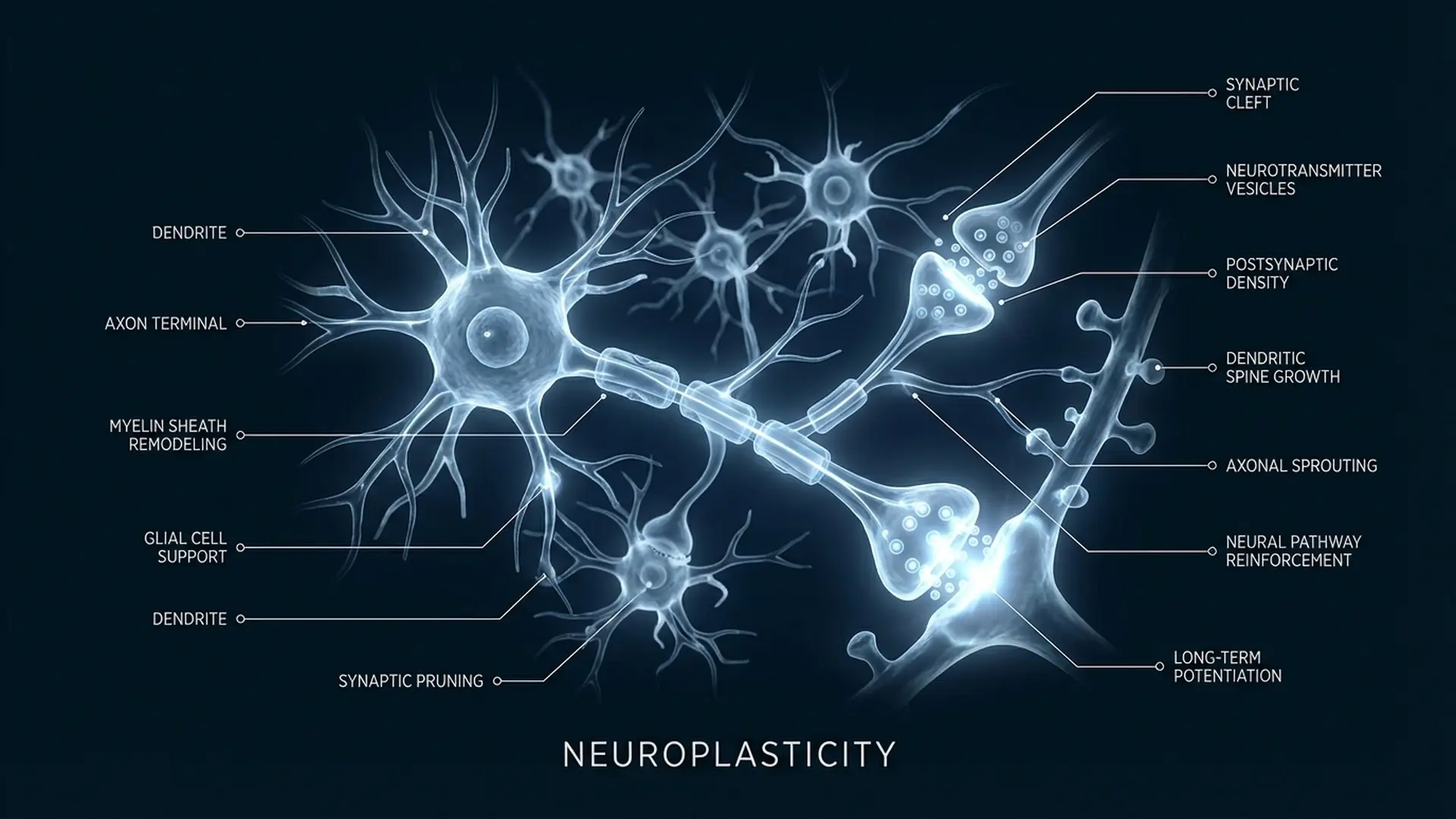
Neuroplasticity
The ability to self-author brain structure. We explore mechanisms like Long-Term Potentiation (LTP) and the specific focus-rest protocols required to hardwire new skills and behaviors.
71 articlesNeuroplasticity is the mechanism that makes lasting change possible. It refers to the brain’s ability to reorganize its own structure, forming new synaptic connections, pruning unused pathways, and strengthening circuits through repeated activation. This is not a metaphor. It is observable at the cellular level: dendritic branching, long-term potentiation, myelination of frequently used axonal pathways. Every behavior pattern you maintain, every emotional response you default to, every decision heuristic you rely on exists because neuroplasticity built the circuitry that supports it.
The foundational work of Merzenich at UCSF demonstrated that cortical maps are not fixed after critical developmental periods, as neuroscience had assumed for most of the twentieth century. They are continuously remodeled by experience. Pascual-Leone’s research at Harvard extended this principle, showing that even mental rehearsal, imagining a piano sequence without physical practice, produces measurable cortical reorganization. The implication is profound: a vividly experienced internal event can drive structural adaptation much as an external one does. What you repeatedly think, feel, and do literally reshapes the physical architecture of your neural networks.
But neuroplasticity is not inherently positive. The same mechanism that enables recovery from stroke or the acquisition of a new language also consolidates maladaptive patterns. Chronic anxiety strengthens threat-detection circuits. Avoidance behavior reinforces the neural pathways that produce it. Rumination deepens the grooves of default mode network loops. The brain is always plastic; the question is whether that plasticity is being directed toward patterns that serve you or patterns that constrain you.
This distinction is central to Dr. Sydney Ceruto’s work at MindLAB Neuroscience. Real-Time Neuroplasticity™, the methodology she developed across 26 years of applied neuroscience, is built on a specific principle: that the most efficient window for circuit-level change is the live moment when a pattern is actively firing. Not in retrospective analysis. Not in a controlled office setting removed from the context where the pattern operates. In the real-time conditions that trigger the circuitry, which is precisely when the brain is most available for reorganization. A strategy call is where this process begins, mapping the patterns and identifying what targeted neuroplastic intervention looks like for your specific circuitry.
The articles below explore how neuroplasticity operates across cognitive, emotional, and behavioral domains, and what the science reveals about directing it with precision.
Latest Articles
Learning Agility & Skill Acquisition
Read article : Why You Hit a Learning Plateau (and How to Break It)

Brain Health & Optimization
Bidirectional LTP and LTD remain trainable in adults: the neuroscience of how NMDA and AMPA receptors rewire synapses, and what...
Read article : How to Improve Synaptic Plasticity | MindLAB Neuroscience
Relationship Intelligence
Neuroplasticity after a breakup is real: the acute stress that causes the pain is the same mechanism that rewires attachment...
Read article : Neuroplasticity After Breakup | Dr. Sydney Ceruto — MindLAB
Strategic Career Architecture
How your early-career brain actually works: prefrontal maturation, dopamine, stress, and the neuroplasticity that makes your 20s the highest-leverage decade.
Read article : Neuroscience for Young Professionals: Your Brain at Work
Strategic Career Architecture
Lasting change in life and career runs on neuroplasticity, dopamine, the prefrontal cortex, and habit circuitry. A neuroscientist explains how...
Read article : The Neuroscience of Life and Career Success: How Your Brain Drives Lasting Change

Mental Rehearsal & Visualization
Mental rehearsal activates the same motor-planning circuits as physical practice, but only the superficial cortical layers. What brain scans actually...
Read article : The Neuroscience of Mental Rehearsal: What Brain Scans Actually Show

Brain Health & Optimization
The adult brain keeps rewiring well past 40. The neuroscience of what changes, what stays intact, and the habits that...
Read article : Neuroplasticity After 40: What the Science Actually Shows