Key Takeaways
- Self-attack after a mistake is threat circuitry firing before rational thought arrives.
- Shame evolved to guard your standing in the group, built for speed not accuracy.
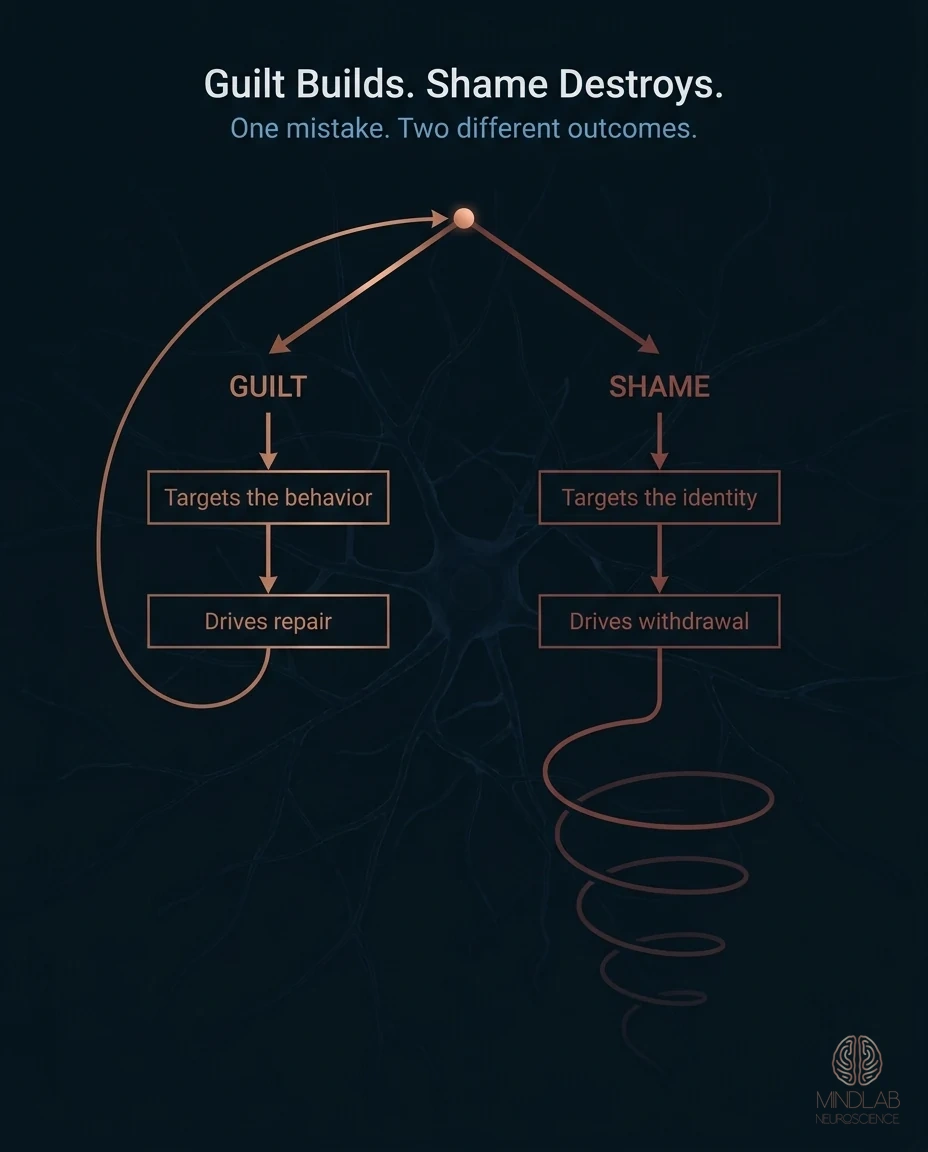
- Guilt targets behavior and drives repair; shame targets identity and drives withdrawal.
- Self-compassion raises personal responsibility after a mistake, and lowers cortisol, not standards.
- The self-punishment loop becomes its own problem, outlasting whatever triggered it.

We punish ourselves for mistakes because the brain files a social error the way it files a physical threat. Shame evolved to guard your standing in the group, and alarms of that kind are built for speed rather than accuracy. Yours is still firing long after the mistake itself ended.
This is a practitioner’s account of what the self-punishment loop does after one specific mistake, told through a single case. It sits inside our hub on emotional resilience, part of the wider stress, resilience and regulation pillar. If you are looking for the general trait-level account of why the brain turns on itself rather than one case of it, that is the evolutionary neuroscience of self-hatred.
Somewhere between the ages of six and sixteen, most of us learned an unspoken rule that has since run our entire adult lives without our permission. The rule is simple and brutal: when you fail, you are allowed no mercy, not even a sliver of grace. Not from your parents, not from your coach, not from your boss, and least of all from yourself. I have sat across from executives, founders, and high-performing professionals who would defend a stranger on the street from a fraction of the cruelty they aim at themselves after a single bad decision. Ask any of them what they would say to a close friend who made the same mistake they just made, and the answer is almost always gentle, reasonable, forgiving. Ask what they said to themselves in the same moment, and the answer is something closer to a verdict than a thought. This gap between how we treat others and how we treat ourselves is not a personality flaw. It is a neurological event, and it has a history that predates language itself.
What fascinates me the most after years of working inside the brains of people rebuilding their lives after a costly mistake is how automatic the self-attack is. It does not feel like a choice because it is not one. When you make an error, whether it is forgetting an anniversary or losing a client, the brain’s threat circuitry fires before your rational mind has a chance to weigh in. Neuroimaging research has shown that self-critical thoughts activate the amygdala and the dorsal anterior cingulate cortex, the former the same region responsible for detecting a physical predator. Your brain doesn’t have a separate filing system for “external danger” and “internal disappointment.” A missed deadline and a growling animal in the dark are processed by overlapping circuitry. This is why a single mistake can hijack an entire evening, an entire week, sometimes an entire identity. You are not weak for spiraling after a failure. You are running software that was built for a world where a mistake could mean expulsion from the only group standing between you and starvation.
You are not weak for spiraling after a failure. You are running software that was built for a world where a mistake could mean expulsion from the only group standing between you and starvation.
The Evolutionary Trade You Never Agreed To
To understand why self-punishment feels so involuntary, you have to go back further than childhood, further than culture, all the way to the small hunting and gathering bands our ancestors lived in for the overwhelming majority of human history. In groups that size, reputation was survival. If you made a mistake that damaged the group’s trust in you, whether it was mishandling shared resources or failing at a task others depended on, the consequence was not embarrassment. It was potential exile, and exile from the group in that environment was frequently a death sentence. Evolutionary researchers describe shame as a kind of internal alarm system built specifically to prevent damaging information about you from spreading and reducing your standing in the group. The feeling of wanting to disappear after a mistake, the urge to hide, minimize, or over-apologize, these are not character defects. They are ancient appeasement behaviors, the same submissive postures you see in primates who have fallen out of favor with a dominant member of their troop.
Here’s the part that should genuinely unsettle you. That system was never designed to be accurate. It was designed to be fast. A brain that overestimates social danger and self-punishes preemptively was, in evolutionary terms, safer than a brain that waited for definitive proof before reacting. Natural selection does not reward precision, it rewards survival, and a slightly paranoid, harshly self-critical ancestor who apologized too much and trusted themselves too little was less likely to be cast out than one who waited to see how things played out. You inherited the nervous system of the cautious ones, it’s not really yours to begin with. The problem is that you are no longer living in a hundred-person tribe where one mistake could end you. You are living in a world of quarterly targets, group chats, and quiet professional disappointments, and your six-figure brain is still responding to a spreadsheet error as though it were a threat to your life.
Guilt Builds. Shame Destroys.
One of the more useful distinctions I walk clients through is the difference between guilt and shame, because the two feel similar in the moment but produce opposite outcomes. Guilt says, I did something that did not align with who I want to be. Shame says, I am fundamentally the kind of person who does this. Guilt is behavior focused and tends to motivate repair, an apology, a correction, a better decision next time. Shame is identity focused and tends to motivate withdrawal, avoidance, and self-sabotage, because if the mistake reveals who you truly are at your core, the only logical response is to hide that core from view. Research on self-conscious emotion consistently finds that people who default to shame after a setback are less likely to take constructive action, not more, despite feeling like they are being appropriately hard on themselves. The harshness feels like accountability, neurologically it functions closer to paralysis.
This is precisely where most high achievers get it backwards. They believe the intensity of their self-criticism is what keeps their standards high, that if they ever let themselves off the hook they would become complacent or careless. What the research actually shows is closer to the opposite. Self-compassion is consistently associated with greater personal responsibility after a mistake, not less, because removing the threat of total identity collapse frees up the exact cognitive resources needed to actually solve the problem in front of you. When your brain is spending its energy defending your worth as a human being, it has very little left over to think clearly about the actual error.
There’s also a physiological signature to this that most people never learn about. Self-compassion has been linked to measurably higher heart rate variability and lower cortisol output after a stressful event, meaning a genuinely kinder internal response to failure calms the body faster than a harsh one does, not slower. The instinct to believe that suffering after a mistake proves you care enough to do better is one of the most persistent myths I encounter in my work. Your nervous system does not read intensity as virtue. It reads intensity as danger, and danger, sustained long enough, degrades the very faculties you need to actually perform better next time.
Your nervous system does not read intensity as virtue. It reads intensity as danger, and danger, sustained long enough, degrades the very faculties you need to actually perform better next time.
Michael N. and the Deal That Almost Broke Him
I want to tell you about a client I’ll call Michael N., because his case captures this pattern with unusual clarity. Michael came to me in his mid-forties, a partner at a real estate investment firm he had spent nearly two decades building. He was sharp, articulate, and by every external measure extraordinarily successful. Six months before we met, he had made a calculation error on a major deal, a projection mistake that was ultimately caught before it caused irreversible damage, but not before it cost his firm a significant sum and rattled the confidence of a senior partner who had backed him for years.
Objectively, the mistake was recoverable. The firm absorbed it, the relationship with the partner remained intact, and within weeks the business had moved on. Michael had not moved on. He described lying awake most nights replaying the exact moment he had signed off on the projection, running the numbers again and again in his head as though enough repetition might somehow rewrite what had already happened. He had started second-guessing decisions that had nothing to do with the original mistake, delaying approvals, over-checking work that used to take him minutes, and pulling back from the same partner who had, in reality, moved past the incident far faster than Michael had. He told me, almost word for word, “I use to trust my judgement completely. Now I don’t trust anything I decide.” He was not describing a confidence problem. He was describing a nervous system stuck in a loop of self-generated threat, six months after the actual danger had passed.
What became clear almost immediately was that Michael’s brain had never gotten the signal that the threat was over. The mistake itself lasted a single afternoon. The self-punishment had been running continuously for half a year, longer, more intense, and more damaging to his performance than the original error had ever been. This is the part people rarely understand about their own self-criticism. It is not proportional to the mistake. It becomes its own separate, self-sustaining problem, often outlasting and outweighing whatever triggered it in the first place.
What made Michael’s case especially telling was a detail he mentioned almost in passing during our first conversation. He said the moments he felt worst were never at his desk, in front of the numbers, or in meetings where the mistake might actually come up. They were late at night, in the quiet unstructured minutes before sleep. That detail matters more than it sounds. The brain’s resting state network, the same circuitry responsible for wandering, self-referential thought, becomes most active precisely when external demands fall away, and in the self-critical clients I work with, that network defaults to scanning for unresolved threats rather than settling into rest. Michael’s mind was not malfunctioning at 2 a.m. It was doing exactly what an under-regulated threat system does when given open space to think, which is to keep reopening the same file over and over, looking for a resolution it was never built to find on its own.

Where the Real Work Happened
The turning point with Michael wasn’t a pep talk, and it wasn’t convincing him that his mistake hadn’t really mattered, because he would have rightly dismissed that as hollow reassurance. The work was in intervening at the actual neural level where the self-punishment loop was being reinforced, which meant catching him in real time, in the moments his brain was actively firing the threat response, rather than trying to reason with him about it afterward in a calm state where none of it felt urgent.
This is the foundation of Real-Time Neuroplasticity™, the methodology I built after years of watching insight alone fail to produce lasting change in clients exactly like Michael. Understanding intellectually why you are hard on yourself does almost nothing to change the pattern, because the self-critical circuit fires faster than conscious reasoning can intervene. Change has to happen while the pattern is actively live, while the brain is in the narrow window of heightened plasticity that opens immediately around a triggering event, not three days later in a reflective conversation about it.

With Michael, that meant identifying the exact cognitive sequence his brain ran every time he caught himself in a small error, the flash of dread, the internal accusation, the compulsion to over-check and withdraw, and interrupting that sequence at its earliest point, before it could complete its usual circuit. We worked on separating the event from the identity conclusion he had attached to it, training him to catch the automatic leap from “I made an error in this projection” to “I am someone who cannot be trusted with decisions of this size.” Over a period of weeks, using structured, repeated intervention at the moment his threat response activated rather than after the fact, that leap began to weaken. The nightly replay loop shortened, then largely stopped. His decision speed returned. More tellingly, when a genuinely minor error did occur again months later, he caught it, corrected it, and moved on within the hour, which is the entire point. The goal was never to make Michael immune to mistakes. It was to give his brain a faster route back to baseline once one occurred.
What My Program Actually Targets
This is the pattern I built my practice around, because it’s far more common among high performers than most people realize. My program is designed specifically to identify where a client’s threat circuitry has become locked into self-punishment after setbacks, whether that shows up as a career pattern that keeps repeating, a relationship that keeps fracturing under the weight of one partner’s self-directed harshness, or a decision-making capacity that quietly erodes every time a mistake goes unresolved at the neural level. Rather than talking through the mistake in hindsight, the work happens by mapping the specific circuit driving the self-attack and intervening while it is active, so the brain learns a new response in the exact moment it would normally default to the old one. That is the difference between understanding your pattern and actually rewiring it.
The Standard You Deserve
None of this is an argument for lowering your standards, just to be clear. It is an argument for recognizing that the version of accountability wired into your nervous system by an ancestral threat system is not the same thing as genuine responsibility, and it is certainly not the same thing as growth. The friend you would comfort without hesitation deserves that comfort because their worth was never actually in question after one bad decision. You are operating under the exact same terms, whether your six-hundred-thousand-year-old brain has caught up to that fact or not. The mistake you’re still punishing yourself for tonight ended the moment it happened. Everything since then has just been your oldest, most primitive circuitry, mistaking a closed chapter for an open wound.
The mistake you’re still punishing yourself for tonight ended the moment it happened.
References
- Longe, O., Maratos, F. A., Gilbert, P., Evans, G., Volker, F., Rockliff, H., and Rippon, G. (2010). Having a word with yourself: neural correlates of self-criticism and self-reassurance. NeuroImage, 49(2), 1849-1856. https://doi.org/10.1016/j.neuroimage.2009.09.019.
- Kim, J. J., Kent, K. M., Cunnington, R., Gilbert, P., and Kirby, J. N. (2020). Attachment styles modulate neural markers of threat and imagery when engaging in self-criticism. Scientific Reports, 10(1), 13776. https://doi.org/10.1038/s41598-020-70772-x.
- Landers, M., Sznycer, D., and Al-Shawaf, L. (2024). Shame. In The Oxford Handbook of Evolution and the Emotions. Oxford University Press. https://doi.org/10.1093/oxfordhb/9780197544754.013.8.
- Tangney, J. P., Stuewig, J., and Mashek, D. J. (2007). Moral emotions and moral behavior. Annual Review of Psychology, 58, 345-372. https://doi.org/10.1146/annurev.psych.56.091103.070145.
- Neff, K. D. (2023). Self-compassion: theory, method, research, and intervention. Annual Review of Psychology, 74, 193-218. https://doi.org/10.1146/annurev-psych-032420-031047.
Where this goes next depends on what you want from it. For the core science of how the brain actually rebuilds after disruption, see the neural architecture of psychological resilience; for what happens when an outcome does not go your way at all, how the brain processes unmet expectations. The error-signal side of the same story, what the brain does in the instant it detects a mistake, is covered in learning from mistakes. The method described above is Real-Time Neuroplasticity™.
Understanding why the loop runs does not switch it off, which is the whole point of the section above. The change happens while the circuit is live, and mapping where your own threat response locks into self-punishment is what a strategy call with Dr. Sydney Ceruto is built to do.
From Reading to Rewiring
Understand the neuroscience. Apply it to your life. Work directly with Dr. Ceruto to build a personalized strategy.
One hour with Dr. CerutoWhy am I so much harder on myself than I would ever be on a friend?
Because the two judgments run on different machinery. Asked what you would say to a friend who made your mistake, the answer is usually gentle and reasonable. Asked what you said to yourself, it is closer to a verdict. That gap is not a personality flaw. It is a threat response firing before your rational mind has a chance to weigh in, on a system that treats social danger as physical danger.
What is the difference between guilt and shame?
Guilt says you did something that did not align with who you want to be. Shame says you are fundamentally the kind of person who does this. Guilt is behavior-focused and tends to motivate repair: an apology, a correction, a better decision next time. Shame is identity-focused and tends to motivate withdrawal and self-sabotage, because if the mistake reveals who you really are, hiding is the only logical response.
If I go easier on myself, won’t my standards slip?
The research points the other way. Self-compassion is consistently associated with greater personal responsibility after a mistake, not less, and has been linked to higher heart rate variability and lower cortisol. Removing the threat of total identity collapse frees up the cognitive resources you need to actually solve the problem. When your brain is busy defending your worth, it has little left for the error itself.
Why does it always feel worst late at night?
Because that is when external demands fall away. The brain’s resting state network, responsible for wandering, self-referential thought, becomes most active precisely when nothing else is competing for attention. In the self-critical clients I work with, that quiet does not produce rest. It produces scanning: the same file reopened again and again, looking for a resolution it was never built to find on its own.
How long should it take to get over a mistake?
There is no fixed timeline, and the more useful question is whether the self-punishment has become its own problem. A mistake can last an afternoon while the response to it runs for months, longer and more damaging to your performance than the original error. The goal is not to become immune to mistakes. It is a faster route back to baseline once one happens.