
As a young professional entering adulthood, your nervous system is already experiencing overload.
You are told to build a career, make smart financial decisions, stay mentally healthy, maintain relationships, keep up with constant change, and appear “put together” while you do it. The world you enter is more uncertain, connected, and demanding than the one older generations entered.
From a neuroscience perspective, that combination matters. Your brain is still wiring its long-term patterns around work, identity, relationships, and safety. The experiences you have now are teaching your nervous system what “normal” life feels like. If normal feels like constant pressure, comparison, and exhaustion, your brain will adapt to that, even if it is quietly burning you out.
This sensation is not a character flaw. There is no evidence that young professionals are weaker or less committed. It is a predictable response from a brain that is trying to survive in an environment that sends mixed signals all day long.
In this guide, I want to give you something different from generic career advice. You will not find empty slogans about “hustle” or “grind” here. Instead, you will see how the brain of a young professional actually responds to modern work life, which mental traps make things feel heavier than they need to be, and what practical, brain-friendly habits can help you stay ambitious without burning yourself out.
You do not need to become a different person. You need better instructions for the hardware you already have in your head.
Your worth is not measured by how calmly you carry impossible loads, but your brain often acts as if it is. When you feel overwhelmed, your nervous system is not blaming you; it is just indicating that your demands and resources are out of balance. Seeing your experience this way softens the harsh inner commentary that tells you to work harder instead of listening closer.
The more you understand your brain as a living system that responds to conditions, the easier it becomes to change them in small, targeted ways. From that place, growth stops being a test you pass and becomes an experiment you are allowed to run.

Young professional experiencing burnout and emotional exhaustion at a late evening desk.
The World Young Professionals Are Walking Into
Before you blame yourself for feeling overwhelmed, it is worth naming the reality of the world young professionals are stepping into.
Most young professionals are dealing with some mix of these pressures:
- Rising cost of living, while early career salaries lag behind
- Competitive job markets with more applicants and fewer “secure” roles
- Hybrid or remote work structures can be isolating and confusing
- Social media feeds that constantly showcase other people’s wins.
- A 24/7 digital culture that makes it hard to ever entirely switch off
Your brain did not evolve for this level of constant input. It evolved to scan for threats, detect patterns, and keep you alive in a much slower environment. When you combine economic pressure, information overload, and a sense that you are constantly being watched or compared, your nervous system quietly shifts into a state of chronic vigilance.
For young professionals, that vigilance often shows up as:
- Feeling like you are always behind, even when you are working hard
- Difficulty relaxing without guilt
- Trouble falling or staying asleep because your brain keeps spinning
- Emotional swings between “I am going to crush this” and “I have no idea what I am doing.”
The key point is that feeling this way doesn’t mean you’re not fit for work. It means your brain is trying to carry more uncertainty and evaluation than it knows how to process.
Once you understand what is going on in your nervous system, you can stop personalizing everything and start working with your brain instead of against it.
It is also worth noticing how invisible many of these pressures are to the people around you. Older colleagues may not fully grasp the cognitive tax of constant notifications, public metrics, and the feeling that every misstep is permanently recorded online. Your nervous system, however, registers each of these as tiny hits of social and professional risk that accumulate over time.
Part of maturing as a young professional is learning to name these conditions clearly, not to make excuses, but to understand the game you are actually playing. Once you see the landscape with more accuracy, you can set expectations that are firm and sane rather than quietly punishing.
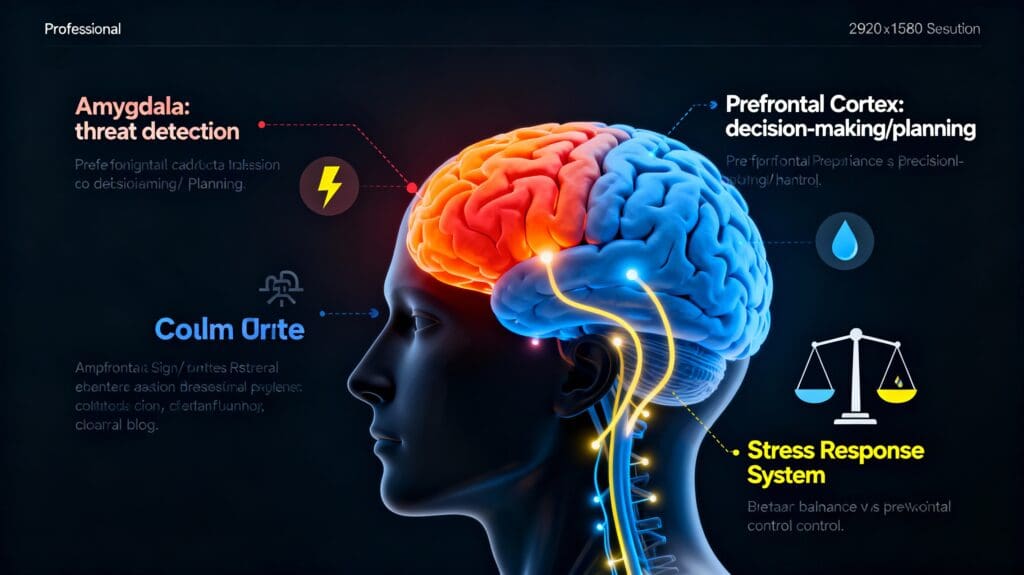
What Happens In The Brain Of A Young Professional Under Pressure
When young professionals talk about being stressed, anxious, or burned out, they are describing real patterns inside the brain and body.
There are a few key players to understand:
- The amygdala, which scans for threat and reacts quickly to danger
- The prefrontal cortex, which handles planning, long-term thinking, impulse control, and perspective taking
- The stress response system, which uses hormones like cortisol and adrenaline to prepare the body for action
In a healthy balance, the amygdala alerts you to potential problems, the prefrontal cortex evaluates the situation, and your body ramps up or down accordingly. You feel focused, engaged, and able to make decisions.
In the day-to-day reality of many young professionals, that balance is disrupted.
Unclear expectations, constant digital input, fear of making mistakes, and high stakes around money and reputation send frequent signals of threat. The amygdala starts to dominate, and the brain leans toward short-term survival rather than long-term growth.
You might notice:
- Your attention is jumpy and fragmented
- You either overreact to feedback or feel completely numb
- You replay conversations and emails over and over in your head
- You find it difficult to access big-picture thinking when you need it most
At the same time, neuroplasticity is always at work. The brain strengthens the circuits it uses most often. If your days are filled with frantic multitasking, emotional reactivity, and harsh self-talk, those networks become more efficient. Your brain becomes excellent at living in a state of urgency and self-criticism, even though it exhausts you.
This phenomenon is why young professionals can feel stuck in patterns they consciously dislike. The problem is not that you lack insight. It is that your nervous system has rehearsed survival mode so many times that it now runs automatically.
The hopeful side of the equation is essential: because your brain is so plastic at this stage of life, deliberate changes in how you work, rest, and relate to yourself can have powerful long-term effects. You are not fixed. You are still wiring.
Chronic stress teaches your brain to anticipate the worst, causing it to constantly make predictions about the future. This predictive mode can make even neutral situations feel loaded, because your body prepares for disaster before there is real evidence. Over time, that pattern becomes exhausting and can erode your ability to feel simple pleasure or satisfaction in your work.
The same neuroplasticity that locked in this hypervigilance can be recruited to build new associations of safety, competence, and agency. Each time you respond to a stressful cue with a slightly more grounded action, you are sending a quiet message to your brain that the future is not only danger; it is also possibility.

Five Hidden Mental Traps Young Professionals Fall Into
Most young professionals are bright, motivated, and self-aware. That does not protect you from mental traps. In fact, high intelligence and ambition can make some traps more potent because you can rationalize them.
Here are five patterns I see over and over in young professionals and what they do to the brain.
1. All-or-Nothing Success Thinking
The message often sounds like:
- “If I am not ahead by thirty, I have failed.”
- “If I do not land this role, my whole career is off track.”
This kind of thinking pushes your brain into a binary state. You are either winning or losing, safe or doomed. The amygdala loves binaries because they fit neatly into its threat detection work. The problem is that real careers are not binary, and real growth is rarely linear.
When young professionals live in an all-or-nothing mindset, they miss nuance and opportunity. They also turn everyday challenges into existential crises, which keeps the stress response constantly activated.
All-or-nothing thinking can also make you ignore the quiet evidence that you are, in fact, progressing as a young professional. Your brain discounts small wins because they do not fit the dramatic story that everything is either wonderful or ruined. The result leads to a constant feeling of being behind, even in seasons where you are building skills and relationships that will serve you later.
A more brain-friendly approach for young professionals is to ask, “What moved even one percent in the right direction this week?” This helps your nervous system recognize that these experiences are real. Over time, this trains your mind to see progress in shades rather than absolutes.
2. Perfectionism Disguised As High Standards
You might tell yourself that you simply have “very high standards.” On the surface, that sounds admirable. Underneath, it can hide a pattern in which any small mistake feels unacceptable, and any incomplete mastery feels like failure.
Perfectionism narrows your focus to what went wrong. The brain’s negativity bias is amplified, and your internal narrative becomes quietly punishing. Over time, this drains motivation and makes it harder to start tasks, because you are already anticipating self-criticism.
Young professionals trapped here tend to oscillate between bursts of overwork and periods of paralysis. The nervous system associates work with threat, not curiosity.
These mental traps are not random flaws in your character; they are shortcuts your brain uses to simplify a complex world, especially when you are still learning the rules. When faced with uncertainty in life, many young professionals resort to simplistic narratives that are easier to comprehend than complex realities.
The problem is that these shortcuts often create more fear and rigidity than they resolve. By bringing them into conscious awareness, you begin to loosen their grip and create space for more flexible, accurate interpretations of your experience. That flexibility is one of the core ingredients of psychological resilience in young professionals.
Perfectionism in young professionals also tends to shrink your appetite for experimentation, because anything less than flawless feels like a public risk. Instead of using early attempts as data, you interpret them as verdicts, which keeps your learning curve painfully flat. Your brain becomes so busy rehearsing worst-case responses that it has little energy left for creative problem-solving, especially in high-pressure environments where young professionals are being evaluated.
Reframing mistakes as information rather than evidence changes the chemistry of these moments, making them less like attacks and more like training reps. This shift allows the nervous system of young professionals to stay engaged enough to grow, even when they are still far from mastery.

3. Identity Fused With Work
Another common trap is shaping your entire sense of self around your job title, employer, or industry. You might think:
- “If this role does not work out, it means I am not valuable.”
- “If I am not considered successful here, I am nothing.”
From a brain perspective, this fusion turns professional risk into existential risk. Feedback, restructures, and market changes become personal verdicts on your worth. The amygdala responds accordingly, and you live in a state of background dread.
Young professionals in this pattern often feel both overinvested and deeply insecure. It becomes hard to explore, experiment, or say no, because everything feels tied to your identity.
Fusing identity and work can make any pause or boundary feel like a threat to who you are, not just what you do. Your brain may resist rest or diversification of interests because it unconsciously equates them with becoming irrelevant. This is a heavy burden for the nervous system of young professionals who are still learning what kind of life they want their work to support.
Creating even small pockets of identity outside of work gives your brain alternative sources of stability when professional circumstances shift. Over time, this makes young professionals more adaptable, not less ambitious, because they are no longer betting their entire selfhood on one role.

4. Constant Comparison
Social media, professional platforms, and digital visibility make comparison a breeze. You see curated snapshots of other young professionals landing promotions, launching projects, or living seemingly perfect lives.
Your brain naturally uses social comparison to understand where you stand. The problem is that you are comparing your unfiltered reality to someone else’s highlight reel.
Constant comparison activates the same neural circuits involved in physical pain and social threat. It quietly tells your nervous system that you are behind, excluded, or lacking. Over time, this drains confidence and joy from your own path, even when you are objectively doing well.
Comparison also distorts your internal compass, because you begin to chase what looks impressive rather than what genuinely fits your strengths and values. The brain’s reward system is hijacked by likes, titles, and external markers that deliver quick hits of validation. While these may provide immediate satisfaction, they can leave young professionals feeling strangely depleted afterward, akin to consuming excessive sugar without sufficient nourishment.
Pausing to ask, “Do I actually want the life behind this image?” helps your nervous system differentiate between real desire and borrowed desire. That question alone can prevent years of effort young professionals might spend pursuing someone else’s version of success.
5. Burnout As A Badge Of Honor
In many environments, being exhausted is regarded as a sign of importance. If you are burned out, it must mean you are in demand, dedicated, and strong.
In reality, chronic burnout is a sign that your nervous system has been pushed past its capacity for too long. The brain begins to conserve energy by numbing out emotions and dampening motivation. You feel detached, cynical, or hollow.
Young professionals may mistake this numbness for resilience. It is not. It is a protective shutdown that makes it harder to feel engaged and creative. If you keep going past this point, your body will eventually force a crisis.
Recognizing these mental traps is not about shaming yourself. It’s about seeing how automatic some patterns are and knowing they’re not “just who you are.” They are habits that can be rewired.
Burnout as an identity can be seductive, because it signals to others that you are in demand and important. Your brain may even associate exhaustion with belonging if you are surrounded by people who normalize running on fumes. The cost is that you slowly lose access to joy, curiosity, and spontaneity, which are the very states that make a career feel worth having for young professionals.
Choosing to respect your limits is not a retreat from ambition; it is a way of protecting the neural circuits that make high-quality work possible. Young professionals who learn this early often build longer, more creative careers than those who ignore every warning sign.

Nervous System Hygiene For Young Professionals
You hear a lot about productivity hacks, but much less about nervous system hygiene. But for young professionals, how you care for your body and mind is a key predictor of success.
Nervous system hygiene is not about elaborate routines. It is about simple, repeatable practices that signal to your brain it is safe to engage in higher-level thinking.
Here are a few pillars you can build into your week.
Daily Micro Downshifts
Your brain needs small, frequent signals of safety during the day. This is especially true for young professionals working in fast-paced or unpredictable environments.
A few examples:
- One to three minutes of slow breathing between meetings
- A brief walk without your phone, focusing on what you see and hear
- Short body scans where you relax your jaw, shoulders, and stomach
These micro downshifts help move your nervous system out of constant alert and back toward a more regulated state. They are more effective than waiting for a single big break at the end of the week.
Thinking of nervous system hygiene as “emotional flossing” can be helpful; it is not glamorous, but it prevents problems that are much harder to fix later. Instead of waiting for a full breakdown to reconsider how you live and work, you build tiny habits that keep you from drifting too far into overload.
The brains of young professionals respond best to consistency, so low-effort practices done most days will usually beat intense routines you abandon after a week. As you experiment, notice which practices genuinely leave you feeling more grounded rather than more pressured to be perfect. Let those become the core of your personal maintenance plan as a young professional.
Boundaries Around Input
The amount of information young professionals consume is immense—emails, chats, video calls, social feeds, news, and endless content. Every piece of input is something your brain has to process.
You cannot control everything, but you can create edges.
For example:
- Set specific windows for checking news or social media, instead of grazing all day
- Decide on a realistic time each evening to stop checking work messages.
- Create a small shutdown ritual, such as closing your laptop, changing the lighting, and doing something that marks the end of the workday
These cues signal to your brain that it can shift out of performance mode. Without them, the nervous system remains half-activated, and proper rest is rare.
Information boundaries protect your brain’s limited processing and integration bandwidth. When you consume inputs without a filter, your nervous system spends the entire day sorting signals from noise. That invisible labor makes you more irritable, more distracted, and more prone to catastrophizing.
Choosing when and how you engage with digital content is a way of reclaiming agency, not withdrawing from reality, especially for young professionals whose work lives are already screen heavy. Young professionals who learn to curate their inputs often find they have more energy left over for deep work and real relationships.
Body Basics Without Perfectionism
Sleep, nutrition, and movement are often framed as lifestyle choices. From a neuroscience standpoint, they are inputs your brain depends on.
Young professionals often try to overhaul everything at once, fail to maintain it, and then judge themselves for it. Instead, look for small, doable shifts, such as:
- Going to bed and waking up at more consistent times
- Making sure you have at least one authentic meal during the workday
- Building in brief movement blocks, even if you cannot make it to a full workout
You are not trying to create an idealized version of yourself. You are trying to give your brain enough stability so it can process stress rather than drown in it.
Your body is not a separate project from your career; it is the infrastructure that makes every decision and conversation possible. When you overload your brain’s capacity, it begins to reduce your attention span and emotional range. Small physical adjustments, like drinking enough water or getting ten extra minutes of sleep, sound trivial, but they change the internal chemistry you are working with.
Rather than pursuing an ideal wellness routine, strive to establish a foundation of “good enough most days” that is both human and sustainable for young professionals with busy schedules. This gives your nervous system a stable platform from which to handle the inevitable spikes of stress.
Naming What You Feel And Need
Many young professionals have sharp analytical skills but limited emotional vocabulary. They know they feel “off” or “stressed” but cannot describe it. The brain interprets this vagueness as danger because it cannot categorize what is happening.
A simple practice is to pause and complete two sentences:
/wp:paragraph –>- “Right now I feel…”
- “Right now I need…”
It is not necessary to address every need right away. Naming alone activates the prefrontal cortex and lessens the feeling of a vague storm engulfing you.
Putting language to your state shifts your brain from pure reaction into a mode where choice becomes possible. It moves you from “something is wrong with me” to “something specific is happening in me.” That difference sounds subtle, but it dramatically reduces shame and opens the door to problem-solving, especially for young professionals who tend to live in their heads.
Over time, this practice also helps you recognize patterns, such as the situations that reliably leave you drained or energized. With that data, young professionals can start designing their schedule and commitments in ways that match how their nervous system actually operates, rather than how they wish it did.

Rethinking Success When You Feel Behind
Young professionals receive powerful cultural messages about what success should look like. These scripts often include ideas such as:
- You should know your path early and stay on it
- Progress should be steady and visible
- Changing direction is a sign that you failed somewhere
When your real life does not look like that, it is easy to feel behind.
From a neuroscience perspective, rigid success scripts are a problem because they frame normal exploration as failure. The brain responds with shame and self-criticism, narrowing attention and reducing creativity. You discover it harder to notice opportunities that do not fit the original script.
A more brain-friendly way to contemplate success as a young professional is to focus on three areas:
- Skills
What are you actually getting better at over time? This includes technical skills, communication, decision-making, and self-regulation. Your brain loves learning, mainly when it can track progress. - Systems
How do you structure your days, manage your energy, and organize your work? Systems are where you translate your intentions into consistent action. Even a slight improvement to a system can dramatically lower stress. - Stories
How do you talk to yourself about where you are and where you are going? The stories you repeat become the lens through which your brain interprets events. Stories of doom create threat. Stories of learning create possibility.
Young professionals who focus on these three areas tend to feel more in command of their path, even when circumstances are messy. They understand that a sideways move, a pause, or a step back can all be part of a longer trajectory.
You are not a static product being judged. You are a nervous system learning how to navigate a complex world.
Feeling behind often comes from comparing your messy middle to someone else’s edited outcome. Your brain forgets that every impressive achievement is built on years of ambiguity, false starts, and private doubt. When you zoom out and see your life as a series of seasons rather than a straight ladder, short periods of apparent stagnation look less like failure and more like incubation.
Skills, relationships, and self-knowledge are often compounding quietly even when external markers do not move. Remembering this allows young professionals to make choices from a place of grounded strategy rather than panic about lost time.
Belonging, Mentorship, And Loneliness At Work
One of the most overlooked challenges for young professionals is loneliness.
Remote and hybrid work, high turnover, and lean teams mean fewer organic moments of connection. You may log into meetings, share screens, and discuss deliverables without ever feeling that anyone truly knows you or cares about your inner life.
The brain is a social organ. Connection is not a desirable extra. It is a basic need. When you feel isolated or invisible, your nervous system registers a social threat. Over time, this fuels anxiety, self-doubt, and disengagement.
You do not need a perfect mentor or a dream team to improve this. You can start with small, intentional moves:
- Ask a more experienced colleague one specific question about how they approach a task
- Invite a coworker for a short virtual or in-person coffee with a clear time frame
- Express genuine appreciation when someone helps you, instead of just moving on
These actions create micro experiences of belonging. Your brain starts to update its model of the workplace from “I am alone here” to “There are at least a few people I can connect with.”
For young professionals, even one or two supportive relationships can significantly buffer stress. They also provide models for navigating situations you have not faced before, reducing uncertainty.
Seeking connection at work does not mean forcing instant closeness with everyone; it means looking for a few human-sized relationships that feel mutual and safe. Your nervous system relaxes when it senses even a small circle of people who see you as more than a role.
You can support your nervous system by showing up consistently, keeping your word, and allowing small glimpses of your real personality to be visible. This kind of quiet authenticity often attracts the very mentors and peers who will matter most to young professionals over the long run. For young professionals, investing in these relationships is not a distraction from performance; it is one of the strongest buffers against burnout.

A Weekly Brain Reset For Young Professionals
Given everything your brain is holding, it is helpful to have a simple ritual that helps you process the week instead of letting it blur together.
Here is a weekly reset that many young professionals find helpful. It can take as little as twenty minutes.
Step 1: Download
Take a blank page and write down what actually happened this week—meetings, tasks, conversations, decisions, and moments that stood out. Do not edit or judge. You are giving your brain a chance to externalize information rather than carry it all internally.
Step 2: Highlight
Circle three things you handled well. They do not need to be dramatic. Perhaps you communicated clearly in a difficult conversation, finished something you had been avoiding, or took a small step to care for yourself.
This step trains your attention away from pure negativity bias. Young professionals often rush past what they did well. Your brain needs to see those moments to strengthen those circuits.
Step 3: Learn
Choose one challenging moment and ask yourself, in writing:
- “What was my brain trying to protect me from here”
It could be protecting you from embarrassment, rejection, uncertainty, or conflict. Naming the protective motive helps you see your reactions less as failures and more as attempts to stay safe.
From there, you can ask:
- “If I could replay this moment with a slightly calmer nervous system, what might I try differently?”
You are not rewriting the past. You are rehearsing a new pattern.
Step 4: Design
Finally, pick one or two small experiments for the coming week. For example:
- Taking a brief breathing break before a recurring stressful meeting
- Preparing one question in advance for a senior colleague
- Setting a realistic boundary around late-night emails one evening
The key is to keep these experiments tiny and specific. Young professionals often try to change everything at once and then conclude that change is impossible. Your brain responds better to small, repeatable shifts.
Over time, this weekly reset becomes a powerful tool. It turns your life as a young professional into a series of teachable moments instead of a blur of stress.
A weekly reset teaches you that you can shape your life, not just witness it. By regularly reviewing what worked and what did not, you stop letting your hardest moments define the whole story of your week.
This practice can become an anchor ritual that signals the transition between one chapter and the next, which your nervous system finds deeply regulating. Over months, young professionals may notice that their sense of agency increases even if external conditions change slowly. That growing agency is one of the clearest signs that your inner wiring is shifting in a healthier direction.
Frequently Asked Questions From Young Professionals
How do I know if I am actually burned out or just tired?
Feeling tired is normal after periods of effort. Burnout, in contrast, often includes emotional numbness, cynicism, and a sense that nothing you do makes a difference. If rest does not restore you, if you dread work in a way that feels heavy and constant, and if you feel detached from things that used to matter, your nervous system may be in burnout territory rather than simple fatigue.u003cbru003e
What if I cannot afford to leave a job that is hurting my mental health?
Many young professionals feel financially trapped. If changing jobs is not immediately possible, focus on changes within your control, such as boundaries around after-hours communication, small pockets of recovery during the day, and building support outside of work. These shifts will not fix every structural problem, but they can give your nervous system some breathing room while you plan longer-term moves.
I feel behind compared to other young professionals. Is it too late?
It is almost impossible not to compare yourself when you constantly see other young professionals posting milestones. Your brain is wired to scan for status and belonging. Remember that most paths are nonlinear and that you do not see the full story behind any post. It is not too late to learn, pivot, or build. What matters most for your brain and career is the direction you consistently move in, not the exact timeline.
How much ambition is too much?
Ambition itself is not a problem. Your brain likes challenge and growth. Ambition becomes a problem when it is fused with your self-worth or when it consistently overrides your basic needs. If you find yourself sacrificing sleep, health, or relationships, or if you feel like a failure whenever you are not accelerating, it may be time to recalibrate. Healthy ambition works with your nervous system, not against it.
What is one small thing I can start this week if I feel overwhelmed?
If you are a young professional who feels completely overwhelmed, start with two things. First, add one daily micro downshift, such as a short walk without your phone or a few minutes of slow breathing. Second, commit to a brief weekly reset where you write down what happened, what went well, and one small experiment for next week. These simple practices start teaching your brain that life is not the only force pushing you. You are participating in how your system adapts.
#youngprofessionals #neuroscience #careers #burnout #mentalhealth #workplacewellbeing
This article is part of our Social Resilience & Connection collection. Explore the full series for deeper insights into social resilience & connection.