
Key Takeaways
- Self-hatred activates physical disgust circuits: the anterior insula processes self-directed contempt as a threat signal.
- The brain’s negativity bias prioritizes threat detection, making self-critical thoughts neurologically “stickier” than self-affirming ones.
- Gilbert’s three-system model (threat, drive, soothing) explains why high-achievers often have an atrophied self-compassion circuit.
- Self-hatred is a learned neural pattern that can be restructured through circuit-level intervention.
In crisis? Call or text 988 (Suicide & Crisis Lifeline, 24/7, free) or text HOME to 741741.
You are not broken. You are not “bad.” You are the victim of a survival mechanism that saved your ancestors but is currently trying to kill you.
If you struggle with the relentless voice of inner criticism, you likely view it as a moral failing. You assume that if you hate yourself, there must be a valid reason, that you are fundamentally flawed. However, when we strip away the emotion and examine the evolutionary neuroscience of self-hatred , a different picture emerges.
By combining evolutionary psychology, anthropology, and modern brain imaging, we can dismantle the lie that you were born to hate yourself. What I offer here is the raw, science-backed explanation of why your brain turns on you and how you can use the principles of the evolutionary neuroscience of self-hatred to cultivate greater well-being.
Chronic self-criticism activates the same lateral habenula circuitry implicated in social defeat processing in animal models, with habitual self-attacking thought patterns suppressing dopaminergic reward signaling through a mechanism neurologically indistinguishable from externally imposed subordination stress.
Self-compassion interventions reduce amygdala threat-encoding responses to self-relevant failure stimuli within eight weeks, and that this shift correlates with decreased cortisol reactivity and increased ventral striatal activation during subsequent self-evaluation, a neural signature consistent with moving from threat to care mode.

Is Self-Hatred a Disorder or a Mental Illness?
Self-hatred is not a standalone psychiatric diagnosis; you will not find it as its own entry in the DSM-5. It is better understood as a transdiagnostic symptom: a learned neural pattern of self-directed threat processing that surfaces across depression, anxiety, complex trauma, and personality difficulties, and sometimes on its own. The distinction matters clinically. A symptom maintained by specific, identifiable circuitry can be restructured at the circuit level, whereas treating self-hatred as a fixed disorder implies a permanence the neuroscience simply does not support.
Part I: The Evolutionary Neuroscience of Self-Hatred & The Survival Trap
To understand the roots of the evolutionary neuroscience of self-hatred, you have to go back 50,000 years. In the Paleolithic era, human beings were not the strongest animals on the savannah. We were soft, slow, and defenseless against predators. Our only superpower was the tribe.
If you were part of the group, you would survive. If you were kicked out or exiled, you died. Therefore, the human brain evolved a high-sensitivity alarm system to prevent social rejection. This alarm is the true evolutionary purpose of shame. It was a warning light designed to keep you in line. If you took more than your share of food, your brain flooded you with cortisol and shame, forcing you to submit and apologize. This act of submission de-escalated the conflict and allowed you to remain in the safety of the group.
In the modern world, this system has malfunctioned. We are no longer fighting for survival in a tribe of fifty people. We are navigating a complex world of billions. However, your brain continues to view social awkwardness or failure as fatal consequences. Your boss’s critical email triggers the same neurochemical cascade that an exile from a Paleolithic tribe would have. Cortisol floods your body. Your muscles tense. Your breath becomes shallow. And your mind begins the desperate search for what you did wrong. The telltale markers can include a tight chest, shallow breathing, muscle tension, and nonstop mental replay.
This sensation is not weakness. This response is not a character flaw. The real question is, is self-loathing a truth about you or an outdated alarm your brain learned to trust? This activation is your nervous system doing exactly what it was designed to do. The problem is that the design is 50,000 years old, while you live in the 21st century. The evolutionary neuroscience of self-hatred helps us understand this fundamental mismatch between our ancient programming and our modern environment.

The Submission Cascade
Evolution did not create shame or make us feel unworthy. It created shame to change our behavior. The mechanism works like this: You commit a social transgression. Your brain detects the threat of exile. Shame floods your system. You immediately shrink, apologize, and submit. The group sees your submission as genuine remorse and reintegrates you into the tribe. You survive.
This submission cascade worked perfectly when humans lived in small groups where reputation was everything. But in the modern world, we have internalized this shame response without the external resolution it once had. You make a mistake at work. Your brain activates the shame system. But there is no tribe gathering to decide your fate. There is no public apology that resolves the tension. Instead, you are left alone with the neurotransmitter cocktail of shame, and your brain keeps the alarm on for days, weeks, or even years.
The problem compounds when you realize that the evolutionary neuroscience of self-hatred is not just about current mistakes. It is also about how your brain learned to use shame as a survival strategy in childhood. In my practice, I consistently observe that this phase is where the real damage begins, and decades of neuroscience research confirm it.
Betrayal Blindness and the Child’s Dilemma
The most tragic root of self-hatred lies in childhood, specifically in a concept called Betrayal Blindness. Cognitive psychologist Dr. Jennifer Freyd identified this mechanism to explain why children blame themselves for the abuse or neglect of their caregivers. This survival mechanism is central to the evolutionary neuroscience of self-hatred.
Research on betrayal trauma confirms that children are entirely dependent on their caregivers for survival. If a caregiver is abusive, neglectful, or emotionally volatile, the child faces a terrifying dilemma. They cannot accept the reality that their parent is dangerous, because that realization is too scary to process. If your parent is harmful, you should run away or call for help. But you cannot survive without your parent. You have nowhere to go. You have no resources. The terror is paralyzing.
So instead of accepting the unbearable truth, “My parent is a threat,” the child’s brain chooses a survival strategy. It blinds itself to the parents’ betrayal and turns the hatred inward. The child adopts the belief that one parent is beneficial and the other is bad. If they can just be “better,” they will be safe. If they can anticipate the parent’s mood, they can prevent the abuse. If they can just be smarter, prettier, and quieter, they will be loved.
In this context, self-hatred is a survival strategy. It allows a child to maintain an attachment to a dangerous caregiver by absorbing the “badness” in their identity. You didn’t start hating yourself because you were unworthy. You started hating yourself because it was the only way to feel safe.
Decades later, as an adult, you carry this belief in your nervous system. Your conscious mind may understand that your parents’ behavior was not your fault. But your body still responds as if you are in danger. Your brain still scans for threats. Your default mode network still generates rumination about what you should have done differently. What I’ve observed across 26 years of applied neuroscience work is that this pattern is not a psychological failing. It is a neurobiological adaptation to a dangerous environment.

The Social Baseline Hypothesis
There is another evolutionary layer to self-hatred that is worth understanding. The social baseline hypothesis posits that the human brain is fundamentally social. We are not designed to regulate ourselves alone. We are designed to co-regulate with others. This co-regulation insight is a key component of the evolutionary neuroscience of self-hatred.
When you are with someone who cares about you, your nervous system actually shifts. Your heart rate variability improves. Your cortisol levels drop. Your immune function improves. You can think more clearly. When you are alone, especially in isolation and self-criticism, your nervous system lacks an external source of regulation. It turns inward and attacks.
This co-regulation requirement explains why self-hatred is so much worse in solitude. This dynamic explains why social media (which gives us the illusion of connection without actual co-regulation) worsens self-hatred. And this pattern explains why the evolutionary neuroscience of self-hatred is inseparable from the biology of loneliness. You are not meant to be your own judge, jury, and executioner.
Part II: The Anthropological Context (Guilt vs. Shame)
Not all forms of self-hatred share the same characteristics or cultural origins. Anthropology distinguishes between two powerful social control mechanisms: guilt cultures and shame cultures. Understanding this distinction is vital to grasping the evolutionary neuroscience of self-hatred across different human societies and historical periods.
In guilt cultures, which are typical of the modern West, the internal dialogue focuses on actions. The thought process is “I did something bad.” Guilt is about violating an internal moral code. It is about responsibility and behavior change. Shame motivates you to apologize, change your behavior, and avoid breaking your code again.
In shame cultures, typical of collectivist societies in Asia and the Middle East and of traditional communities, the focus is on identity and public perception. The thought process is “I am bad.” Shame is about the failure of the entire self, not just one action. It is about how others perceive you. It is about honor, reputation, and status in the community’s eyes.
These emotional systems are two different mechanisms with different evolutionary purposes. Guilt evolved to help individuals within a group maintain their moral standards. Shame evolved to help individuals maintain their standing within a group. Both are valuable in the proper context. But when they malfunction, they create very different forms of suffering. The evolutionary neuroscience of self-hatred manifests differently depending on whether you grew up in a guilt or shame culture.

The Paradox of Toxic Individualism
Modern Western societies are living through a paradox of toxic individualism. In traditional shame cultures, shame serves as a tool for social cohesion. If you make a mistake, the group corrects you and reintegrates you. The shame resolves because the community participates in that resolution.
However, in the modern West, we have retained the biological mechanisms of shame while lacking the community structure necessary to resolve it. We feel the ancient, tribal shame of “not being good enough,” but we lack the tribe to absolve us or reintegrate us. We are left alone in a room, scrolling through social media, comparing our internal struggles to everyone else’s curated lives. We are suffering from tribal rejection in a world where the tribe doesn’t even exist.
This mismatch is why the evolutionary neuroscience of self-hatred is particularly acute in individualistic societies. We experience the shame response typical of collectivist cultures, but we also face the isolation characteristic of individualist cultures. We feel the weight of group judgment, with no possibility of group redemption. Many of my clients describe exactly this: a catastrophic mismatch between their biology and their environment, which is a core concept in the evolutionary neuroscience of self-hatred.
Cross-Cultural Variations in Self-Criticism
Research on self-criticism across cultures reveals essential nuances in the evolutionary neuroscience of self-hatred. Studies comparing Western and Eastern populations show that while self-criticism exists in all cultures, it is expressed differently and has different relationships with depression. The underlying neural mechanisms involve coordinated activity across cortical.
In individualist cultures, self-criticism is often framed as motivation. “I need to criticize myself to improve.” In collectivist cultures, self-criticism is often framed as a form of protection. “I criticize myself so that others don’t have to.” Both forms are unhealthy when they become chronic, but they emerge from different evolutionary and cultural contexts.
The critical insight is that the evolutionary neuroscience of self-hatred cannot be separated from the cultural context in which it develops. Your self-hatred is not just a biological malfunction. It is also a cultural adaptation. You have internalized the values and judgments of your family and your society. You have turned the voice of the critic into your own internal monologue.
Part III: The Hardware of the Evolutionary Neuroscience of Self-Hatred
If we look at the brain of someone suffering from chronic self-loathing, we can see the physical evidence of this struggle. Self-hatred has a physical address in the brain. Modern neuroimaging has revealed the specific regions and circuits involved in the evolutionary neuroscience of self-hatred.
Neuroscientists Semir Zeki and John Romaya conducted a groundbreaking study on hatred. They showed subjects images of people they hated and scanned their brains with functional MRI. They identified the “Hate Circuit” in the brain. These regions, including the superior frontal gyrus, the insula, and the putamen, light up when we feel intense hatred toward an enemy.
What is remarkable is that the same circuit activates when we hate ourselves. Your brain employs the same neural mechanisms to hate an external enemy as it does to hate yourself. You are literally viewing yourself as an enemy. This self-targeting activation is the neurological basis of the evolutionary neuroscience of self-hatred.
| Brain Region / Network | Normal Function | Role in Self-Hatred | Clinical Significance |
|---|---|---|---|
| Superior frontal gyrus + insula + putamen (“Hate Circuit”) | Detect and respond to external threats and enemies | Activates identically against the self: the brain treats you as your own enemy | Zeki & Romaya fMRI studies confirm identical activation patterns |
| Default Mode Network (mPFC, PCC, angular gyrus) | Self-reflection, mind-wandering, future planning | Becomes hyperactive and rigid: generates relentless rumination and self-blame loops | Hyperactivity correlates directly with depression severity |
| Prefrontal cortex (regulatory regions) | Contextualizes mistakes, provides perspective and emotional braking | Disconnects from hate circuit: aggression runs without cognitive regulation | “Uncoupled” circuit explains inability to extend self-mercy |
| Dorsal anterior insula | Processes disgust and aversion to harmful stimuli | Activates against the self: produces literal self-disgust and dehumanization | Mechanistic dehumanization: viewing self as broken machine, not person |
| Soothing system (oxytocin/opioid pathways) | Promotes rest, recovery, social bonding, safety signals | Chronically underdeveloped: starved by persistent threat-mode activation | Primary intervention target: must be manually re-engaged |
The Uncoupled Hate Circuit
Areas responsible for emotional regulation and perspective-taking connect with the regions responsible for aggression and judgment in a healthy brain. When you make a mistake, you can contextualize it. You can say, “I made a human error, but I am still a worthy person.” However, in the brain of someone with deep self-hatred, this circuit becomes uncoupled.
This circuit uncoupling is particularly pronounced in depression. Researchers have found that depression literally disconnects the hate circuit from the regions that regulate emotion. You literally lose the neurological ability to extend mercy to yourself. Your brain attacks without hesitation, and the attack continues without relief.
This internal targeting is why self-hatred is so much harder to overcome than external hatred. When you hate someone else, you can at least escape them. You can avoid them. You can separate yourself from them. However, when self-loathing consumes you, there is no escape. The attacker is inside your skull. In my experience, helping clients understand this mechanism is often the first step toward reclaiming agency over their own neural circuitry.
The Default Mode Network and Rumination
Another key player in the evolutionary neuroscience of self-hatred is the Default Mode Network (DMN). This network is the brain region cluster that activates when you’re daydreaming or zoning out. The DMN includes areas such as the medial prefrontal cortex, posterior cingulate cortex, and angular gyrus.
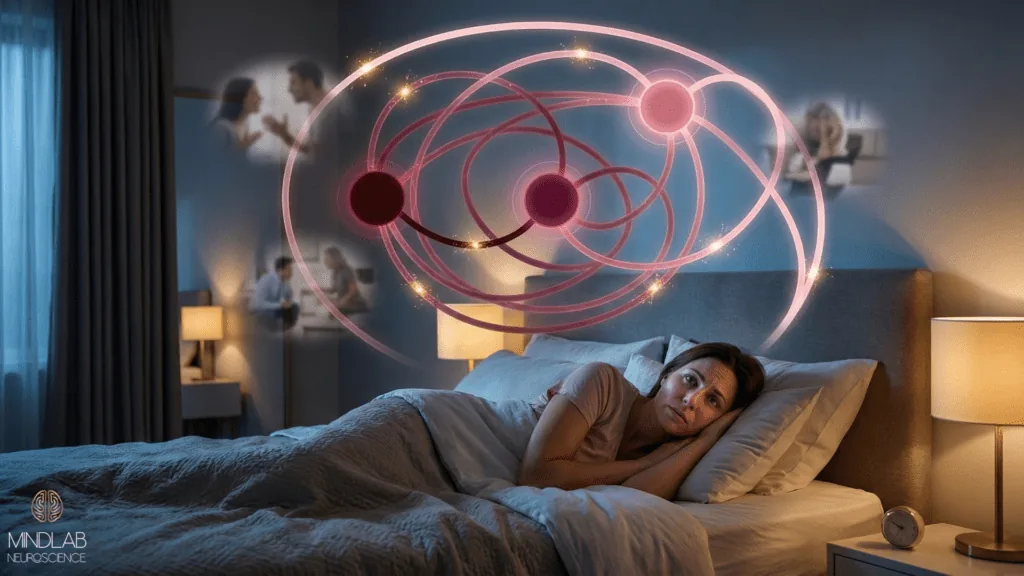
In a healthy brain, the DMN is active but flexible. It might drift to planning dinner, remembering a movie, or imagining a future scenario. But in a depressed or self-hating brain, the DMN is hyperactive and rigid. It drifts immediately to rumination. It becomes stuck in loops of regret, embarrassment, and self-blame.
This rigidity explains why silence is so terrifying for people who hate themselves. When the external noise stops, when you are lying in bed or sitting in a car alone, the DMN activates and begins the “time travel of regret.” It replays every mistake and embarrassment. It constructs worst-case scenarios. It generates evidence for your unworthiness. The evolutionary neuroscience of self-hatred reveals that its existence is not a choice. It is a neural pattern that has been reinforced over the years.
Self-Referential Processing
The evolutionary neuroscience of self-hatred also involves hyperactive self-referential processing. The brain has evolved to process information about the self, particularly regarding self-hatred. When you encounter information relevant to your identity, specific brain regions light up to integrate that information into your self-concept.
In people with healthy self-regard, this system works adaptively. You encounter feedback, integrate it into your self-concept, and update your behavior if needed. But in people with self-hatred, this system is hyperactive and distorted. Neutral or even positive information is interpreted as evidence of unworthiness. A compliment becomes “They are just being nice.” “It was just luck” becomes a success. A failure becomes “I am a complete failure.”
The default mode network mediates this hyperactive self-referential processing, and it is one of the core features of depression and chronic self-loathing. The brain is literally allocating more neural resources to process self-relevant information and interpreting it in a negatively biased way. This negativity bias is a cornerstone of the evolutionary neuroscience of self-hatred. Quieting that overactive loop is exactly the aim of the neuroscience of calm analytical mind.
Mechanistic Dehumanization
Perhaps the most chilling finding in the evolutionary neuroscience of self-hatred is the concept of mechanistic dehumanization . When we hate ourselves, we often use the same brain areas used to view objects or machines, not people. We stop viewing ourselves as complex human beings with needs, feelings, and inherent worth, and start viewing ourselves.
We apply a cold, mechanical standard to ourselves that we would never apply to a friend or a loved one. We regard ourselves with the cruelty and indifference we would reserve for a defective tool. This pattern of mechanistic dehumanization is part of what makes self-hatred so corrosive. It is not just that we dislike ourselves. It is that we have excluded ourselves from the moral category of “people who deserve compassion.”
You did not start hating yourself because you were unworthy. You started hating yourself because it was the only way your nervous system knew how to keep you safe. The survival strategy that once protected a child is now imprisoning an adult.
The brain region involved in this dehumanization is the dorsal anterior insula, which processes disgust and aversion. Hatred of oneself literally leads to a feeling of self-disgust. This self-disgust response is the neural signature of the evolutionary neuroscience of self-hatred.
Part IV: Pathways to Well-being and Neuroplasticity (The Hope)
Although the science is stark, it’s not a fatal blow. The most important discovery in modern neuroscience is neuroplasticity, the brain’s ability to rewire itself. The “Hate Circuit” is simply a neural pathway that has been reinforced over years of use. It is a habit, not a destiny. And habits can be changed.
The Three Emotional Regulation Systems
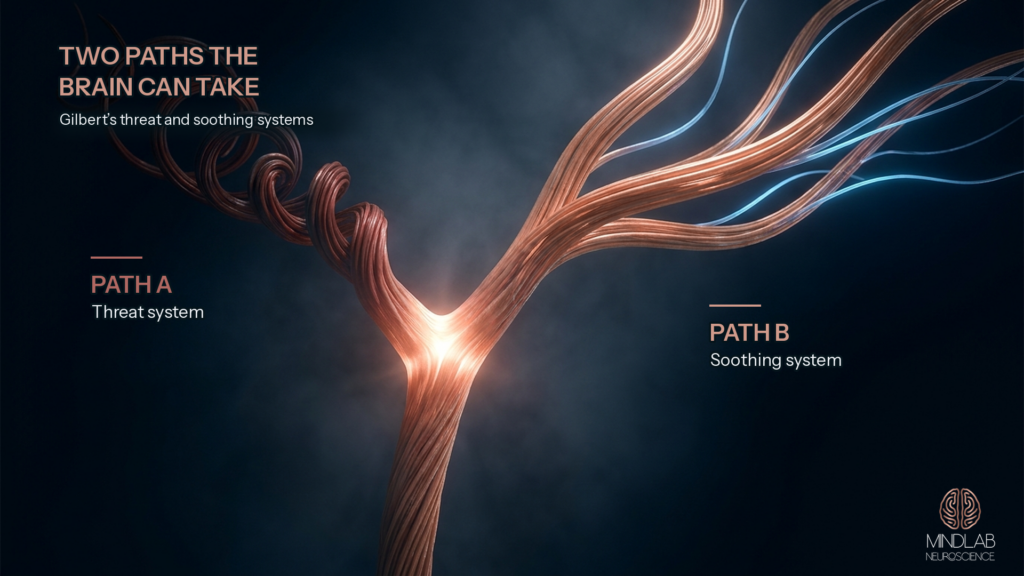
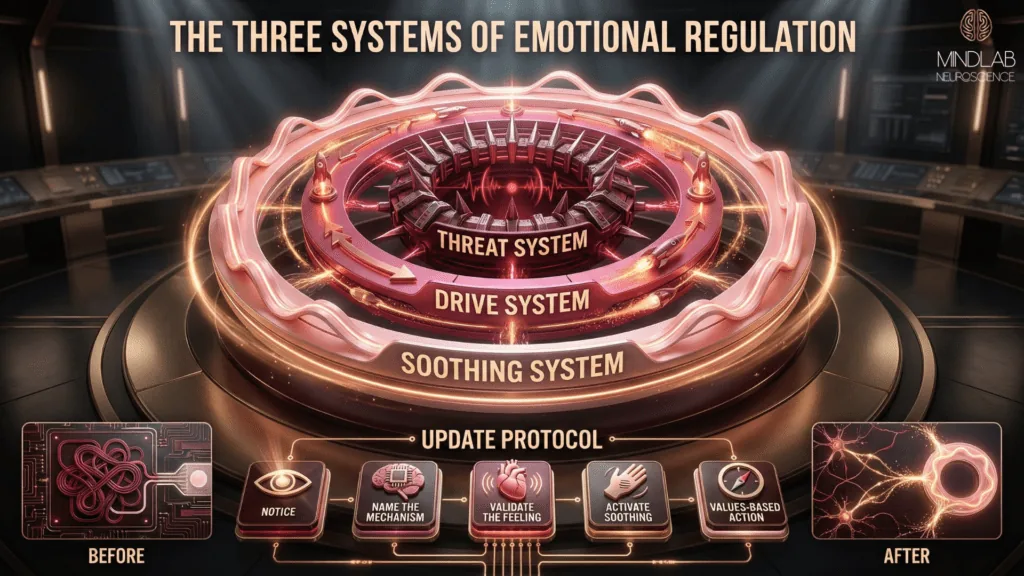
Dr. Paul Gilbert, a leading researcher in the evolutionary neuroscience of self-hatred, developed Compassion Focused Therapy (CFT) based on a model of three major emotional regulation systems. Understanding these systems is crucial to understanding how to address self-hatred. Multiple brain regions contribute to this process through synchronized.
The first system is the Threat System. This system is designed to detect danger and mobilize the body for fight, flight, or freeze responses. It is powered by adrenaline and cortisol. It is fast, reactive, and focused on survival. In the context of self-hatred, this system is constantly activated. Your body is in a state of high alert, ready to attack or defend.
The second system is the Drive System. This system is designed to pursue goals and resources. It is powered by dopamine. It is focused on achieving, competing, and acquiring. Many people with self-hatred also have an overactive Drive System, which manifests as perfectionism, workaholism, and a constant pursuit of achievement to prove their worth.
The third system is the Soothing System. This system is designed to calm the body and promote rest, recovery, and social bonding. It is powered by oxytocin and opioids. It is the system of safety, connection, and peace. And this is the system that is most underdeveloped in people with chronic self-hatred. Because this system is activated most strongly through safe connection, it also underlies the neuroscience of optimize neuroplasticity in relationships.
Self-hatred keeps you locked in the Threat System and the Drive System. Self-hatred forces you to constantly battle an adversary, only to discover that it is actually you. You are continually trying to prove your worth through achievement. To address this, you cannot simply “think positive.” You must manually engage the Soothing System to change your physiology. This engagement is the practical application of understanding the evolutionary neuroscience of self-hatred, and it is the foundation of the recalibration work I do with my clients.

Activating the Soothing System
Engaging the soothing system involves various practices that calm your nervous system and activate your parasympathetic response. These include slow, deep breathing exercises, progressive muscle relaxation, warm baths, physical touch, and compassionate imagery. Multiple brain regions contribute to this process through synchronized neural firing patterns that emerge.
One of the most potent practices is compassionate imagery. This imagery practice involves visualizing someone who deeply cares about you (a person, an animal, or even an imagined ideal figure) and imagining their presence with you. As you visualize this, your body actually releases oxytocin and opioids. Your heart rate variability improves. Your nervous system shifts from threat mode to soothing mode.
Another powerful practice is self-compassion. This self-compassion work involves speaking to yourself as you would talk to a dear friend who is suffering. Instead of the harsh, critical voice, you practice a warm, supportive voice. This practice of deliberate self-directed kindness is not about being weak or avoiding accountability. It is about approaching yourself with basic human decency.
Research on Compassion Focused approaches shows that these practices can literally rewire the brain. The regions involved in self-criticism become less active. The areas involved in empathy and compassion become more active. The hate circuit becomes less responsive. The soothing system becomes stronger. This rewiring process is how we shift the mechanisms identified by the evolutionary neuroscience of self-hatred.
Updating the Software: Recognizing the Voice
You cannot fight self-hatred with more hatred. That approach only adds to the system’s aggression. Instead, you must recognize the voice for what it is: an outdated survival program. Multiple brain regions contribute to this process through synchronized neural firing patterns that emerge during both resting and. Replacing that self-attack with a workable response is the practical thread running through the neuroscience exploring how to overcome self-defeating behaviors.
When the inner critic attacks, you can respond with scientific truth. You can acknowledge that your evolutionary “exile alarm” is going off because it thinks you are in danger of social rejection. You can recognize that your brain is running software designed for the Paleolithic era, not for your actual life. You can thank your brain for trying to keep you safe while reminding yourself that you are an adult, you are secure, and you are not in danger.
This approach is not denial. This reframing is not positive thinking. This technique is simply naming the mechanism. It is like saying, “I hear the smoke detector, but there is no fire.” The alarm may be real, but the threat is not. This clarity of recognition is what the evolutionary neuroscience of self-hatred teaches us. It simply refuses the mind’s habit of turning a single failure into a global verdict, the distortion mapped in the neuroscience of examples of overgeneralization.

The Update Protocol
Here is a simple protocol I walk my clients through for updating the software when the self-hatred voice activates:. Functional neuroimaging studies reveal coordinated activation across prefrontal and limbic networks during this process, with measurable changes in neural connectivity patterns emerging within weeks of consistent practice.
First, notice the voice without judgment. “There is the inner critic. There is the shame response.”
Second, acknowledge the evolutionary source. “This is my brain’s exile alarm. It evolved to keep me safe in a tribe of fifty. It thinks I am in danger of rejection.”
Third, validate the feeling without accepting the narrative. “I can feel this emotion. Emotions are real. But emotions are not facts. My brain is lying to me about my worth.”
Fourth, activate the Soothing System. Take a few deep breaths. Put your hand on your heart. Speak to yourself with kindness.
Fifth, take action aligned with your values. Do something that reminds you that you are alive, that you are capable, that you are worthy.
This update protocol is not an instant remedy. It is a practice. You will need to repeat it many times. But with repetition, the neural pathways of self-compassion strengthen, while those of self-hatred weaken. You are literally rewiring your brain based on what the evolutionary neuroscience of self-hatred has taught us.
Neuroplasticity and the Long Game
Neuroplasticity means that your brain is not fixed. The patterns of self-hatred are not destiny. But neuroplasticity also means that change takes time. You cannot expect to rewire decades of neural patterning in a few weeks. This process is the long-term approach.
Research on neuroplasticity suggests that sustained practice over weeks and months can produce measurable changes in brain structure and function. Your default mode network can become less hyperactive. Your threat system can become less reactive. Your Soothing System can become more available. New tools are accelerating that process too, a frontier examined in the neuroscience of ai and neuroscience.
But such transformation requires consistent practice. It requires patience. It requires self-compassion to acknowledge that you struggle. It requires the understanding that achieving well-being is not a destination. It is a direction. Understanding the evolutionary neuroscience of self-hatred provides you with the map to that direction.

The Hopeful Conclusion: You Are Not Your Brain’s Story
Self-hatred feels like the ultimate truth, but evolutionary neuroscience shows it is a lie. It is a map your ancestors drew to survive the wilderness and a map your childhood self drew to survive a difficult home. Multiple brain regions contribute to this process through synchronized neural.
You no longer need that map. The savannah is gone. The dangerous parent is gone. Even if your nervous system hasn’t caught on, you are safe.
The path to improved well-being is not about fixing a broken version of yourself. It is about recognizing that you were never broken in the first place. You are a human being operating with outdated software. You are a nervous system that evolved for a world that no longer exists, living in a world you were not designed for.
But here is the extraordinary truth: You can change. Your brain can rewire. The hate circuit can quiet down. The soothing system can strengthen. The default mode network can learn new patterns. The evolutionary neuroscience of self-hatred is not a life sentence. It is a map. And you can choose a different path.
You can thank the bodyguard for his service. You can relieve him of his duty. You can finally, after all these years, lay down your sword and be at peace.
This cognitive shift is not the end of the struggle. This cognitive shift is the beginning of self-compassion. And self-compassion is the most radical act of defiance against the lie that you were born to hate yourself.
You were born to live. You were born to connect. You were born to be at peace with the person you are.
The evolutionary neuroscience of self-hatred shows you why you turned on yourself. Now, use that exact science to turn back toward yourself with kindness.
| Dimension | Self-Criticism (Functional) | Self-Hatred (Pathological) |
|---|---|---|
| Neural activation | Prefrontal cortex: evaluative, goal-correcting | Anterior insula + ACC: disgust/threat response |
| Duration | Situational: resolves when behavior is corrected | Chronic: persists independent of circumstances |
| Specificity | Targets specific behavior (“I made a mistake”) | Targets identity (“I am the mistake”) |
| Motivational effect | Course-correcting: generates approach behavior | Paralytic: generates avoidance and withdrawal |
| Physiological signature | Moderate cortisol, quick return to baseline | Chronic cortisol elevation, HPA axis dysregulation |
“Self-hatred is not honesty about your flaws. It is your threat detection system treating you as the threat, and the neural architecture that produces it was built before you had any say in its construction.”
For one case of that mechanism running in a single person after a single professional mistake, and what interrupting it took, see why we punish ourselves for mistakes long after they end.
Why does my brain seem to attack me even when nothing is wrong?
Your brain is running a threat-detection program that evolved 50,000 years ago to prevent tribal exile. In the Paleolithic era, social rejection meant death, so the brain developed a hypersensitive alarm system. In modern life, that same circuit fires in response to minor social stress: a critical email, an awkward conversation, even silence.
Is self-hatred a sign that something is fundamentally wrong with me?
No. Self-hatred is not a character defect or a reflection of your true worth. It is a learned neural pattern, often rooted in childhood survival strategies like betrayal blindness, where a child absorbs the “badness” to maintain attachment to an unsafe caregiver.
What brain regions are involved in chronic self-loathing?
Research has identified a specific “Hate Circuit” involving the superior frontal gyrus, the insula, and the putamen (the same regions that activate when you hate an external enemy). In chronic self-loathing, the default mode network becomes hyperactive and rigid, generating relentless rumination.
Can self-hatred actually be rewired through neuroplasticity?
Yes. Neuroplasticity means the hate circuit is a reinforced habit, not a permanent structure. In my practice, I use targeted approaches that activate the brain’s soothing system, the oxytocin and opioid pathways that promote safety and connection. Research on compassion-focused interventions shows measurable changes: the regions involved in self-criticism become less active while the.
How do guilt and shame cultures shape self-hatred differently?
In guilt cultures (typical of the modern West), self-criticism focuses on actions: “I did something bad.” In shame cultures (typical of collectivist societies), the focus shifts to identity: “I am bad.” Both produce self-hatred, but through different mechanisms. The critical modern problem is that we experience the shame response of collectivist cultures combined with the.
References
- Zeki, S., & Romaya, J. P. (2008). Neural correlates of hate. PLoS ONE, 3(10), e3556. https://doi.org/10.1371/journal.pone.0003556
- Freyd, J. J. (1996). Betrayal trauma: The logic of forgetting childhood abuse. Harvard University Press.
- Gilbert, P. (2014). The origins and nature of compassion focused therapy. British Journal of Clinical Psychology, 53(1), 6-41. https://doi.org/10.1111/bjc.12043
Crisis & mental-health support resources
If you are in crisis or thinking about harming yourself, support is available right now.
- 988 Suicide & Crisis Lifeline: call or text 988 (24/7, free, confidential).
- Crisis Text Line: text HOME to 741741.
- If you are in immediate danger, call 911 or go to your nearest emergency room.
From Reading to Rewiring
Understand the neuroscience. Apply it to your life. Work directly with Dr. Sydney Ceruto to build a personalized strategy. Electroencephalography studies show distinct patterns of cortical activation during this process, with theta and gamma wave synchronization reflecting deep neural integration across distributed brain networks.
One hour with Dr. Ceruto