Key Takeaways
- Negative self-talk co-activates the amygdala and medial prefrontal cortex; the brain reads criticism as danger
- The default mode network generates negative self-referential content, scanning for unresolved problems and social exclusion
- Chronic self-criticism reduces prefrontal cortex gray matter and alters hippocampal architecture, both reversible through intervention
- Rumination causes depression, not merely signals it, entraining self-critical circuits and suppressing hippocampal neurogenesis
- Cognitive defusion, self-distancing reappraisal, and attentional redirection re-engage the prefrontal cortex against amygdala-driven suppression
Negative self-talk is not a habit you can simply decide to stop: it is an overlearned neural circuit that has been reinforced through thousands of repetitions until it operates below the threshold of conscious choice. At MindLAB Neuroscience, I have worked with individuals across every domain of life who describe the same experience: a critical internal voice that feels louder than any external input, that distorts their perception of their own identity and self-worth, and that operates with a speed and certainty that makes its pronouncements feel like facts rather than neural signals. The neuroscience of self-referential thought reveals both why this pattern is so persistent and why it is restructurable.
What Happens in the Brain During Negative Self-Talk?
Negative self-talk activates a network of brain regions, primarily the amygdala, anterior cingulate cortex, and medial prefrontal cortex, triggering a stress response that is neurologically indistinguishable from an external threat. The brain does not distinguish between a perceived danger in the environment and a harsh internal verdict delivered about yourself. This connects directly to the neural drivers of autophobia vs loneliness.
When that inner voice fires a critical thought, the amygdala registers it as a threat signal and initiates the same cascade of cortisol and norepinephrine that would follow a physical confrontation. The medial prefrontal cortex, the region most associated with self-referential processing, becomes hyperactive, amplifying the emotional weight of the thought rather than moderating it.
Positive and negative self-talk produce measurably different patterns of brain functional connectivity, with negative self-talk increasing coupling between threat-detection and self-referential regions. In my practice, this shows up in a very specific way: individuals arrive describing a sense that they cannot quiet their mind, that the critical voice feels louder than any external input.
What the research doesn’t capture is the cumulative cost. A single critical thought is recoverable. A pattern, tens of thousands of negative self-referential thoughts repeated over months or years, begins to carve grooves into the neural architecture in ways that make the default toward self-criticism feel inevitable rather than chosen.
Why Does the Default Mode Network Make Self-Talk Turn Negative?
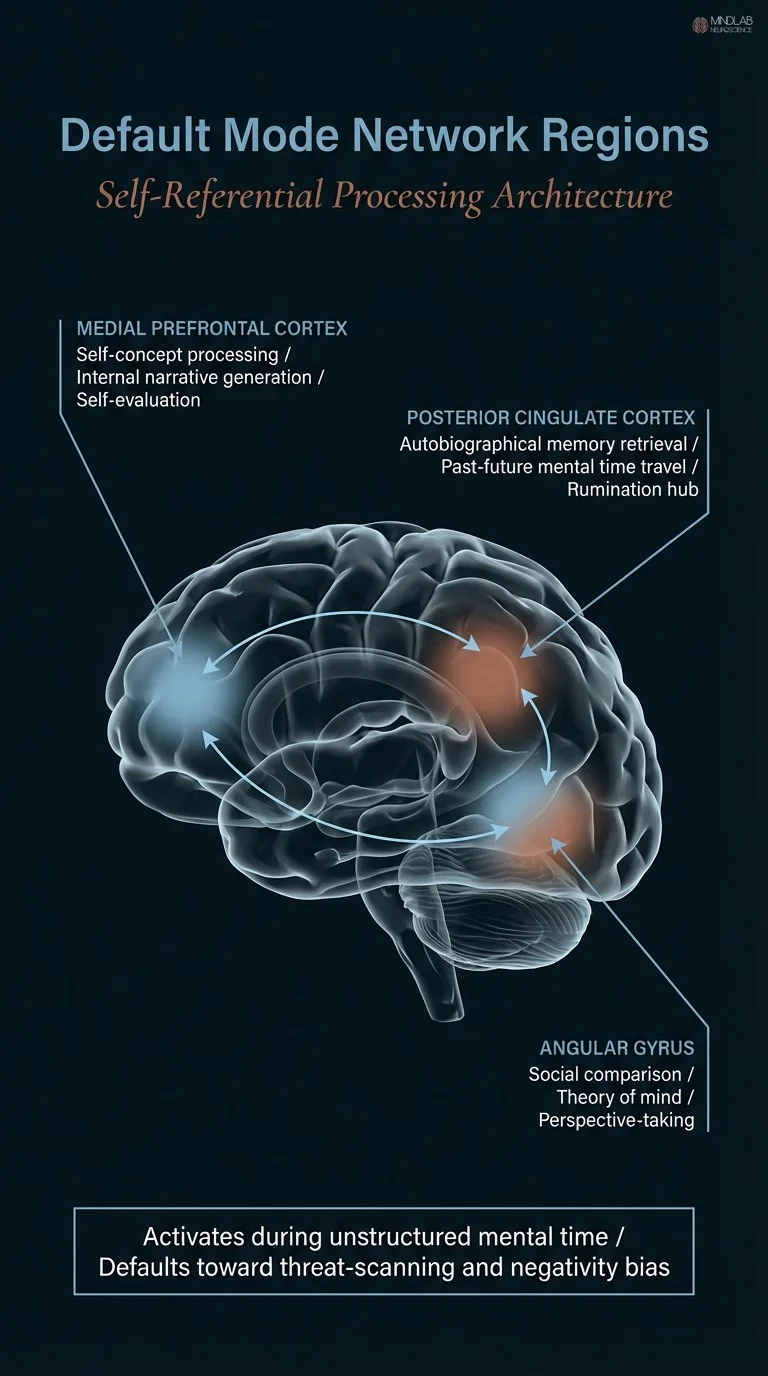
The default mode network, the brain’s resting-state system, preferentially generates negative, self-referential content because it evolved to scan for unresolved problems, threats, and social exclusion risks, not to produce neutral reflection. When you are not actively focused on a task, this network activates automatically and tends to default toward rumination.
The default mode network includes the medial prefrontal cortex, posterior cingulate cortex, and angular gyrus, structures that collectively process self-concept, autobiographical memory, and social comparison. When this network is unchecked, it loops through past regrets and future anxieties, with negativity bias ensuring the threatening content receives the most processing time.
Hamilton and colleagues established that default mode network hyperconnectivity is linked to depressive rumination, providing a landmark meta-analytic model for understanding why some brains are predisposed to negative self-talk during idle moments. In my practice, individuals who describe feeling worst during quiet moments, commutes, before sleep, early morning, are experiencing exactly this: the default mode network running its evolutionary scanning function without a task to interrupt it.
The nuance here is that the default mode network is not pathological. It is performing a function it was designed to perform. The problem arises when an individual’s library of self-referential memories is predominantly negative, giving the network threat-flagged material to cycle through. The intervention point is not to silence the network but to change the content it has available.
The inner critic is, in neurological terms, self-defeating: it undermines the cognitive machinery required to evaluate and correct the very behaviors it targets.
Can Negative Self-Talk Physically Change Your Brain Structure?
Chronic negative self-talk produces measurable structural changes in the brain, most notably a reduction in prefrontal cortex gray matter density, enlarged amygdala volume, and altered hippocampal architecture, changes that compound over time and increase vulnerability to depression and anxiety.
This is not metaphor. Neuroimaging studies have shown that sustained psychological stress, including the stress generated by chronic self-criticism, alters brain morphology. The hippocampus, which is critical for memory consolidation and stress regulation, is particularly sensitive to cortisol exposure. Prolonged cortisol elevation, driven by the brain’s threat response to self-critical thought, accelerates hippocampal cell loss.
Price and Duman documented that neuroplasticity mechanisms in cognitive and psychological processes are altered by chronic stress, with prefrontal deficits and negative cognitive biases becoming structurally encoded. In my practice, the most important piece of information I can give someone early in our work together is that this is reversible, but only with consistent, targeted intervention.
Individuals navigating high-stakes decisions often carry years of internalized performance criticism that has quietly reshaped their neural architecture. The self-doubt that feels like a personality trait is frequently a structural adaptation, one that can be restructured through deliberate, evidence-based methodology, but not through willpower alone.
How Does the Inner Critic Hijack Your Prefrontal Cortex?
The inner critic impairs prefrontal cortex function by triggering amygdala hyperactivation, which floods the prefrontal region with excess catecholamines and reduces its capacity for rational evaluation, planning, and impulse regulation, effectively taking offline the brain system you need most when facing a challenge.
When the inner critic fires, the excessive norepinephrine released during the stress response, amplified by cortisol, is directly harmful to the prefrontal cortex at high concentrations. The result is a temporary but significant degradation in executive function: decision quality drops, working memory narrows, and the capacity to evaluate the inner critic’s claims rationally is compromised at the very moment you most need it.
Chou and colleagues found that default mode network activation in the medial prefrontal cortex correlates directly with rumination and depression vulnerability, confirming that the brain regions processing self-criticism overlap with those required for executive regulation. In my practice, this explains a pattern I observe consistently: the more critical the internal voice becomes about a performance or decision, the less capable the individual is of accurately assessing whether the criticism is warranted.
The inner critic is, in neurological terms, self-defeating. It undermines the cognitive machinery required to evaluate and correct the very behaviors it targets.
What Is the Connection Between Rumination and Depression?
Rumination, the repetitive, passive focus on distress and its causes, is not merely a symptom of depression but a causal mechanism that drives depression onset and relapse by entraining self-critical neural circuits, suppressing hippocampal neurogenesis, and locking the brain into a default mode network loop that becomes increasingly difficult to interrupt. For a deeper look, see what the research reveals about depersonalization causes symptoms.
The relationship between rumination and depression is bidirectional but not symmetrical. Rumination predicts the onset of depressive episodes even in individuals with no prior history. It amplifies and prolongs emotional distress rather than resolving it, because the neural circuits activated during rumination reinforce themselves through repeated activation.
Zhou and colleagues conducted a meta-analysis of 14 neuroimaging studies on rumination and the default mode network, confirming the involvement of the dorsal medial prefrontal cortex subsystem and establishing that rumination-prone brains show distinct connectivity signatures at rest. In my practice, the shift that most reliably changes this trajectory is not thought suppression, which is neurologically counterproductive, but pattern interruption followed by deliberate redirection toward constructive processing.
The caveat is precision: not all repetitive thinking is rumination. Problem-solving, even when it circles the same issue, engages the prefrontal cortex actively and produces measurable progress. The distinction is whether the repetitive thinking is passive and self-condemning or active and generative.
A single critical thought is recoverable. A pattern, tens of thousands of negative self-referential thoughts repeated over months, begins to carve grooves into the neural architecture.

How Does Neuroplasticity Allow You to Rewire Negative Thought Patterns?
Neuroplasticity, the brain’s lifelong capacity to reorganize its synaptic connections in response to experience, makes the rewiring of negative thought patterns neurologically predictable: every time a new response is practiced in place of a habitual self-critical reaction, the neural pathway supporting that new response is strengthened while the old one is gradually pruned through disuse.
The mechanism is Hebbian: neurons that fire together wire together. The negative self-talk loop is not a character flaw: it is an overlearned neural circuit that has been reinforced thousands of times. Rewiring it requires the same mechanism that built it: repetition. The difference is that deliberate, structured repetition of new cognitive responses recruits the prefrontal cortex, which gives the new pathway executive support and makes consolidation faster.
A comprehensive review of default mode network development has shown that the network’s self-referential processing is shaped by experience across the lifespan and remains responsive to restructuring interventions. In my practice, the individuals who progress most reliably are those who understand they are not trying to think positively: they are practicing a new neural pattern until it becomes the default.
What the research doesn’t fully capture is the motivational architecture required. Neuroplasticity is not passive. It demands deliberate effort, consistency, and a methodology structured enough to work with the brain’s learning mechanisms rather than against them.
How Does Childhood Experience Shape the Adult Inner Critic?
The adult inner critic is not generated spontaneously: it is the product of early relational experience that shaped the developing brain’s self-referential circuitry during periods of maximum plasticity, when the neural architecture for self-evaluation was being constructed from the responses of caregivers, peers, and authority figures.
During childhood and adolescence, the brain’s self-concept circuits are extraordinarily sensitive to reflected appraisal, the process of constructing self-understanding from how others respond to you. Critical, dismissive, or inconsistent feedback during these periods does not simply create negative memories. It builds the actual neural circuits through which self-evaluation will be conducted for decades. The medial prefrontal cortex, which processes self-referential information, is literally shaped by these early inputs.
In my practice, I consistently find that the inner critic’s specific vocabulary, the exact phrases it uses, the particular domains it targets, the conditions under which it activates, maps with remarkable precision onto early relational experiences. An individual whose inner critic fires hardest around professional performance often had formative experiences in which their worth was contingent on achievement. Someone whose self-criticism centers on relational adequacy typically carries early attachment patterns in which emotional needs were met inconsistently. The circuit was built to solve a specific problem, maintaining connection with important figures by anticipating their criticism before it arrived.
Understanding this origin does not change the circuit. What changes it is systematic restructuring of the neural patterns that were consolidated during those formative periods, a process that requires working within the emotional states that activate the original architecture, not discussing them retrospectively from a position of calm.
What Strategies Actually Interrupt the Neural Loop of Self-Criticism?
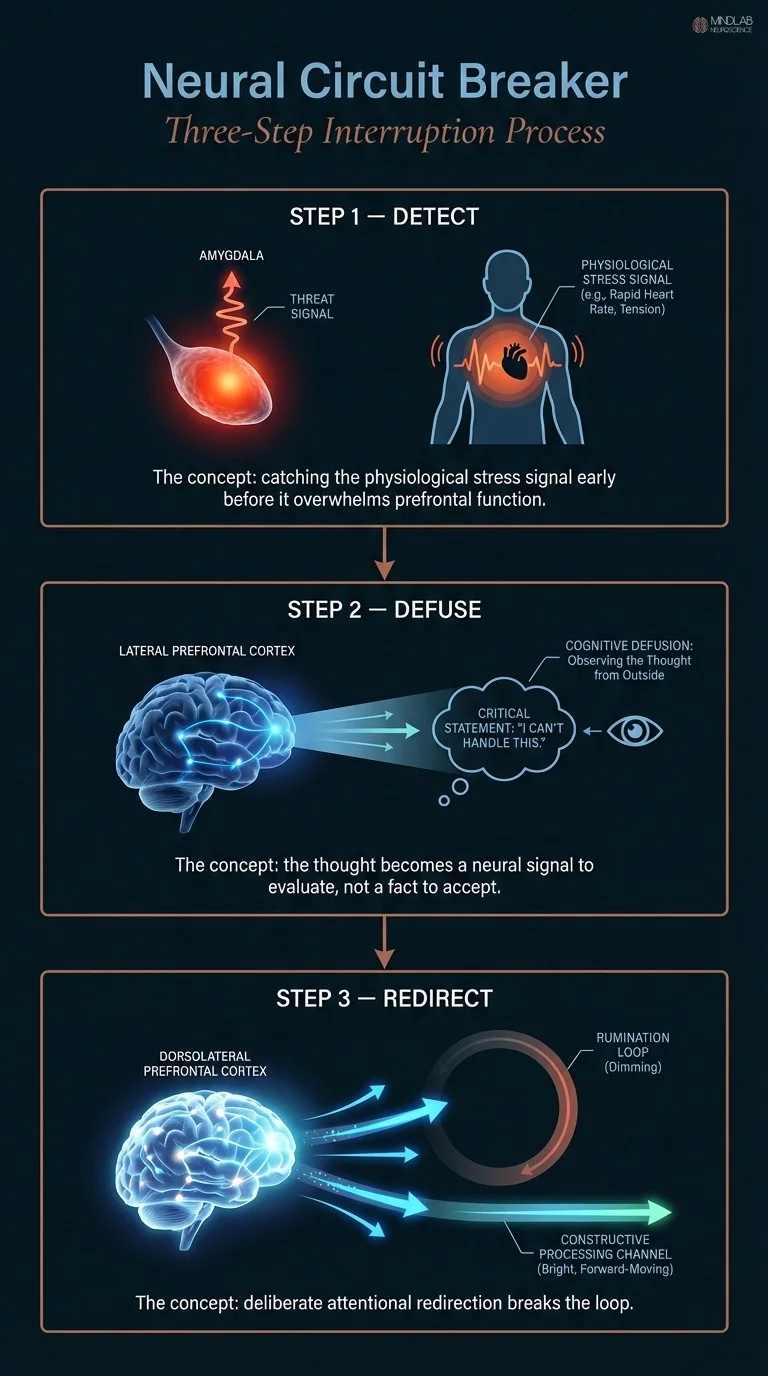
The neural loop of self-criticism is interrupted most effectively by strategies that activate the prefrontal cortex, specifically, cognitive defusion, self-distancing reappraisal, and deliberate attentional redirection, because these techniques directly counteract the amygdala-driven suppression of executive function that allows the loop to perpetuate. This pattern is examined in the brain science of anxiety paradoxical intention.
When someone is locked in self-critical rumination, the prefrontal cortex is compromised. Any strategy that re-engages it creates a circuit breaker. Cognitive defusion, observing a thought as a mental event rather than identifying with it, activates the lateral prefrontal cortex and disrupts the sense that the critical thought is a fact rather than a neural signal. Self-distancing reappraisal, which involves mentally stepping back and considering the situation from a slight remove, reduces amygdala activation and improves emotional regulation.
The key caveat is that these strategies require practice before they become accessible under pressure. A technique learned in a calm state must be rehearsed repeatedly to be available when the amygdala is activated and excessive catecholamine signaling, amplified by cortisol, is degrading prefrontal function. This is precisely why Real-Time Neuroplasticity™ intervenes during the live moment, when the relevant circuits are firing and the brain is biologically primed for restructuring. The window for intervention is real, but it requires preparation and the right methodology for neural pattern restructuring.
Why does negative self-talk feel so much more believable than positive thoughts?
Negative self-talk feels more credible than positive thoughts because the brain’s negativity bias, an evolutionary adaptation that prioritizes threat-relevant information, assigns greater processing weight, emotional intensity, and memory consolidation to negative self-referential content. The amygdala processes threatening information faster than the prefrontal cortex can evaluate it, creating a temporal window in which the critical thought feels like established fact before rational assessment has even begun. This is a processing asymmetry, not an indication that the negative content is more accurate.
Can you completely eliminate negative self-talk?
Complete elimination of negative self-talk is neither neurologically possible nor desirable: the brain’s self-monitoring system serves a legitimate function in detecting errors, evaluating performance, and maintaining social awareness. The goal of neural restructuring is not silence but recalibration: shifting the default mode network’s self-referential processing from threat-scanning rumination to accurate, proportionate self-assessment. The individual learns to experience self-critical thoughts as signals to evaluate rather than verdicts to accept, fundamentally changing the relationship with the inner voice without attempting to abolish it.
How long does it take to rewire negative thinking patterns?
Measurable changes in brain connectivity patterns associated with negative self-talk appear within four to eight weeks of consistent, structured practice targeting the specific neural circuits involved. Behavioral shifts (reduced frequency and intensity of self-critical episodes, faster recovery when they occur, improved capacity to interrupt the rumination loop) typically emerge within the same timeframe. Durable architectural changes that persist independently of ongoing practice require three to six months of sustained neural restructuring, with the timeline depending on how deeply the pattern has been consolidated.
Does negative self-talk affect physical health?
Chronic negative self-talk produces sustained activation of the hypothalamic-pituitary-adrenal stress axis, generating elevated cortisol levels that directly affect cardiovascular function, immune response, digestive health, and sleep architecture. The brain’s threat response to self-critical thought is physiologically identical to its response to external stress: cortisol, norepinephrine, and inflammatory markers rise regardless of whether the threat originates from the environment or from an internal narrative. Over time, this chronic stress activation contributes to systemic inflammation, impaired immune function, and increased vulnerability to stress-related physical conditions.
References
- Gross, J. J. (2015). Emotion regulation: Current status and future prospects. Psychological Inquiry, 26(1), 1-26. https://doi.org/10.1080/1047840X.2014.940781
- Ochsner, K. N., and Gross, J. J. (2005). The cognitive control of emotion. Trends in Cognitive Sciences, 9(5), 242-249. https://doi.org/10.1016/j.tics.2005.03.010
- Davidson, R. J. (2000). Affective style, psychopathology, and resilience: Brain mechanisms and plasticity. American Psychologist, 55(11), 1196-1214. https://doi.org/10.1037/0003-066X.55.11.1196
- Etkin, A., Büchel, C., and Gross, J. J. (2015). The neural bases of emotion regulation. Nature Reviews Neuroscience, 16(11), 693-700. https://doi.org/10.1038/nrn4044
- McEwen, B. S. (2007). Physiology and neurobiology of stress and adaptation: Central role of the brain. Physiological Reviews, 87(3), 873-904. https://doi.org/10.1152/physrev.00041.2006
- Arnsten, A. F. T. (2009). Stress signalling pathways that impair prefrontal cortex structure and function. Nature Reviews Neuroscience, 10(6), 410-422. https://doi.org/10.1038/nrn2648
What the First Conversation Looks Like
When someone reaches out to MindLAB Neuroscience about negative self-talk, they usually describe a voice that has been running unchecked for years, a relentless internal critic that distorts their perception of their own competence, relationships, and potential. The patterns feel permanent because they have been rehearsed so deeply that the brain treats them as established fact rather than distorted interpretation.
Dr. Sydney Ceruto will map the specific neural circuits maintaining your self-critical patterns, identifying where the default mode network is generating rumination, how the amygdala is reinforcing the threat signal, and which prefrontal regulatory connections need strengthening. From that assessment, a structured path forward becomes clear: targeted, measurable, and grounded in the neuroscience of how internal dialogue is actually rewired.