

Key Takeaways
- Every shift between unrelated tasks comes with a switching cost.
- The dorsolateral prefrontal cortex (dlPFC) holds working memory for the task while inhibiting competing demands.
- Compartmentalization is not avoidance: it deliberately contains cognitive demands rather than suppressing emotions.
- Many leaders compartmentalize to keep performing across multiple domains.
- Chronic stress, sleep deprivation, or emotional overload breaks compartmentalization: that is prefrontal fatigue, not laziness.
Why Your Brain Needs Compartmentalization, and What Happens When It Fails
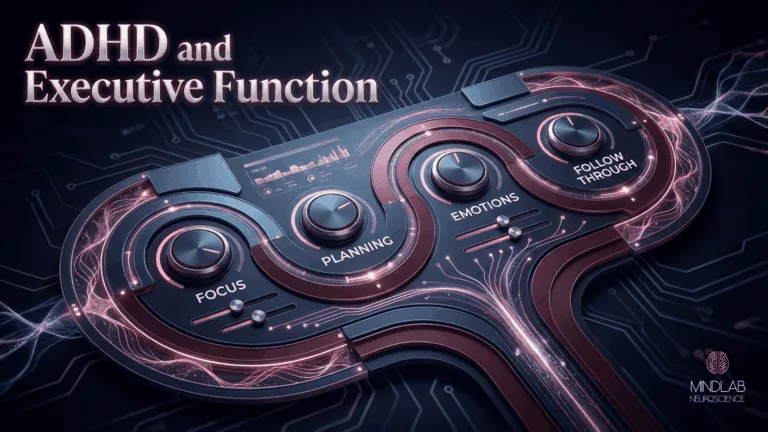
Compartmentalization gives the brain’s prefrontal cortex a mechanism to isolate competing cognitive demands in separate mental workspaces, preventing cross-contamination between domains. When prefrontal regulation fails, work stress, personal conflict, and unresolved emotional load merge into chronic cognitive overload: a state neurologically distinct from burnout that measurably degrades executive function, decision-making accuracy, and sustained attentional control. This skill sits within our broader ADHD and executive function work.
This is not a soft skill. It is a neural competency governed by specific brain regions, neurotransmitter systems, and attentional networks that can be measured, trained, and strengthened. The executives and professionals who come to me at MindLAB Neuroscience rarely lack intelligence or drive. What they lack is the neurological infrastructure to hold multiple high-stakes domains without collapse.
The dorsolateral prefrontal cortex suppresses competing neural activity from irrelevant domains, and chronic stress physically degrades this inhibitory circuitry within weeks.
The science behind compartmentalization reveals why willpower-based approaches to work-life balance consistently fail, and what actually works instead.
Context-switching between unrelated task domains has a cost, which is one reason to separate domains on purpose. For the mechanism behind this, see the Cognitive Architecture pillar overview.
Individuals trained in structured mental compartmentalization, establishing distinct contextual frames for different life domains, show reduced default mode network interference during goal-directed task engagement.
How Does the Brain Manage Compartmentalization?
The brain manages compartmentalization through the executive function network, specifically prefrontal circuits governing attention, working memory, and inhibitory control. The dorsolateral prefrontal cortex (dlPFC) maintains the active mental workspace while suppressing competing neural activity from irrelevant domains. When a person focuses on work despite emotional distress, dlPFC-driven inhibitory control is the underlying mechanism.
Supporting this process is the anterior cingulate cortex (ACC), which monitors for conflict between competing cognitive demands and signals the dlPFC to increase suppression when interference is detected. Research by Liston, McEwen, and Casey, published in Proceedings of the National Academy of Sciences, demonstrated that chronic stress reversibly disrupts this circuit, weakening functional connectivity across the frontoparietal attention network and the inhibitory control that makes compartmentalization possible. This is why stressed individuals report that “everything feels overwhelming”: their neural compartment walls have literally thinned.
I see this pattern regularly in my practice. A client who once moved fluidly between demanding roles (parent, executive, partner) arrives at MindLAB unable to focus on any single one. They usually describe it as burnout or overwhelm. But the underlying mechanism is almost always prefrontal fatigue: the compartmentalization circuitry has been degraded by sustained overload, and the brain can no longer maintain clean separation between domains.

The Neuroscience of Task Switching: Why Context Shifts Drain Your Brain
Task switching has a cost every time the brain shifts from one context to another. Monsell, reviewing the evidence in Trends in Cognitive Sciences, documented these switching costs as real. Frequent context shifts make it harder to stay focused and do high-quality work.
In practice, people who multitask heavily are worn out by evening. So are people who let personal and professional concerns interrupt each other all day. Decision quality degrades. Emotional regulation weakens. Irritability increases. This is why I tell clients that energy management outperforms time management, because the real bottleneck is not hours in the day but glucose in the prefrontal cortex.
The solution is not to eliminate context switching: that is impossible in a complex life. The solution is to reduce unnecessary switches and strengthen the neural infrastructure that handles necessary ones. This is where compartmentalization training becomes critical. Through targeted work on attentional control and executive function, the brain can learn to execute cleaner, faster transitions with lower metabolic cost. The result is not robotic efficiency: it is the ability to be genuinely present wherever you are, because your brain is not bleeding cognitive resources into domains that are not currently relevant.
What Is the Difference Between Compartmentalization and Avoidance?
Compartmentalization and avoidance differ in one neurologically critical way: conscious intent. Healthy compartmentalization requires deliberate prefrontal cortex engagement: the stressor is acknowledged, emotionally registered, and scheduled for later processing. Avoidance suppresses emotional registration entirely. Brain imaging has linked hiding your feelings to more activity in the amygdala.
Avoidance, by contrast, is an amygdala-driven defense mechanism. The stressor is too threatening or painful to process, so the brain shunts it below conscious awareness. The person is not choosing to defer: they are unable to engage. The critical difference is neurological: compartmentalization activates the dlPFC (top-down control), while avoidance activates the amygdala and limbic system (bottom-up defense). One builds cognitive capacity over time. The other erodes it.
In my practice, I consistently observe that clients who believe they are compartmentalizing are often avoiding. The distinguishing marker is what happens when the deferred issue is revisited. Healthy compartmentalizers can access the emotion and engage productively when they choose to. Avoiders experience a surge of anxiety, defensiveness, or cognitive blankness when the topic resurfaces, because the brain never actually processed it; it only buried it. Identifying which pattern is operating is one of the first things I map, because the work for each is fundamentally different.
Compartmentalization as a Leadership Skill
Leaders who sustain high performance across decades demonstrate strong compartmentalization as a core cognitive skill. Prefrontal cortex regulation allows them to process difficult information in one context and lead strategic initiatives hours later without emotional carryover between domains. This capacity reflects disciplined neural inhibition, not emotional coldness or detachment.
I have worked with executives who built extraordinary companies while navigating divorce, parental illness, and personal crises, not by ignoring those realities, but by training their brains to hold them in sequence rather than in parallel. The neuroscience is clear: the human prefrontal cortex is not designed for parallel processing of emotionally loaded tasks. It is designed for serial processing with rapid, clean switching. Leaders who try to hold everything simultaneously are fighting their own neural architecture.
This is why I frame compartmentalization as a leadership competency, not a coping mechanism. The capacity to overcome decision fatigue in leadership depends directly on the brain’s ability to isolate the current decision from the emotional residue of the previous one. Without compartmentalization, every decision carries the accumulated weight of every unresolved concern, and decision quality degrades accordingly.

When Compartmentalization Becomes Harmful
Compartmentalization becomes harmful when the brain uses emotional walling as a permanent avoidance structure rather than a temporary sequencing strategy. Chronic emotional suppression has been linked to poorer health. One 12-year study linked it to higher mortality. That’s one reason to come back to what you’ve set aside.
I watch for specific markers in my clients. If someone reports that they “never think about” a major life event (a loss, a betrayal, a failure) that is not healthy compartmentalization. That is a limbic avoidance structure masquerading as strength. The distinction matters because the intervention is opposite: healthy compartmentalization needs reinforcement and refinement, while avoidance structures need careful, graduated exposure and integration work.
The goal is flexible compartmentalization: the ability to contain when containment serves you, and to open the compartment and process its contents when the time is right. Rigidity in either direction, constant compartmentalization or constant emotional flooding, represents a neural imbalance. Through Real-Time Neuroplasticity™, we train the brain to develop this flexibility: the capacity to choose, in the moment, whether to contain or to engage, based on what the situation actually requires rather than what the amygdala reflexively demands.
Strategies That Actually Strengthen Compartmentalization
Effective compartmentalization requires deliberate neural boundary-setting strategies that reshape prefrontal cortex activity. Approaches to try when one part of life spills into another: transition rituals, temporal blocking, cognitive offloading, and training the prefrontal cortex directly. Structured boundary practices ease the spillover of stress between roles.
Transition rituals. The brain needs a clear signal that one cognitive context is ending and another is beginning. A physical action (changing clothes, a specific route home, a brief period of silence) gives the ACC a concrete marker to trigger the dlPFC’s context switch. Without such a marker, the brain attempts a gradual fade between domains, which is metabolically expensive and usually incomplete.
Temporal blocking. Designating specific times for specific cognitive domains reduces the number of context switches the brain must execute. When a client knows that family concerns will be addressed from 7-8 PM, the dlPFC can suppress intrusive family-related thoughts during the workday with less effort, because the brain trusts that the deferred domain has a scheduled place. This leverages what neuroscientists call the Zeigarnik effect: unfinished tasks create cognitive tension, but scheduling a completion time releases much of that tension.
Cognitive offloading. Writing down a concern, even briefly, transfers it from working memory to external storage. This frees prefrontal resources for the current domain. I recommend this to every client: when an intrusive thought from another domain appears, capture it in writing and return to the current task. The act of writing signals to the brain that the concern has been registered and will not be lost, allowing the dlPFC to release it from active processing.
Training the prefrontal cortex directly. The compartmentalization circuitry, like all neural circuits, strengthens with targeted use. In my work at MindLAB Neuroscience, we identify the specific domains where a client’s compartmentalization breaks down (it is rarely global: most people compartmentalize well in some areas and poorly in others) and design structured interventions to rebuild the circuit precisely where it has failed. This is where understanding flow state through neuroscience becomes practically useful: flow is essentially deep compartmentalization, and the neural conditions that produce it can be engineered.
The Cost of Not Compartmentalizing
The alternative to effective compartmentalization is cognitive bleed: the state in which every domain of life contaminates every other domain simultaneously. Work stress degrades sleep. Poor sleep weakens emotional regulation. Weakened regulation produces conflict in relationships. Relationship conflict intrudes on work performance. The cascade is self-reinforcing, and without intervention, it typically terminates in what most people call burnout.
But burnout is not a clinical label: it is a description of the endpoint of neurological depletion that demands targeted rewiring. The prefrontal cortex has been exhausted by continuous, uncontained cognitive switching. The dopamine system has been depleted by chronic demand without recovery. The amygdala, no longer adequately suppressed by the PFC, begins driving behavior, producing reactivity, irritability, withdrawal, and the characteristic emotional flatness that accompanies burnout.
This is why I consider compartmentalization training to be preventive, not remedial. By the time someone reaches true burnout, the neural infrastructure is already under heavy strain. But strengthening compartmentalization circuits before they degrade, through the strategies above and through targeted neuroscience-based work, is one of the most protective investments a high-performing individual can make.
This article explains the neuroscience underlying compartmentalization and work-life balance. For a personal read, contact MindLAB Neuroscience directly.
What is compartmentalization in psychology?
Compartmentalization is a cognitive process where the brain separates competing thoughts, emotions, and responsibilities into distinct mental workspaces. The dorsolateral prefrontal cortex governs this by maintaining active focus on the current task while inhibiting irrelevant neural activity from other domains. Compartmentalization allows full engagement in one area, such as work, without intrusive interference from another, like personal stress.
Is compartmentalization healthy or harmful?
It depends on how it’s used. Healthy compartmentalization is deliberate sequencing, you acknowledge a stressor, schedule it for later, and consciously redirect focus. Harmful compartmentalization becomes permanent avoidance, walling off emotions that are never processed. The neurological distinction is clear: healthy compartmentalization engages prefrontal cortex top-down control, while avoidance activates amygdala-driven defense mechanisms.
How does the brain manage compartmentalization?
The brain manages compartmentalization through its executive function network, primarily the dorsolateral prefrontal cortex (dlPFC) and the anterior cingulate cortex (ACC). The dlPFC maintains the active mental workspace and suppresses irrelevant competing neural activity. The ACC monitors for conflict between domains and signals the dlPFC to increase inhibition when interference is detected. Chronic stress, sleep deprivation, and sustained cognitive overload can physically impair these circuits, reducing the brain’s compartmentalization capacity.
What is the difference between compartmentalization and avoidance?
Compartmentalization is a top-down prefrontal process, you acknowledge the stressor exists and consciously defer engagement. Avoidance is a bottom-up limbic defense that shunts the stressor below conscious awareness. The distinction becomes clear when the issue resurfaces: compartmentalizers can access and engage it productively, while avoiders experience anxiety, defensiveness, or cognitive blankness because the brain never actually processed the concern.
How can compartmentalization improve work-life balance?
Effective compartmentalization reduces cognitive bleed, the state where every domain of life contaminates every other domain. When people keep work and personal concerns cleanly separate, they tend to ruminate less and have more capacity for whatever they’re doing now. Practical strategies include transition rituals between domains, temporal blocking of responsibilities, and cognitive offloading through writing, all of which reduce the prefrontal switching cost that drives mental exhaustion.
References
- Liston, C., McEwen, B. S., & Casey, B. J. (2009). Psychosocial stress reversibly disrupts prefrontal processing and attentional control. Proceedings of the National Academy of Sciences, 106(3), 912–917. https://doi.org/10.1073/pnas.0807041106
- Monsell, S. (2003). Task switching. Trends in Cognitive Sciences, 7(3), 134–140. https://doi.org/10.1016/S1364-6613(03)00028-7
- Arnsten, A. F. T. (2009). Stress signalling pathways that impair prefrontal cortex structure and function. Nature Reviews Neuroscience, 10(6), 410–422. https://doi.org/10.1038/nrn2648
If your brain has lost its ability to hold competing demands without cross-contamination, if work follows you home and home follows you to work and nothing gets your full attention anymore, that pattern is not a character flaw. It is a prefrontal circuit operating under strain. And circuits can be retrained. Schedule a consultation with Dr. Sydney Ceruto to map what your brain actually needs.
From Reading to Rewiring
Understand the neuroscience. Apply it to your life. Work directly with Dr. Ceruto to build a personalized strategy.
Book Your Consultation