
If you are reading this, there is a good chance you are capable, smart, and exhausted from feeling scattered. You start the day with clear plans. By noon, you are buried under messages, half-finished tasks, and a mind that will not sit still. You may even wonder whether there is something wrong with you or whether you simply never learned to focus in a way that works for your life.
From a neuroscience point of view, your brain is not broken. It is doing exactly what it has been trained to do. Modern life has shaped your attention to jump, scan, and react. No one taught you how to focus in a way that works with your brain instead of against it.
For more than twenty-five years, I have coached founders, executives, traders, physicians, and other high performers whose careers depend on clear thinking. On the surface, they looked in control. Inside, their attention was noisy, fragmented, and easily pulled off course. When we use neuroplasticity and dopamine in a deliberate way, something important changes: learning how to focus stops feeling like a fight and starts feeling like a trainable skill.
Learning how to focus is not about becoming a different person. It is about teaching the brain you already have to work for you, not against it. In this article, I will walk you through how focus works in the brain, why it keeps slipping away, and how to build it back up, step by step. We will look at professional struggles with concentration, what happens in your personal life, how dopamine shapes your attention, how to focus with an ADHD brain, and how to separate procrastination from true attention problems.

Understanding How to Focus in the Brain
Most people think of focus as “trying harder.” In reality, learning how to focus means understanding that attention is a network of brain systems working together. When you understand how those systems function, it becomes easier to see how to focus in a kinder, more realistic way.
The front part of your brain, behind your forehead, is called the prefrontal cortex. You can think of it as the conductor of an orchestra. It holds your goals in mind, decides what matters, and tells other areas what to do next. When this region is supported, you can ignore a buzzing phone, finish an email, and stay with a hard project a little longer. This region is central when you practice focusing on one thing at a time.
Toward the back of your head is the parietal cortex. It helps direct your awareness to things in space: the paragraph you are reading, the face in front of you, and the numbers on the screen. Together, the prefrontal and parietal areas form key attention networks that allow you to concentrate on one target and let the rest fade into the background.
There is also another major network called the default mode network. It becomes active when your mind drifts, daydreams, replays old scenes, or worries about the future. You need this network for creativity and self-reflection. But when it takes over at the wrong time, it pulls you away from the task in front of you and makes knowing how to focus on a single task feel almost impossible.
Learning how to focus your attention is partly about training your brain to switch more smoothly between these networks. You want to be able to lean into task mode when you need to work and then give your brain space to wander when it is time to rest. You are not trying to shut off thoughts. You are learning how to guide them.
Neuroplasticity: Why How to Focus Is Trainable
Neuroplasticity is your brain’s ability to change its wiring and function based on what you do over and over. Every time you repeat a pattern, your brain learns from it. That pattern might be deep, single-task work, or it might be constant multitasking. Either way, your brain is learning how to focus based on what it sees most often.
If you spend your day switching between twelve tabs, scanning your phone, and reacting to every message, your brain gets very good at jumping. If you spend your day in short, protected blocks of real concentration, your brain gets better at holding a stable target. This is the core of how to focus with less effort over time.
Think of it like walking through a field of tall grass. The first time you cross, it is hard. The grass is high, and each step takes effort. If you walk the same path every day, a trail forms. The grass lies flat. Soon, it is the easiest route to take. Your attention works the same way. Every time you gently bring your mind back to one thing, you are stamping down the “focus trail.” Every time you let it scatter, you are stamping down the “distraction trail.”
This is why quick hacks are never enough. A timer or app can help, but what really teaches your brain how to focus is repetition. The goal is not harsh perfection. The goal is hundreds of small moments where you notice your attention drifting, and you guide it back with as little drama as possible. That is where neuroplasticity quietly does its work.

Dopamine and Attention: How to Focus When Tasks Feel Boring
Dopamine is a brain chemical that plays a major role in reward, motivation, and learning. It is not simply a “pleasure chemical.” It is more like a marker that tells your brain, “Pay attention, this matters.” When you understand dopamine, you understand a big part of how to focus in a fast, noisy world.
When dopamine supports your attention networks, it is easier to start tasks, stay with them, and feel a sense of progress. When dopamine is low or poorly timed, even simple tasks can feel heavy, flat, or pointless.
This is why you can fall into a deep, effortless tunnel watching a show you love or talking about a passion project, yet feel blocked by a plain email. Your brain reads one as rewarding and interesting and the other as dull and unrewarding. In those moments, how to focus on the dull task feels out of reach, even though you know what to do.
You cannot control dopamine directly, but you can shape the conditions that influence it:
Small wins. When you break a project into tiny steps and check them off, your brain gets little bursts of “this is working.” Over time, that supports the circuits that help you stay with a task and teaches your brain how to focus for longer stretches.
Clear goals. Your brain focuses more easily when it knows what “done” looks like. Vague tasks like “work on presentation” do not give dopamine much to latch onto. Concrete goals like “outline the three main points” do. This clarity turns the question of how to focus into something your brain can actually answer.
Values and meaning play a significant role in this process. Your brain tags a task as more important when it relates to something you care about, like caring for a loved one, protecting your health, or serving clients. That sense of meaning boosts your willingness to stay present. Your brain learns to focus not just on the task but on the life you want.
Healthy rhythms. Sleep, movement, and nutrition all affect how dopamine is made, released, and reabsorbed. They are not about being “perfectly healthy.” They are about giving your brain the basic fuel it needs so attention is even possible.
Dopamine optimization is not about chasing constant highs. It is about creating a life where your brain expects frequent, honest signals of progress and purpose. When you do that, how to focus on tasks that used to feel pointless becomes much more realistic.
Why Focus Is So Hard at Work
Work is often where struggles with attention hurt the most. You understand what is expected of you. You care about your career. Yet your day fills with shallow tasks, and your deeper work keeps getting pushed to “later.” In these moments, you might blame yourself instead of asking a better question: how to focus in a work culture that never stops pinging you.
Here are a few reasons focus is especially fragile in professional life:
Endless inputs. Email, chats, notifications, and meetings all compete for your eyes. Your brain is forced into a constant state of scanning. This technique trains you to react rather than to stay. With this pattern, you never acquire the conditions you need to practice focusing in a deep, sustained way.
Hidden expectations. Many workplaces reward fast responses more than thoughtful output. You may fear that if you do not reply right away, you will look lazy or unavailable. So you stay in a surface-level loop and never get to the work that actually uses your full brain.
Pressure and perfectionism. When stakes feel high, your nervous system moves into a threat state. In that state, it is much harder to think clearly or settle. Your brain wants to protect you, not help you write the next paragraph of a report. How to focus becomes a question about safety, not just productivity.
No recovery. Long days, late nights, and always being “on call” drain the resources your prefrontal cortex needs. It is like asking a tired runner to sprint over and over without water or rest.
To change this, you do not need to quit your job. You need to adjust the way you move through the workday in small but consistent ways.
You might choose one or two focus blocks each day where you close extra tabs, silence non-emergency notifications, and work on a single piece of meaningful work. You might communicate to your team that you check messages at set times. You might lower the bar for starting: instead of expecting yourself to produce a perfect draft, you commit to a rough outline. These are all practical ways to answer the question of how to focus at work without burning out.
Each of these acts is a signal to your brain: “Deep work matters here.” Over time, your nervous system begins to believe you and support you. Learning how to focus at work is less about willpower and more about training your entire system to regard important work as worthy of protection.

Focus in Your Personal Life
Loss of attention does not only show up at the office. It shows up when you are with your partner but quietly checking your phone. It shows up when your child is talking and your mind drifts to your to-do list. It shows up when you scroll late at night instead of doing the small things that would actually restore you. In these moments, how to focus on the people and moments that matter most becomes a very real and painful question.
At home, the cost is more emotional. You feel less present, less connected, and more distant from your own life.
Your brain does not automatically know that downtime and relationships deserve the same quality of attention as your job. You have to teach it how to focus on love, rest, and joy, not just on deadlines.
You can do this in simple, human ways:
Create device-free pockets. Decide that the first 20 minutes after you arrive home, the dinner table, or the last 20 minutes before sleep are screen-free. Use that time to actually feel where you are and who you are with. This is often where you discover how to focus on connection again.
Practice single-task joy. Choose one small activity each day that you do with full attention: drinking your coffee, walking the dog, listening to a song, or hugging someone you love. Let your senses take over. Notice sights, sounds, and body sensations. This is the focus, too.
Name the moments that matter. When you catch yourself being present—laughing with your partner, really hearing your child, feeling calm in your own skin—say quietly to yourself, “This is what I want more of.” Your brain listens. It will try to return to that state more often.
If you want to learn how to focus better in your personal life, you do not need more rules. You need more moments that feel genuinely good to be inside of. Those moments become natural magnets for your attention.
Real-Life Examples: Focus Struggles at Work and at Home
Sometimes it is easier to understand your own brain when you see it in someone else. Here are two brief examples of how focus problems often show up and how small, science-based changes can help.
Imagine a portfolio manager who spends the entire morning reacting to market news, chat messages, and emails. By the afternoon, their brain feels fried, yet the real work still waits: thinking through risk, making calm decisions, and writing clear notes. Their question was simple: how to focus on high-stakes thinking when the entire environment rewards reactivity.
We started by carving out one protected block early in the day for their deepest thinking, before checking messages. During that time, they shut down market noise, used the 4–2–6 breath, and broke their decisions into small written steps. Within a few weeks, they noticed that their mind felt clearer, decision quality improved, and their need to chase constant updates dropped. Their brain had started to relearn how to focus on what actually moves performance, not just on what screams the loudest.
Now picture a parent who wants to be present with their children but finds themselves half-listening while scrolling on their phone. At the end of the night, they feel guilty and disconnected, even though they were “around” their family for hours. Their quiet question was how to focus on the people they love when their brain has been trained to chase every alert.
Together, we created a simple evening ritual: phones in a drawer during dinner and for 30 minutes after, one shared activity with full attention, and a brief moment before bed to name one good thing from the day. These small steps gave the brain a repeating pattern of calm, rewarding connection. Over time, it became easier and more natural to drop into presence with loved ones. The urge to escape into the phone softened because real life began to feel more satisfying.
In both cases, the change did not come from suddenly becoming more disciplined. It came from understanding what the brain needed, setting up clear cues, and repeating them until new wiring formed. This is the quiet, practical side of how to focus with neuroplasticity and dopamine on your side.
Procrastination vs Lack of Focus
People often confuse procrastination with a simple shortage of attention, but they are not the same thing. Knowing the difference is an important part of learning how to focus wisely.
Lack of focus means your attention drifts easily. You intend to stay with a task, but your mind wanders or outside things pull you away. Once you calm your system and reduce distractions, it becomes easier to stay on track.
Procrastination is more emotional. You delay starting or finishing something, even when the path is clear. Under the surface, there is usually fear, shame, or inner conflict. You might fear doing poorly, being judged, feeling bored, or losing freedom. Pushing the task away protects you from those feelings in the moment.
Here are a few ways to tell which one you are dealing with:
Avoiding a particular project while happily working on other tasks is typically a sign of procrastination rather than a lack of focus.
If you start a task and then keep jumping away to check things, that is more about scattered attention.
If the idea of even opening the file makes your stomach drop, emotion is involved. Your brain is not just unfocused; it is trying to keep you safe from discomfort.
Both patterns change through neuroplasticity, but they need slightly different approaches.
For scattered attention, you work on shaping your environment, calming your nervous system, and practicing short blocks of concentration. You practice how to focus again and again in small, forgiving ways.
For procrastination, you get curious about the feeling under the delay. You might name the fear, lower the stakes by making a tiny first step, or ask, “What would make this feel 10 percent less heavy?” As you practice starting in small, safe ways, your brain learns that doing the thing is less dangerous than avoiding it.
When you can tell procrastination from lack of focus, you know where to aim your efforts. That clarity is a quiet but profound part of learning how to focus in real life.
Common Myths About Focus
Because most people are never taught how attention really works, a lot of myths grow around it. These stories increase shame and make it harder to change. Here are a few that I hear often in my practice.
“My focus should be the same every day.” In real life, attention rises and falls with sleep, hormones, stress, illness, and what is happening around you. Expecting yourself to perform like a machine sets you up to feel like a failure. A more realistic goal is to notice where you are today and choose one or two things that support how to focus from there.
“If I really cared, I would just do it.” Caring and capacity are not the same thing. You can care deeply and still feel stuck, especially if your nervous system is flooded or your brain has learned to link certain tasks with fear or shame. Learning how to focus often starts with lowering judgment, not raising pressure.
“Using tools means I am weak.” Timers, planners, whiteboards, and routines are not crutches. They are external pieces of the brain you build on purpose. Strong performers in every field use structure to protect their attention. The goal is not to prove you can do everything unaided. The goal is to get your best thinking into the world and to protect how to focus on what matters most.
“I have already tried to change, so this is just who I am.” Many people have tried the same strategies over and over: forcing themselves, staying up later, adding more caffeine, or downloading another app. When those do not work, they assume nothing will. In reality, they have not been shown how to work with their biology. When you shift your methods and respect your brain, your results can change too.
Letting go of these myths opens space for a kinder, more accurate approach. You can then learn how to focus based on how your brain actually functions, instead of how you think it “should” behave.

Fast Grounding Tools to Bring Your Attention Back
Occasionally you need a quick reset. Your thoughts are racing, you have five tabs open, and you can feel your attention slipping. In those moments, complicated systems will not help. Your brain needs something simple and physical to restore your ability to focus in the next few minutes.
Here are three grounding tools you can use almost anywhere:
The 4–2–6 breath. Inhale through your nose for a count of four. Hold for two. Exhale slowly through your mouth for a count of six. Do this three to five times. The long exhale tells your nervous system, “We are not in danger.” It is much easier to direct your attention once your body is calmer.
The five-sense scan. Pause and name three things you see, two things you can feel (like your feet on the floor or your back on the chair), and one sound you can hear. This moves you from the swirl of thoughts back into the present moment, which is where you actually practice how to focus.
The one-sentence plan. Write down a single, clear sentence about what you will do next. “For the next ten minutes, I will only write the first part of this email.” When your attention tries to drift, gently point it back to that sentence.
These tools are not about being perfect. They are about giving your brain a clean slate so you can choose your next step with more clarity. When used often, they become tiny anchors that support how to focus again after life has pulled you away.
Setting Up a Brain-Friendly Environment
Attention does not live in your head alone. It lives in your surroundings too. The more friction in your environment, the harder your prefrontal cortex has to work every time you try to remember how to focus.
You can make things easier on yourself with a few simple changes:
Clear the immediate area. You do not need a spotless home or office. But the space right in front of you should match the task. If you are writing, put away unrelated papers. If you are planning, keep only your planner and pen out.
Choose a focus signal. Create a small ritual that tells your brain, “We are settling now.” It could be putting on the same pair of headphones, lighting a candle, or placing your phone out of sight. Repeating this ritual turns it into a cue for your nervous system that it is time to practice how to focus.
Protect small islands of quiet. You may not be able to control your entire day. But you can often protect 20–40 minute islands of time. Close non-essential tabs, silence notifications, and commit to one task at a time during those windows. These islands become your training ground for how to focus.
Respect natural cycles. Few people can concentrate deeply for hours on end. Many do best in 25–50 minute blocks with short breaks. During breaks, move your body, look at something far away, or breathe. Avoid filling the break with more screen stimulation.
These are not fancy tricks. They are small acts of kindness toward your future self. Each time you make it easier to do the right thing, you are teaching your brain how to focus with less resistance.
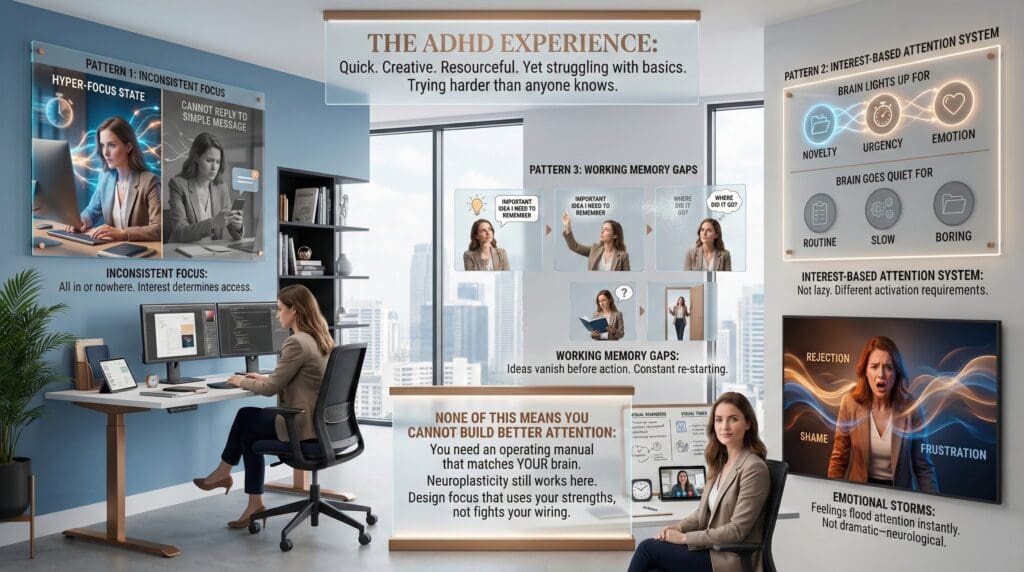
How an ADHD Brain Experiences Focus
If you live with ADHD, all of this can feel more intense. You may be quick, creative, and resourceful, yet still feel unable to do basic things on time. You might have been told your whole life to “just try harder,” even though you are trying much harder than most people every single day. It can make the phrase “how to focus” feel like a cruel joke instead of a real possibility.
An ADHD brain usually has:
Inconsistent focus. You can hyper-focus on something that interests you and then be unable to reply to a simple message.
An interest-based attention system. Your brain lights up for novelty, urgency, and emotion. It goes quiet for routine, slow, or boring tasks, even if they are important.
Working memory gaps. Ideas slip away before you can act on them. You forget what you just read. You walk into a room and immediately lose the reason you are there.
Emotional storms. Feelings like rejection, shame, or frustration can grab your entire attention in seconds.
None of this means you cannot build better attention. It means you need an operating manual that matches your brain. Neuroplasticity still works here. You simply have to design how to focus in a way that uses your brain’s strengths instead of fighting its wiring.

ADHD-Friendly Ways to Support Attention
Use interest, urgency, and meaning on purpose. Pair low-interest tasks with elements that add stimulation: a favorite playlist, a friendly race against a timer, or a co-working session with someone else. Before you start, remind yourself why the task matters to your future self, not just to your boss. This helps your brain link how to focus with something that truly matters to you.
Externalize everything you can. Do not expect your brain to hold the plan. Write it down. Use a whiteboard, a notebook, or a simple app. Break projects into small, obvious steps, and keep the very next step where you can see it. This makes it easier to know how to focus on the next action rather than the entire project.
Add movement. Many ADHD brains settle better when the body is not rigid. Stand, pace, stretch, or use a fidget while you think. Short bursts of movement between focus blocks give your nervous system a way to discharge energy, making it easier to remember how to focus when you sit back down.
Try body doubling. Work at the same time as another person, either in person or on video. You do not need to talk. The shared presence creates a light sense of structure that can make it easier to stay with what you are doing.
Shrink the starting line. Instead of “work on the report,” commit to opening the file and writing one messy sentence. Once you begin, your brain often finds it easier to keep going. Over time, this practice teaches your ADHD brain how to focus on starting instead of waiting for the perfect moment.
Most of all, replace self-attack with curiosity. When you understand that ADHD is a difference in how your brain regulates attention, not a failure of character, you can stop fighting yourself and start designing support. That shift alone begins to change how focus feels in your daily life.
Daily Habits That Strengthen Focus
Big changes in attention grow out of small, repeatable habits. You do not have to overhaul your entire life. Choose a few of these and practice them with kindness. They are simple, but each one trains your brain in how to focus a little more reliably.
Sleep at consistent times. Your brain needs rhythm. Going to bed and waking up at roughly the same time each day gives your attention systems a stable base.
Move your body. You do not need intense workouts. Regular walks, light strength training, or any movement you enjoy increase blood flow to the brain and support clear thinking. Movement is one of the easiest ways to prepare your brain for how to focus in the next hour.
Practice short moments of awareness. Take five minutes a day to sit quietly and notice your breath, sounds, or body sensations. When your mind wanders, gently bring it back. This simple practice teaches your brain that it can return to the present without drama. You are literally rehearsing how to focus in a calm, low-stakes way.
Do one thing at a time twice a day. Pick two small tasks, such as washing dishes, answering a few emails, or folding laundry, and do them without switching to anything else. These are real “reps” for your attention circuits.
Give yourself real off time. Choose windows where you are not trying to be productive at all. Read for pleasure, be outside, or connect with someone you care about. Rest is not a reward for having perfect focus. It is part of the way your brain learns to show up when you ask it to. When you recover well, it becomes much easier to remember how to focus when it matters.
These habits are not flashy, but they are powerful. Each day you practice them, you are gently training how to focus across every area of your life.

A Gentle 30-Day Practice Plan
To create lasting change, you need repetition over time. Here is a simple 30-day plan you can adapt to your life. It is not about doing it perfectly. It is about showing up more often than not and giving your brain many chances to practice how to focus in small ways.
Days 1–7: Notice and name. Once or twice a day, do a 10-minute block of single-task work. Before you start, take a few slow breaths. When your attention wanders, say quietly, “coming back,” and return to the task. At the end of the day, write down one pattern you noticed about your attention. You are learning how to focus by simply watching your mind without judgment.
Occasionally Days 8–14: Shape your space. Choose one place where you often work. Clear the surface. Pick a small ritual that signals it is time to settle. Protect at least one 20-minute block each day in this space with notifications off. During that time, answer one question only: how to focus on the single task in front of me, not on everything at once.
Days 15–21: Link focus to meaning. Choose one piece of work or life project that actually matters to you. Once per day, give it a focus block. Before each block, write one sentence about why it matters. This helps your brain stay with it when it gets hard. You are teaching yourself how to focus on what is truly important, not just what feels urgent.
Days 22–30: Build identity. Each evening, write down one way you showed up as someone who cares about the quality of their attention. It can be as simple as “I put my phone away during dinner” or “I finished a small task instead of scrolling.” You are teaching your brain, “This is who I am now. I am someone who knows how to focus and protect my attention.”
By the end of 30 days, you will still be human. You will still have messy days. But if you follow this plan with even moderate consistency, your brain will have dozens of new experiences of steady, grounded attention. Those experiences are the raw material neuroplasticity uses to build change and refine how to focus in a sustainable way.

Frequently Asked Questions
Why do some people seem naturally focused while I struggle so much?
You do not see the full story of other people’s lives: their sleep, stress levels, nervous systems, or support. Many who look calm on the surface are fighting the same battles you are. Your brain may also be more sensitive to stimulation or threat. That is not a flaw. It simply means you need clearer systems and more care as you learn how to focus in a way that fits you.
How long does it take to see changes in my attention?
Most people notice small shifts within a couple of weeks: starting tasks a bit sooner, feeling less pulled by every alert, or coming back more quickly after distractions. Deeper changes build over months as your brain’s networks adapt. The key is not speed. The key is steady practice in how to focus, even when it feels imperfect.
What if I have tried everything and nothing works?
You probably have not tried everything. You have tried many things that were not designed for your nervous system. If your struggles are intense, it can help to work with a professional who understands both u003ca href=u0022https://mindlabneuroscience.com/adhd-neuroscience-based-treatment-coaching/u0022u003eneuroscience and behavioru003c/au003e. Seeking help instead of white-knuckling life can be so freeing. Together, you can build a personal, science-based approach to how to focus that honors your history.
Can I really change my brain as an adult?
Yes. While the brain is most flexible in childhood, adults can and do create significant change. Every time you practice calming your body, simplifying your environment, and staying with one thing a little longer, you are inviting your brain to build new patterns. Adult neuroplasticity is slower, but it is real, and it responds to how you focus your time and energy.
What is the single most important thing I can do?
Be kind and consistent. There is no perfect system. There is only the next small step you are willing to take today. When you practice returning your attention, even after it has wandered a hundred times, you are training your brain in the direction you want it to go. That is the real heart of how to focus using neuroplasticity.
Final Thoughts
Your ability to pay attention is not a moral scorecard. It is a living, changing process inside a very human brain that has been pushed past its limits for a long time.
When you understand what is happening in your nervous system, you can stop telling yourself harsh stories and start working with your biology. By shaping your environment, honoring your need for rest, using dopamine wisely, and practicing short, honest moments of presence, you slowly build a brain that trusts itself again and remembers how to focus when you need it most.
You do not have to transform your life overnight. You only have to be willing, today, to notice where your attention goes and gently guide it a little closer to where you actually want to be. Each gentle redirection is one more answer to the question of how to focus, not just for today, but for the rest of your life.
#howtofocus #neuroplasticity #attention #focus #brainhealth #neurosciencecoaching #ADHD #dopamine
This article is part of our ADHD & Executive Function collection. Explore the full series for deeper insights into adhd & executive function.