
Key Takeaways
- ADHD is not a shortage of focus capacity. It is a signal-access problem.
- Hyperfocus proves the capacity exists; what fails is access on demand.
- Standard focus advice assumes a dopamine baseline an ADHD brain cannot supply.
- Neuroplasticity strengthens the circuit without requiring the brain to become neurotypical.
- Designing conditions that generate the signal outperforms trying to force attention.
Focusing with ADHD is not a matter of building attention you do not have. The attention is already there, and hyperfocus is the proof. What an ADHD brain cannot do reliably is summon the dopamine signal that tells the prefrontal cortex which task matters right now. Neuroplasticity changes that circuit, but only when the work is aimed at supplying the signal rather than at trying harder without it. That single distinction decides whether every strategy you have tried helps you or quietly makes things worse.
For more than 26 years, I have worked with people whose work depends on clear thinking and whose attention had stopped cooperating. The ones with ADHD are almost never under-trying. They arrive having applied more effort to attention than anyone around them realizes, using methods built for a brain that runs on a different signal.
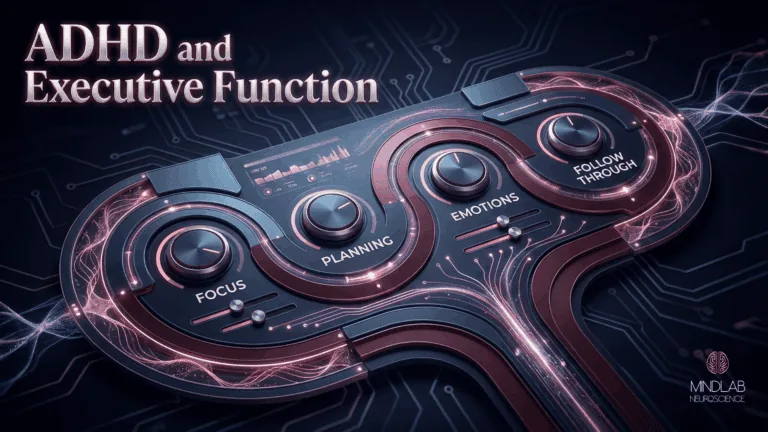
How this series fits together: This article explains why ADHD attention behaves the way it does and what actually changes the circuit. For the broader architecture underneath it, read our work on ADHD and executive function.
The ADHD brain is not unfocused. It is selectively focused on whatever the dopamine system has already decided is worth attending to.
Why can an ADHD brain hyperfocus for hours but not start a ten-minute task?
Because the signal arrives on its own for some work and never for the rest, and what separates them is not how much the task matters. A task you find absorbing produces it. So does a deadline close enough to feel real. Hyperfocus is the brain running on a signal that showed up unasked; the ten-minute task produces none.
This is the reframe that changes what people do next. Attention is not a fuel tank that ADHD brains are born short of. It is a routing decision, and in ADHD the routing runs on a signal that arrives unpredictably. Volkow and colleagues found reduced dopamine receptor and transporter availability in the reward pathway of adults with ADHD, and proposed it as a contributor to the motivation deficits that make generated-motivation tasks behave so differently from tasks that supply their own (Volkow et al., 2009).

What hyperfocus actually proves
It proves the machinery is intact. Sustained attention, working memory under load, resistance to interruption, hours of unbroken depth: an ADHD brain in hyperfocus does all of it, often better than a neurotypical brain does deliberately. Nothing is missing. The constraint sits entirely on the volitional side.
I point this out early with almost every ADHD client, because most of them have spent years assembling evidence that they are lazy or unserious. Hyperfocus is the counter-evidence they already own and have never counted. Once someone accepts that the capacity is demonstrably present, the question stops being how to become a person who can focus and starts being how to get the signal to show up for the things that matter. That is a solvable engineering problem. The first version was not.
What is dopamine actually doing in an ADHD attention system?
It is tagging relevance, not producing pleasure. Dopamine marks what deserves pursuit, and the prefrontal cortex uses that tag to decide where attention goes. Berridge and Robinson separated two functions popular writing merges: dopamine drives wanting, the pull toward a cue, while liking depends on a separate system dopamine does not drive (Berridge and Robinson, 1998).
That distinction is not academic when you have ADHD. It explains why you can genuinely enjoy a task and still be unable to begin it. Liking it was never the constraint. The pull was.
The system is also predictive rather than reactive. Schultz, Dayan and Montague established the pattern: midbrain dopamine neurons fire hardest for reward that was not expected, settle once reward becomes fully predictable, and dip below baseline when an expected reward fails to arrive. Run that through a working week and the pattern in ADHD becomes obvious: the novel project pulls hard, the same project three weeks in pulls almost nothing, and the routine obligation that never produced a surprise in its life pulls nothing at all. This is the attention network doing exactly what it was built to do, on an input that happens to be scarce.
Why interest is not the same as importance
Importance is a judgment the prefrontal cortex makes. Interest is a signal the reward system sends. In a neurotypical brain the judgment can recruit the signal well enough to start the work. In ADHD that recruitment is unreliable, so a task can be objectively critical, consciously understood as critical, and still generate nothing to act on.
Volkow, Wise and Baler, writing on the dopamine motive system in the context of addiction, make the same correction from the other direction: dopamine sets what you move toward, not what you enjoy once you arrive.
This is the mechanism behind the most painful ADHD experience I encounter: caring intensely about something and being unable to move toward it. Clients describe it as a betrayal by their own mind. It is closer to a translation failure. The value is registered in one system and the fuel is issued by another, and in ADHD the message between them arrives late, faint, or not at all. When dopamine supports the attention networks the translation happens invisibly. When it does not, willpower is being asked to do a job it was never the mechanism for.
The problem was never that you lacked discipline. It was that the advice assumed a signal your brain does not reliably send.
Why does standard focus advice fail an ADHD brain?
Because nearly all of it assumes the signal arrives on schedule and only needs protecting. Time-blocking, distraction elimination and priority lists are built for a brain that converts a decision into engagement. They do not supply that missing conversion step, so applying them harder produces effort without traction, and then a verdict about your character.
The table below is the version I draw for clients, because seeing the assumption written down is usually the moment the self-blame breaks.
| Strategy | What It Assumes | Why It Fails for ADHD | ADHD-Compatible Alternative |
|---|---|---|---|
| Time-blocking | Consistent attention during assigned slots | ADHD attention is signal-dependent, not schedule-dependent | Pair the block with something absorbing, or a deadline that feels real |
| Eliminating all distractions | Fewer stimuli means more focus | An under-stimulated ADHD brain seeks input; silence increases restlessness | Provide controlled stimulation such as music, movement, or a visible countdown |
| Willpower extension | Discipline sustains focus past the natural drop-off | The prefrontal cortex is already compensating; forced effort depletes faster | Shorter, higher-intensity bursts with deliberate recovery |
| Priority-based task lists | Importance drives engagement | Engagement follows whatever generates the signal, which ranking rarely does | Build interest or urgency into the task itself, not the list |
What makes this sharply worse at work
Two workplace conditions make this sharply worse. The first is a culture that rewards fast replies over finished thinking, which keeps an ADHD brain in the shallow loop where novelty is constant and depth never starts. The second is the absence of recovery: long days with no off-time deplete the prefrontal resources that ADHD is already spending at a premium.
Neither is fixed by quitting. Both respond to changing how the working day is structured rather than how hard it is attacked.
The myth that does the most damage is that using structure is a form of weakness. Timers, whiteboards, visible next-steps and external checkpoints are not crutches. They are the parts of executive function deliberately moved outside the skull, where an ADHD brain can actually reach them. The professionals who sustain the highest output are almost uniformly the ones who externalized the most.
Why every method collapses after a few weeks
What brings most people to me is not one failed method but a series of them, each working briefly and then collapsing. One client described the years before we found what was driving it. Whether or not that pattern carries an ADHD label, the mechanism underneath is the one this article is about:
Every system, every supplement, every productivity method I tried collapsed within weeks, and nothing held because nothing addressed why my attention kept fragmenting. Dr. Ceruto identified the dopamine regulation pattern that was hijacking my prefrontal cortex every time I needed sustained focus. She didn’t give me another workaround. She restructured the architecture underneath. My brain holds now. That’s not something I ever thought I’d be able to say.
Derek S.

Is it ADHD inattention or is it avoidance?
They produce the same missed deadline and need opposite responses. Inattention is a signal failure: you begin, and your attention leaves. Avoidance is emotional: you do not begin, because starting means contact with something uncomfortable. Applying a focus strategy to avoidance fails every time, and it is the single most common misdirection I see in ADHD work.
Three tells separate them quickly. If you happily do other demanding work while one specific task sits untouched, that is avoidance rather than an attention problem. If you start and then keep leaving, that is scattered attention. If merely opening the file produces a physical drop in your stomach, emotion is doing the driving and no amount of environmental design will reach it.
ADHD complicates this because it produces both, and the two feed each other. Years of missed commitments build a reliable association between certain tasks and shame, and shame is precisely the state that freezes decision-making before it starts. So the task now carries an emotional charge on top of a signal deficit. Approaching that as a focus problem addresses the smaller half.
The practical split I use: if the difficulty is starting, work on the emotional charge and shrink the first action until it is too small to trigger anything. If the difficulty is staying, work on the signal and the environment. Getting this backwards wastes months, and most people arrive having gotten it backwards for years.

How do you design conditions that supply the signal instead of forcing it?
By arranging the work so the signal is already present before you need to begin, and by doing it in an order where each step makes the next one possible. The individual moves are ordinary and you have met all of them. The sequence is the part that decides whether they hold past week one.
I am specific about order because the failures are so consistent. Almost everyone who tells me environmental design did not work for them ran these steps as a checklist, in whatever order the advice happened to list them, and each one quietly undid the one before it. The steps are not independent. Run backwards, they actively teach the brain the opposite of what you intended, which is why the same five tactics produce a durable system for one person and two frustrated weeks for another.
The order that matters
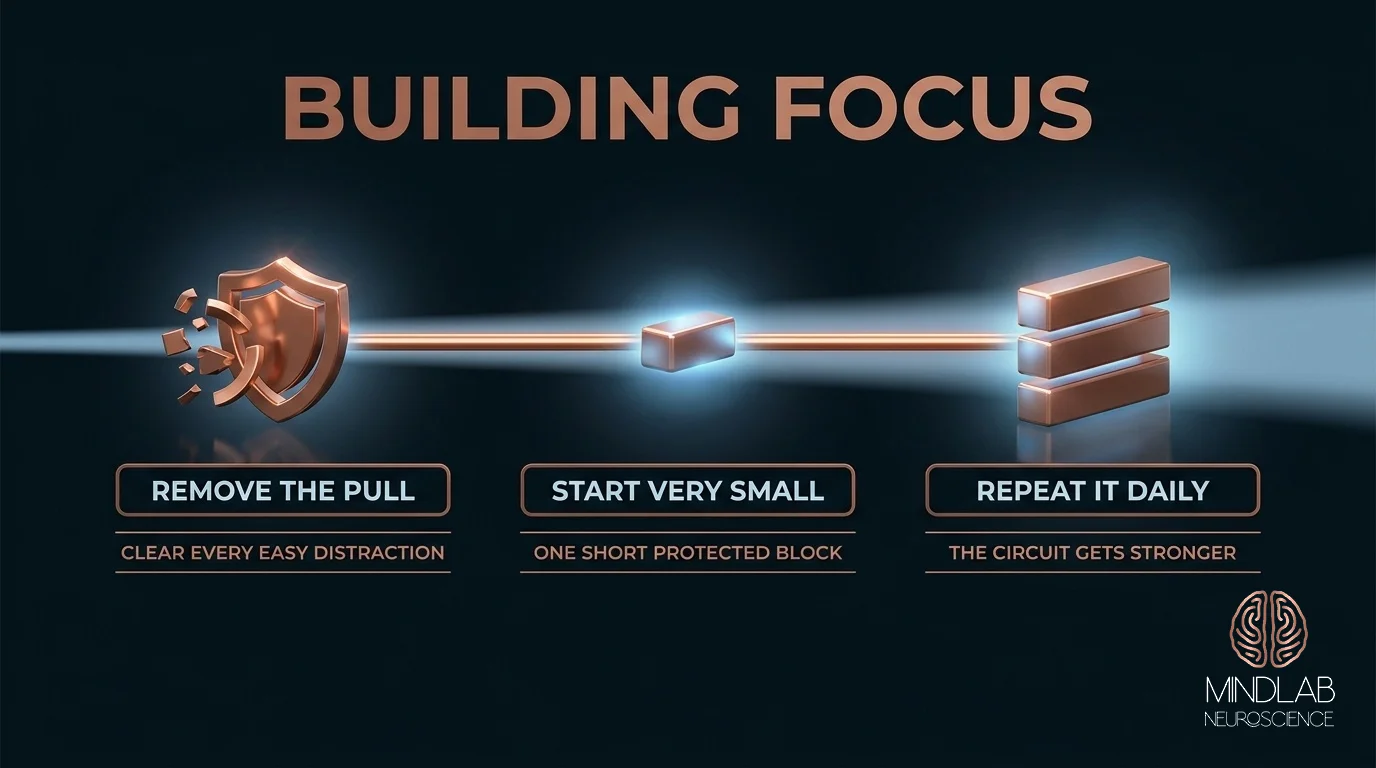
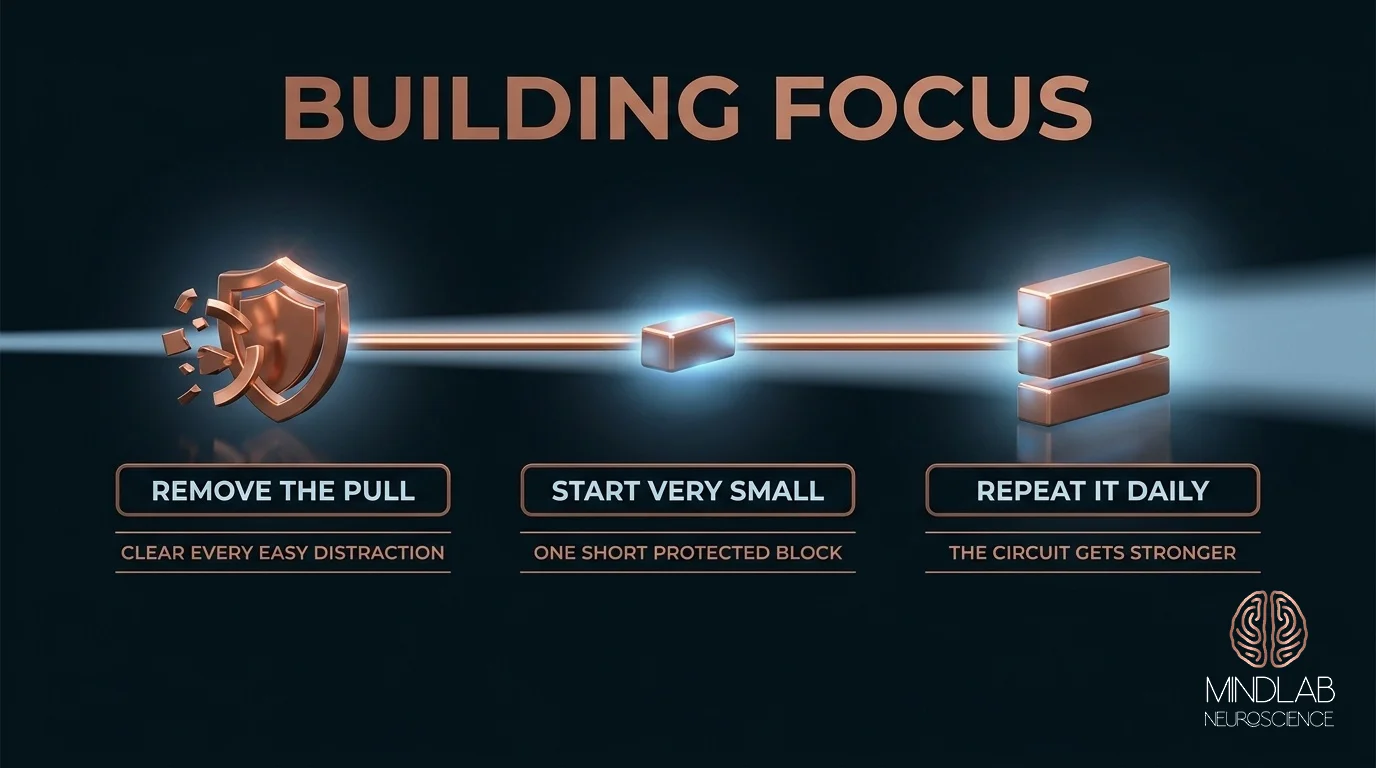
First, shrink the starting line. Not “work on the report” but “open the file and write one bad sentence.” A first action small enough to be boring is one that cannot trigger avoidance. Every step below assumes you got through the door. Skip it and the rest becomes elaborate machinery pointed at a task you never opened.
Second, supply urgency you can see. A visible countdown, a session with a fixed end, a promise to send something at four o’clock. Manufactured deadlines work because the signal never audits whether the urgency is real. Do this before step one and you have raised the stakes on a task you were already avoiding, which hardens the avoidance rather than dissolving it. Urgency is an accelerant, and accelerant applied to a closed door does nothing.
Third, externalize the plan. Do not ask working memory to hold the next step, because in ADHD that is the function most likely to drop it. Keep the next action written and visible: whiteboard, index card, one line at the top of the document. The format is irrelevant, the visibility is not. Do this first and you get what I see constantly, an immaculate system that is itself the procrastination, built in perfect detail and opened once.
What to add once the work has actually started
Fourth, add another person or add movement. Working alongside someone, in the room or on a silent video call, supplies structure at almost no cost. Standing, pacing or holding something gives an under-stimulated system the input it was going to seek anyway.
Do this before the next action is defined and it becomes two people sitting near each other, which is why body doubling gets written off by the people who tried it in the wrong position.
Fifth, protect the block. Twenty to forty minutes, notifications off, one task, fixed end. In the people I work with, quality usually starts dropping somewhere between 25 and 50 minutes, and pushing past that costs more than it earns. Between blocks, move or look at something distant rather than at a screen, which restarts the scanning you just spent half an hour interrupting. If the day is unprotectable, protecting one early block before anything else starts is the highest-yield version.
Why this list usually gets run backwards
Most people run the five steps above in reverse, and that inversion is the single most common reason the approach fails. Standard productivity advice teaches calendar-first: block the time, clear the desk, then begin. For an ADHD brain that produces a protected hour with no defined first action.
An hour like that is spent sitting inside your own guilt with the notifications off. The calendar is the last step, not the first. When someone tells me they have tried all of this and it did not work, they have usually tried exactly this, in exactly that order.
When attention has already gone
Three resets bring it back quickly. The 4-2-6 breath: in through the nose for four, hold for two, out slowly for six, three to five times, because the long exhale settles the nervous system enough to steer. The five-sense scan: three things you see, two you feel, one you hear.
The one-sentence plan: write exactly what you will do for the next ten minutes, and point yourself back at that sentence each time you drift.
Match the reset to the failure, because the wrong one does nothing and people generalize from that to all of them. Breath work is for a system that is revved. Used against boredom-drift it accomplishes nothing, and the client concludes resets do not work for them. The scan is for the moments you have gone somewhere else entirely. The sentence is for the most common case by far, where attention is available and simply unaimed.
The baseline underneath all of it
Sleep, movement and food set how much signal is available to work with at all. They are not a plan on their own, and shaping the conditions that influence dopamine is not about chasing constant stimulation. It is about not starting the day already below the line.
What a realistic dopamine optimization timeline looks like is steady and unglamorous, which is exactly why it gets skipped in favor of whatever is new.
Can neuroplasticity actually change an ADHD attention circuit?
Yes, with one clarification that decides whether the work succeeds. The goal is not to produce neurotypical dopamine signaling, which repetition does not do. It is to strengthen the pathways that let the prefrontal cortex engage given the signaling that exists. Aiming at the first target is why people conclude neuroplasticity failed them.
The circuit is also more distributed than the popular account allows. Castellanos and Proal argue that ADHD is best understood across several large-scale brain systems rather than a single prefrontal-striatal loop (Castellanos and Proal, 2012). That matters practically: it is why a single tactic aimed at one region rarely generalizes, and why the people who improve most are the ones who changed several conditions at once rather than perfecting one.
What repetition does reliably strengthen is the return. Every time attention drifts and you bring it back without drama, you are rehearsing the specific action that ADHD needs most and that no amount of insight installs. The drifting is not the failure. The return is the repetition, and the exercises that rewire attention are almost entirely built out of it.
What Real-Time Neuroplasticity™ actually involves
In practice the intervention is far less elaborate than people expect. When attention slips, the client reaches me in that moment. Not at a scheduled hour, not in a write-up afterwards. We talk through the distraction until they are focused again, and we repeat that as many times as it takes.
The reason it is built that way is timing. The circuit is open to revision while the pattern is actually running, and a lost afternoon reviewed the next day leaves it untouched. This is why so many people with ADHD can describe their attention with real precision and still not change it. Insight and rehearsal are not the same currency, and only one of them alters the pathway.

What does ADHD attention cost the people around you?
More than it costs your output, and almost nobody arrives having counted it. A partner does not experience your attention drifting mid-sentence as a signal deficit. They experience it as not mattering enough to hold your attention. The mechanism is invisible from the outside, so the interpretation defaults to intent, and it is usually wrong.
This is the part of ADHD work clients raise last and grieve hardest. They can describe the missed conversations precisely. What they have never had is a language for it that is neither an excuse nor a character verdict, and the absence of that language is what lets years of small absences accumulate into a settled belief about who they are to someone.
Two things change it, and neither is trying harder to listen. The first is naming the mechanism out loud to the person affected, which converts a pattern that reads as indifference into one that reads as wiring. The second is protecting a small, genuinely device-free window and defending it the way you would defend deep work, because the chemistry that builds connection needs undivided input and gets none from a half-present hour. Twenty minutes fully present outperforms an evening spent nearby.
How long does it take, and what changes first?
In my practice, measurable improvement on specific focus tasks lands somewhere around 8 to 12 weeks, and 6 to 18 months before attention feels generally more available. Those are ranges I observe, not fixed numbers. Consistency moves them, and intermittent effort with an ADHD brain produces intermittent results almost exactly in proportion.
What changes first is not duration. It is recovery time. Before anything else improves, the gap between noticing you have drifted and being back on task starts shrinking, and it shrinks well before anyone notices they are focusing longer. I tell clients to watch for that specifically, because it is the earliest honest evidence the circuit is responding and it is invisible to people measuring the wrong thing.
Second comes the starting cost. Tasks that used to require a run-up begin to open with less resistance. Third, and much later, comes duration. People who quit almost always quit in the window between the first change and the third, having decided that nothing happened because the thing they were watching for had not moved yet. Knowing the order in advance is most of what gets someone through it, and the compounding logic of very small changes is the reason the order runs this way.
What else produces the same attention pattern?
Sleep debt, a sustained threat state, and chronic load all degrade attention in ways that look identical from the outside and respond to completely different inputs. This matters because the strategies in this article are aimed at a signal-access problem, and applied to a sleep problem they will fail while looking like a personal failure.
Sleep restriction degrades many of the same prefrontal functions ADHD is already short of, so a well-rested ADHD brain and a sleep-deprived neurotypical one can present almost the same way for a week. A nervous system holding a threat state does something different: it narrows attention onto scanning for what is wrong, which is not distraction but attention working correctly on the wrong target. Neither of those is reached by environmental design.
In practice I look at the shape of the history before anything else. A pattern that has been present since childhood across every setting behaves differently from one that arrived eighteen months ago alongside a specific pressure. The second one usually resolves when the pressure does. Identifying which pattern is actually in front of you is worth more than any strategy chosen afterwards, and where it genuinely is ADHD, a formal assessment gives you information that self-observation cannot.

What changes when you stop trying to focus like a neurotypical brain?
The effort stops going into the one thing that was never going to work. Almost every person I meet with ADHD has been running a strategy of applying more force to a mechanism that does not respond to force, and getting a result they read as proof about themselves rather than proof about the method.
What replaces it is unglamorous and it works. Build the signal into the task instead of waiting for it. Make the first action too small to avoid. Put the plan somewhere your working memory does not have to hold it. Protect the block, take the recovery, and count every return of a wandering mind as the repetition it actually is.
None of that asks your brain to become a different brain. That was always the flaw in the instructions you were given, and it is worth being precise about what it cost: not a set of missed deadlines, but years of evidence collected against yourself using a test that was measuring the wrong thing.
References
- National Institute of Mental Health. (2024). Attention-deficit/hyperactivity disorder. https://www.nimh.nih.gov/health/topics/attention-deficit-hyperactivity-disorder-adhd
- Schultz, W., Dayan, P., and Montague, P. R. (1997). A neural substrate of prediction and reward. Science, 275(5306), 1593-1599. https://doi.org/10.1126/science.275.5306.1593
- Volkow, N. D., Wise, R. A., and Baler, R. (2017). The dopamine motive system: Implications for drug and food addiction. Nature Reviews Neuroscience, 18(12), 741-752. https://doi.org/10.1038/nrn.2017.130
Focus in an ADHD brain is not built by trying harder at strategies designed for a different dopamine baseline. Real-Time Neuroplasticity™ works with the wiring you have, intervening while attention is actually slipping rather than reviewing it afterwards.
From Reading to Rewiring
If attention has never responded to effort the way you were told it should, the constraint is the mechanism, not the willingness. A strategy call maps which pattern is actually in front of you and what order the work has to follow.
Book a Strategy CallWhy does trying harder to focus often make ADHD worse?
Effort-based focus asks the prefrontal cortex to sustain voluntary attention without the dopamine signal that normally makes it cheap. In ADHD that cortex is already compensating, so adding force accelerates depletion rather than extending focus. The result is a shorter working window, more frustration, and a shame response that interferes with attention further. The alternative is not more effort. It is arranging conditions in which the signal arrives on its own, so the cortex is steering rather than pushing.
Why is focus so much worse on some days than others?
Because an ADHD brain operates with a narrow margin, and anything that taxes the prefrontal cortex consumes that margin quickly. Short sleep, illness, a conflict left unresolved, hunger, or a week of sustained pressure each reduce the resources attention depends on. A neurotypical brain absorbs these with a noticeable dip. An ADHD brain, already close to its floor, drops below it. Day-to-day variability is not inconsistency of character. It is a small buffer meeting an ordinary load.
Why is it easier to focus when there is a deadline?
Urgency is one of the few inputs that generates the dopamine signal automatically, without needing to be summoned. A real deadline converts an abstract task into an immediate one, and the signal that was unavailable all week arrives on its own. This is why last-minute work often feels effortless compared with the same task attempted earlier. The strategy implication is not to rely on genuine emergencies but to manufacture visible, near-term endpoints deliberately, because the mechanism does not check whether the urgency is real.
Is hyperfocus an advantage or a problem?
Both, and which one depends entirely on the target rather than the state. Hyperfocus delivers hours of sustained depth that most brains cannot reach deliberately, which is why so many people with ADHD do exceptional work in narrow domains. The cost is that it cannot be aimed and it does not release on schedule, so meals, commitments and sleep disappear into it. The useful goal is not to suppress hyperfocus but to improve the odds it lands on something worth losing an afternoon to.
Does body doubling actually work, and why?
It works for many people, and the mechanism is not accountability. Another person working alongside you supplies mild, continuous social salience that raises the baseline signal without demanding anything, which is why silent company works as well as conversation and often better. It also creates an implicit start and end to the session, replacing the structure an ADHD brain struggles to impose on itself. Video calls with the microphone muted reproduce most of the effect when a shared room is not available.
What if I have already tried everything and nothing has worked?
Most people who say this have tried many things built for a brain with a different signal, applied with real effort, and drawn a conclusion about themselves from the result. The methods failing does not establish that the person is unreachable; it establishes that the methods assumed a conversion step that was missing. What changes the outcome is matching the approach to the actual architecture rather than repeating a general strategy with more force. Where the pattern is genuinely ADHD, that reframe is usually where progress starts.