Key Takeaways
- Oxytocin is a social salience amplifier, not a comfort chemical or “love hormone.”
- It magnifies what your brain already predicts about closeness: safety or threat.
- In threat-calibrated brains, bonding behaviors sharpen alarm instead of soothing it.
- Sequence decides the outcome: regulation first, then proximity, never the reverse.
- The circuit is neuroplastic, but it rebuilds through calibrated repetition, not intensity.
Oxytocin bonding is the process by which the brain tags a specific person as a reliable source of nervous system regulation. Oxytocin itself does not manufacture love or comfort. It amplifies the social signals your brain is already tracking, which is why the same molecule deepens trust in one person and sharpens dread in another. Whether it bonds you or braces you depends on what your nervous system has learned to predict about closeness, and on the order in which safety and proximity arrive.
That distinction is not academic. It is the difference between advice that works and advice that quietly makes things worse for the people who need it most. In 26 years of founding and leading MindLAB Neuroscience, the single most common bonding error I encounter is not a lack of effort. It is effort applied in the wrong sequence.
How this series fits together: This article explains what oxytocin actually regulates and why bonding advice backfires when the sequence is wrong. For how bonding chemistry can carry a relationship even when physical attraction is not the starting point, read love that deepens beyond physical attraction.
What does oxytocin actually do in the brain?
Oxytocin is a nine-amino-acid neuropeptide synthesized in the hypothalamus and released both into the bloodstream by the posterior pituitary and directly into brain circuits. Its central effect is modulatory: it changes the gain on social information rather than producing a fixed emotional state. Feldman’s work established that oxytocin receptor distribution and reactivity vary substantially between individuals, which is why identical relational input produces very different felt experience in two different people.
The popular framing gets the direction of causation backwards. Oxytocin does not decide that a person is safe and then produce warmth. Your brain decides, largely below conscious awareness, what this person and this moment predict. Oxytocin then turns up the volume on that prediction.
The safety-signal model, and where it breaks
When I explain this to clients, I start with the version they have already read: oxytocin dampens amygdala reactivity, and the amygdala is the structure that detects threat and drives defensive responses. That much holds. A quieter amygdala widens the window in which vulnerability is neurologically possible.
What that model cannot explain is the client who does everything correctly and feels worse. She holds the eye contact. She accepts the long hug. Her chest tightens anyway. Under a pure comfort-chemical model, that response is inexplicable, so it usually gets misfiled as resistance, avoidance, or a character problem. It is none of those things. It is the model being wrong.
Why doesn’t oxytocin work the same way for everyone?
Because oxytocin amplifies social salience rather than producing comfort. Shamay-Tsoory and Abu-Akel’s social salience hypothesis reframed two decades of contradictory findings: oxytocin increases the perceptual and motivational weight of social cues, and the valence of the result depends on the person and the context (Shamay-Tsoory and Abu-Akel, 2016). In a brain that predicts safety, amplified social signal reads as warmth. In a brain calibrated by unpredictability, the same amplification makes the micro-expression, the half-second pause, the slight change in tone land louder and land as danger.
This single correction resolves most of the field’s apparent contradictions. It explains why oxytocin has been reported to increase envy and gloating in competitive settings, why it strengthens in-group preference while increasing wariness toward out-groups, and why intranasal administration helps some anxious participants and worsens others. One molecule, one function, opposite outcomes.
It also explains the most reliable pattern in my practice: the people who report the least benefit from connection advice are the ones running the most of it. They are not under-dosed. They are amplifying a prediction that has not been changed yet.
What the famous trust-spray study actually showed
Nearly every article on this topic cites the 2005 finding that intranasal oxytocin made participants transfer more money to strangers in an economic trust game. It is worth knowing what happened to that result. The original study reported a clear effect in 128 participants. A decade later, a critical review of the literature concluded that the evidence for oxytocin increasing trust in humans is weak, that effect sizes shrink sharply in larger samples, and that publication bias likely inflated the original picture (Nave, Camerer and McCullough, 2015).
What the research doesn’t capture, and what I want you to take from this, is that the correction is more useful than the headline. There is no dose that installs trust. There is only a system that amplifies what your brain has already learned to expect, which is precisely why the intervention has to target the expectation rather than the molecule.
| Bonding Chemical | Role in Love | Activation Trigger | When Absent |
|---|---|---|---|
| Oxytocin | Amplifies social salience; consolidates trust when the context reads safe | Eye contact, touch, vocal warmth, reciprocity | Relationships feel transactional; intimacy triggers anxiety |
| Vasopressin | Pair-bonding, territorial protection of bond | Sustained physical proximity, sexual bonding | Commitment feels unstable; no “mine” feeling |
| Dopamine | Pursuit, excitement, romantic obsession | Novelty, unpredictability, anticipation | Relationship feels flat; seeking intensity elsewhere |
| Serotonin | Emotional stability, mood regulation within bond | Consistent routines, predictable safety | Mood swings, irritability, relational volatility |
| Endogenous opioids | Comfort, pain relief, felt security | Physical closeness, laughter, shared experience | Partner absence feels like physical pain |
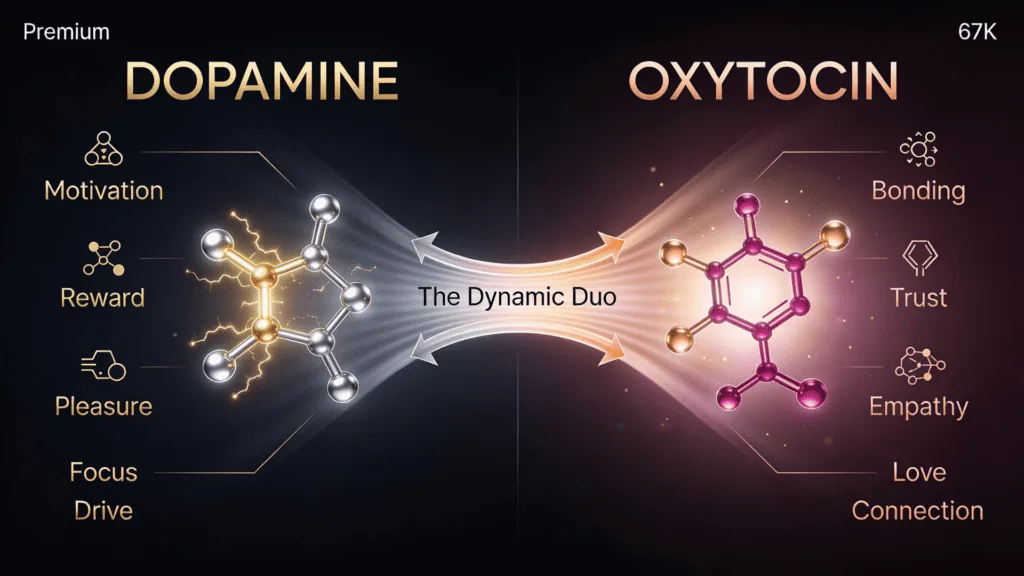
How do dopamine and oxytocin divide the work of love?
Dopamine drives pursuit; oxytocin consolidates attachment. Dopamine answers “go get that,” encoding the gap between what you expected and what you received, which is why early attraction feels urgent and slightly unstable. Oxytocin answers a different question: is this specific person a reliable regulator of my internal state. The two systems converge in the striatum, and that convergence is what binds reward to a particular face rather than to a generic good feeling.
Couples arrive in my practice convinced the spark has died. What has usually happened is a handoff, not a loss. The dopamine phase is prediction error, and prediction error necessarily decays as a partner becomes predictable. That decay is the mechanism working correctly. The problem is that nobody told them the second system has to be built deliberately, so when the first one quiets there is nothing underneath it.
I see the reverse failure just as often, in people whose lives are already full of stimulation: relationships engineered for permanent novelty. Constant travel, constant intensity, constant renegotiation. The dopamine stays high for years. The oxytocin system never gets the repetitive, boring, predictable input it requires, and the bond stays structurally thin under a very exciting surface.
Why does standard bonding advice fail the people who need it most?
Because it prescribes proximity to brains that have not yet established safety, and proximity without safety amplifies threat. This is the sequencing error, and it is the single most consequential pattern I observe in this area of practice.
The standard protocol says: hug for twenty seconds, hold eye contact, schedule physical closeness. For a securely calibrated nervous system that advice is fine and mildly useful. For someone whose early experience paired closeness with unpredictability, each of those instructions is a request to stand still inside an amplified threat signal. They comply, because they want the relationship. Their physiology reads the compliance as danger. They conclude they are broken.
The evidence for sequencing is stronger than the evidence for the advice itself. Coan, Schaefer and Davidson showed that hand-holding during threat attenuated the neural threat response, and critically, that the size of the attenuation tracked the quality of the relationship (Coan, Schaefer and Davidson, 2006). Touch did not create safety. Touch transmitted safety that the relationship already carried. Run that finding backwards and you get the clinical rule: the bond regulates the touch before the touch can regulate the person.
The pattern in practice
A client came to me after two years of doing everything her previous guidance recommended. Daily affection ritual, scheduled date nights, deliberate eye contact. She was exhausted and further from her husband than when she started. Nothing in her protocol was wrong in isolation. Everything in it was aimed at a nervous system that first needed to stop reading his approach as an incoming demand.
We inverted the order. Regulation before proximity: predictable, low-stakes, non-touch contact where nothing was being asked of her. Only once her baseline shifted did we reintroduce physical closeness, at an intensity she set. The behaviors in month four looked nearly identical to the ones that had failed in month one. The sequence was the variable.

What does early attachment actually calibrate?
Early attachment calibrates the prediction, not the capacity. The oxytocin system is present and functional from birth. What repeated early experience sets is the expectation the system amplifies: whether an approaching face is likely to resolve distress or add to it.
Maternal oxytocin rises sharply around birth and nursing, and the infant’s own system responds to being held, rocked and gazed at. This is the brain’s first structured model of what closeness predicts, built through thousands of low-drama repetitions rather than any single formative event. Volume of ordinary repetition is the active ingredient, which is worth knowing because it is also how the model gets revised later.
In clients with avoidant or anxious patterns, I consistently find disruptions in the predictability of early care rather than its intensity. The parent was not necessarily absent. Often the parent was warm, and inconsistent. Inconsistency is the harder input, because it teaches the nervous system that closeness is unresolvable, and an unresolvable prediction is one the brain keeps testing. Where early adversity has shaped adult responses to closeness, the calibration is deeper but the mechanism is the same.
The prediction is revisable. That is the entire clinical case for this work. Attachment styles describe a current calibration, not a permanent identity, and calibration responds to evidence.
Why does heartbreak physically hurt?
Because social rejection recruits some of the same neural substrate as physical pain. Eisenberger’s review of this literature is careful about the claim: social and physical pain show overlapping activity in the dorsal anterior cingulate cortex and anterior insula, which is a shared substrate, explicitly not an identical signature (Eisenberger, 2012). Separate multivariate patterns for social and physical pain do exist. The overlap is real and it is partial, and the partial version is the one worth carrying, because it explains the physicality of the experience without overstating what the imaging shows.
When a bond is established, your partner functions as external regulation. Sleep, appetite and stress reactivity organize partly around their presence. Remove them and you lose a regulator, not only a relationship. The neural map that encoded them does not update on the day they leave; it keeps predicting them and keeps registering the absence as error.
I treat the first weeks as a regulatory problem rather than an emotional one. The task is not to stop missing the person. The task is to restore enough baseline regulation that the nervous system can tolerate the missing. Friends, family and animals all supply usable input during that window, and the input does not have to be romantic to be regulatory.
The human-animal bond is unusually clean for this purpose. Mutual gazing between dogs and their owners raises urinary oxytocin in both species, a genuine reciprocal loop rather than a one-directional comfort effect (Nagasawa et al., 2015). For someone whose predictions about people are currently hostile, an animal supplies bonding input that bypasses the contaminated channel. I have used exactly that as a bridge for isolated clients rebuilding after a separation, and the sequencing logic is identical: regulate first, then reintroduce the harder signal.

Can digital connection trigger oxytocin bonding?
Only weakly, and not through the channels that do the structural work. The oxytocin system evolved as a proximity-dependent mechanism keyed to embodied signals: touch, sustained gaze, vocal prosody, and the fine-grained timing of turn-taking. Text strips every one of those inputs. Video preserves some prosody and a degraded version of gaze, which is why a call outperforms a message and still underperforms a room.
I am deliberate about not overstating this. Digital contact is not neurologically inert, and for people separated by distance or circumstance it is meaningfully better than nothing. The accurate version is narrower: digital contact maintains an existing bond considerably better than it builds a new one, because maintenance needs recognition while construction needs the embodied inputs.
The pattern I see most often in remote-working and younger clients is not isolation. It is high contact volume with low regulatory return. Hundreds of interactions, none of them supplying the input the system actually reads. The correction is not more contact. It is different contact, and less of it, with the embodied channels restored.
How do you rebuild oxytocin responsiveness?
By changing the prediction through repetition at an intensity the nervous system can currently tolerate, in that order. The behaviors are not exotic. Sequencing and dose are what separate a protocol that works from the same list of behaviors that fails.
Real-Time Neuroplasticity™ is built around this timing constraint. The intervention happens during the live moment when the pattern activates, because that is when the prediction is open to revision. Rehearsing a calmer response after the fact leaves the predictive model untouched, which is why insight so often fails to change how closeness feels.
The order that matters
Regulation before proximity. Establish a baseline where the nervous system is not already braced. Nothing below works from a state of alarm, and attempting it teaches the opposite of what you intend.
Predictability before intensity. A brief, reliable, daily contact does more structural work than an intense weekly one. The system reads frequency and reliability, not magnitude. This is the step high-achievers skip most often, because it is unglamorous and looks insufficient.
Receiver sets the dose. The person whose calibration is being revised chooses the intensity and can stop without negotiation. Removing the demand is frequently the whole intervention; a large amount of what presents as touch aversion is aversion to the obligation attached to it.
Then the embodied channels. Sustained touch, held gaze, synchronized activity, undistracted listening. These are the standard recommendations and they are genuinely effective, once the three conditions above are met. Applied before, they are counterproductive. That ordering is the practical content of everything above, and it is what deliberate emotional regulation work is for.
Expect months rather than weeks. Predictive models are built from accumulated evidence and they revise on the same currency. Clients who accept the timeline generally get there; clients who treat it as a two-week protocol generally conclude it does not work for them.
When is oxytocin not helpful?
When the context is adversarial, and when closeness is arriving faster than the nervous system can process it. Both follow directly from amplification.
Oxytocin strengthens in-group attachment while increasing wariness toward those outside it. The protective, tribal quality that makes someone fiercely loyal to their own people is the same mechanism that can harden a boundary against everyone else. Knowing that biology tilts this way is what allows deliberate override; the prefrontal cortex can widen a circle that the peptide would narrow, but only if you know which direction the tilt runs.
For clients with significant trauma histories, closeness can register as threat directly. Their calibration has paired intimacy with danger, and amplifying that pairing produces alarm rather than comfort. We titrate deliberately in these cases, and the receiver-sets-the-dose rule stops being a preference and becomes the safety condition of the work.
What this means for your relationships
The brain is built to connect, and connection measurably regulates physiology. That much of the popular account is true. What the popular account leaves out is that the system is an amplifier with a setting, and that the setting was configured by evidence you did not choose and can be reconfigured by evidence you do.
If connection has been difficult, the likeliest explanation is not deficiency. It is a nervous system running an old prediction accurately. That distinction matters, because a deficit invites resignation and a calibration invites work.
I have watched people in their sixties and seventies revise patterns held for five decades. It was not a personality change. They stopped supplying evidence that closeness is unsafe and started supplying evidence that it is, in a sequence their nervous system could accept, for long enough that the prediction moved. The mechanism does not have an expiry date, and trust rebuilds on the same evidence-based terms.
References
- Feldman, R. (2012). Oxytocin and social affiliation in humans. Hormones and Behavior, 61(3), 380-391. https://doi.org/10.1016/j.yhbeh.2012.01.008
- Kosfeld, M., Heinrichs, M., Zak, P. J., Fischbacher, U., and Fehr, E. (2005). Oxytocin increases trust in humans. Nature, 435(7042), 673-676. https://doi.org/10.1038/nature03701
- Nave, G., Camerer, C., and McCullough, M. (2015). Does oxytocin increase trust in humans? A critical review of research. Perspectives on Psychological Science, 10(6), 772-789. https://doi.org/10.1177/1745691615600138
- Nagasawa, M., Mitsui, S., En, S., Ohtani, N., Ohta, M., Sakuma, Y., Onaka, T., Mogi, K., and Kikusui, T. (2015). Oxytocin-gaze positive loop and the coevolution of human-dog bonds. Science, 348(6232), 333-336. https://doi.org/10.1126/science.1261022
The prediction described in this article was built through thousands of neural repetitions, and it revises on the same currency. Real-Time Neuroplasticity™ provides the mechanism: intervening during the live moments when the pattern activates, building new neural evidence that a different response is architecturally possible.
From Reading to Rewiring
If closeness has consistently felt like effort rather than relief, the variable is usually sequence, not willingness. A strategy call maps where your calibration currently sits and what order the work has to follow.
One hour with Dr. CerutoCan you boost oxytocin naturally?
Yes, oxytocin release responds to specific behavioral inputs: sustained eye contact, warm physical touch, synchronized activities such as walking in step or breathing together, vocal warmth, and acts of generosity or trust. Each activates sensory pathways that converge on the hypothalamus. The important caveat is that release is not the same as benefit: in a nervous system currently predicting threat, amplified social signal can increase anxiety rather than reduce it, which is why sequence matters more than volume. Supplements claiming to boost oxytocin do not cross the blood-brain barrier effectively and are not a reliable substitute for relational input.
Do men and women experience oxytocin bonding differently?
The oxytocin system operates in everyone but interacts with circulating sex hormones. Estrogen tends to amplify oxytocin’s effects, while testosterone tends to blunt them, which may contribute to differences in how bonding is expressed. Individual variation far exceeds any average group difference: attachment history predicts oxytocin responsiveness far more strongly than sex does. Treat the hormonal interaction as background context, not as a rule about any particular person.
Why does oxytocin sometimes increase anxiety instead of calm?
Because oxytocin amplifies the salience of social cues rather than producing comfort directly. If the attachment system is calibrated to expect rejection, oxytocin makes rejection cues more prominent and anxiety increases. This is the social salience hypothesis, and it explains why the same molecule produces opposite effects in different people. In a context the brain reads as safe, it amplifies safety signals; in one it reads as threatening, it amplifies threat signals.
Can chronic stress prevent oxytocin bonding?
Sustained stress makes bonding physiologically harder. Elevated cortisol and ongoing sympathetic activation shift the nervous system toward defense, and a system braced for threat does not read approach as safety. This is why couples under prolonged financial, professional or health stress often report disconnection despite genuinely loving each other: the conditions bonding requires are being suppressed by the stress response. Reducing load is not only a wellness recommendation, it is a precondition for the rest of the work.
How long does it take to build an oxytocin bond?
Plan in months, not weeks. A durable bond typically needs sustained, predictable, reciprocal contact across several months, because the underlying prediction is built from accumulated evidence. This is neurologically distinct from dopamine-driven early attraction, which can arrive within hours. Attraction and attachment are separate systems, and relationships that collapse after an intense start usually had strong early pursuit and never accumulated the repetitive, low-drama input attachment requires.
Why do some people withdraw from closeness even when they want connection?
When early experience paired closeness with unpredictability or pain, the defensive circuitry can be activated by the very cues that would otherwise support bonding, such as eye contact or physical proximity. The withdrawal is not a choice or a lack of desire. It is an automatic response in which the nervous system categorizes intimacy signals as threat, and it resolves by changing what those signals predict rather than by pushing harder against the withdrawal.
Does hugging for twenty seconds actually work?
It depends entirely on whether the bond already reads as safe. Research on hand-holding during threat found that physical contact reduced the neural threat response, and that the size of the reduction tracked relationship quality: touch transmitted existing safety rather than creating it. So a long hug is genuinely useful inside a relationship the nervous system already trusts, and counterproductive when used to force closeness that has not been established. The behavior is not the variable; the sequence is.
How does oxytocin sustain long-term attachment in the brain?
Repeated oxytocin signaling during reliable contact strengthens the association between a specific person and the resolution of internal distress, gradually shifting the basis of the bond from novelty-driven pursuit to stable felt security. Over time the brain encodes that person as a predictable regulator of its own state, which is why the loss of a long-term partner disrupts sleep, appetite and stress reactivity rather than mood alone.