Key Takeaways
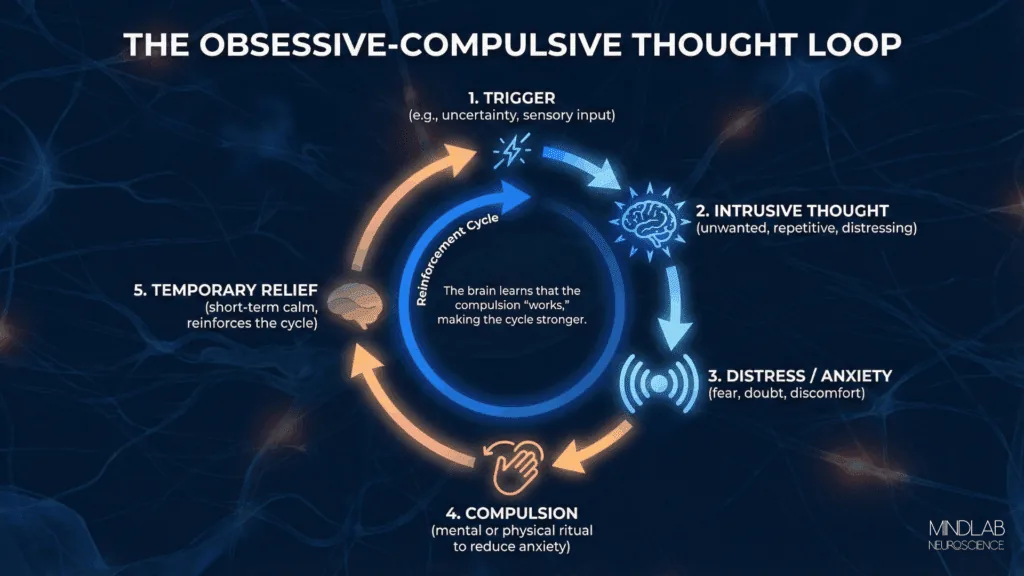
- Obsessive thinking is a dorsal striatum loop reactivating without the satisfaction signal that closes it.
- Obsessive thoughts involve high dopamine in the reward-seeking circuit: the brain pursues them without satiation.
- Suppression increases obsessive thoughts (rebound effect): prefrontal suppression holds them in working memory, strengthening activation.
- Obsession and passion share dorsal striatum activation; only passion produces the closure signal that satisfies.
- Redirection beats suppression: the dorsal striatum needs a target, not a void.
If you have ever felt stuck in your mind, replaying the same thought so many times that it almost feels like it has taken over your body, then you already know what the neuroscience of obsession feels like from the inside. Most people think obsession refers only to classic OCD patterns, but in my twenty-six years of applied neuroscience practice, I have seen obsession show up in countless ways that have nothing to do with rituals or compulsions. Obsession can live in your relationships, your career, your memories, your fears, your ambitions, and even in your sense of identity.
As a neuroscientist and founder of MindLAB, I have spent decades studying how obsession is wired into the brain and how those circuits can be unwired. The neuroscience of obsession is both simple and profoundly complex. It explains why your brain grabs onto certain thoughts, why it refuses to release them, and why some people struggle with obsessive loops far more than others. The more you understand these patterns, the more you realize obsession is not a sign of weakness or a personality flaw. It is a brain pattern that formed through experience, learning, stress, and emotional intensity. And because it is a brain pattern, it can be changed.
Below, I will walk you through the nine parts of obsession that matter most if you want to understand your mind. You will see how anxiety, PTSD, depression, and ADHD shape obsessive loops. You will see multiple real client examples from my practice. You will learn exactly how obsession is wired into the brain, how to tell the difference between healthy and unhealthy obsession, and how to begin rewiring these circuits through neuroplasticity. Obsessive loops sit within the wider OCD and intrusive thought patterns this hub maps.
Obsessive thought patterns are maintained by hyperactivation of the cortico-striato-thalamo-cortical loop, and inhibitory-learning approaches can weaken this circuit’s automatic error-signaling function with sustained, repeated practice.
Resting-state fMRI data reveal that individuals with persistent obsessive loops show abnormally elevated default mode network anticorrelation with task-positive networks, indicating a neural architecture that resists thought disengagement.
By the end of your reading, you will understand that the neuroscience of obsession is not a permanent condition. It is a roadmap. And once you know the map, you can change the path.
The Neuroscience of Obsession: Understanding Why the Brain Cannot Turn Off
The neuroscience of obsession begins with understanding how the brain decides what matters. Your brain spends all day sorting through information, sensations, memories, and predictions. It cannot give equal attention to everything, so it tags certain things as important. When this tagging system becomes too sensitive or too rigid, obsession is born.
The Salience Network and Why Thoughts Stick
At the core of the neuroscience of obsession is the salience network . This system helps the brain decide what deserves attention. When it works well, it flags meaningful things, like an email from your boss or a crying child. When it becomes too reactive, it tags thoughts, memories, or worries as urgent even when they are not.
The Prefrontal Cortex and the Struggle for Control
The prefrontal cortex is the part of your brain that helps you reflect, choose, regulate, and shift your attention. When obsession takes hold, the prefrontal cortex struggles to quiet the emotional noise coming from deeper parts of the brain. You may tell yourself to stop thinking about something, but the emotional circuits keep firing anyway.
Dopamine and the Pull of Uncertainty
Many obsessive loops are driven by dopamine , the neurotransmitter involved in wanting, searching, and seeking. Dopamine does not respond to completion. It responds to anticipation. This is why uncertain situations, like waiting for a text or waiting for news about a job opportunity, pull you into obsession so quickly.
This combination of salience, emotion, attention, and dopamine is the foundation of the neuroscience of obsession. But how these circuits express themselves depends on the emotional landscape of your life.

Why Some Brains Become Obsessive and Others Do Not
You may wonder why certain people struggle with obsessive loops while others move through life with more ease. The neuroscience of obsession shows that multiple factors shape an obsessive brain.
Genetics and Temperament
Some people are born with more sensitive nervous systems. They feel emotions more strongly, attach more deeply, and notice subtle cues that others miss. This sensitivity is not a flaw. It often correlates with empathy, creativity, and high intelligence. But it also means the salience network becomes more easily activated.
Childhood Experiences
If you grew up in an unpredictable or emotionally intense environment, your brain may have learned to stay hyperaware. You may have learned to scan for danger, disappointment, or sudden changes. Obsession often grows out of early attempts to stay safe, to predict what might happen next, or to understand inconsistent behavior in caregivers.
Stress Load in Adulthood
High stress does not initiate obsession, but it intensifies it. When you are overloaded, your PFC becomes less effective, and emotional circuits gain strength. This phenomenon makes it harder to shift your attention, regulate your emotions, or let go of intrusive thoughts.
Dopamine Sensitivity
Some people have dopamine systems that are more responsive to anticipation, reward, novelty, or emotional intensity. These individuals are more likely to experience obsessive interest, obsessive attraction, or obsessive worry.
All of these factors shape the brain’s wiring long before a person becomes aware of their patterns. Understanding these influences helps remove shame and makes room for self-compassion. The neuroscience of obsession does not ask, “What is wrong with you?” It asks, “What happened that taught your brain to latch on so tightly?”

How Anxiety, PTSD, Depression, and ADHD Shape Obsessive Loops
The neuroscience of obsession becomes even clearer when we look at how different conditions influence obsessive thinking. Anxiety, PTSD, depression, and ADHD each create unique patterns that make certain thoughts harder to release.
Anxiety and the Loop of What If
Anxiety fuels obsession by convincing the brain that thinking more will prevent danger. Inside anxiety, the neuroscience of obsession turns small concerns into massive possibilities. You worry about tone, timing, consequences, and everything that could go wrong. Your brain rehearses disasters as a way to prepare, but the rehearsal only strengthens the fear circuit.
I worked with a client named Lara, an attorney whose mind never stopped scanning for problems. She replayed client conversations for hours. She imagined worst-case scenarios that never happened. Her brain tagged every detail as important because anxious minds are built to overprotect. When she learned to interrupt her worry loops early, her brain slowly stopped viewing every thought like an emergency.
PTSD and the Loop of Memory Replay
For clients with PTSD, obsession often centers on unfinished memories. The brain does not store traumatic memories the same way it stores everyday ones. Instead, the memory circuits remain raw and easily triggered. When the brain thinks danger is still present, it replays the moment in an attempt to resolve it.
One of my clients, whom I will call Anthony, was a firefighter who survived a major rescue incident. Years later, his brain replayed vivid images whenever he heard a loud bang or saw flashing lights. The neuroscience behind obsession in PTSD is not a matter of choice. This response is a survival system that remains in a state of high alert. Only when we trained his nervous system to recognize safe cues did those obsessive flashes finally soften.
Depression and the Loop of Self-Blame
Depression creates a different type of obsessive loop. Instead of predicting future danger, the brain fixates on past mistakes, losses, or perceived failures. People with depression replay conversations where they think they sounded foolish or inadequate. They analyze relationships they believe they ruined. They obsess about choices they can no longer change.
One client, a founder named Elise, could not stop thinking about a business mistake from years earlier. Even while leading a thriving company, her brain pulled her backward. The neuroscience of obsession in depression often comes from a brain that has learned to expect disappointment. When Elise practiced grounding in the present and began rehearsing evidence that contradicted her old story, her obsessive rumination finally started to loosen.
ADHD and the Loop of Hyperfocus
Most people associate ADHD with distraction, but many of my clients with ADHD also experience intense, gripping obsession. Hyperfocus is the brain’s way of locking onto interesting or emotionally charged tasks. This same system can latch onto a new idea, a relationship, or a worry and refuse to let go.
One of my clients, Jordan, was brilliant and creative but lived inside emotional obsession. If someone did not respond to him quickly, he spiraled into hours of replaying conversations. The neuroscience of obsession in ADHD comes from dopamine-driven urgency. When we taught Jordan how to shift states with small sensory breaks, his brain finally learned it did not need to chase every thought to completion.

Healthy Obsession vs Unhealthy Obsession
Not all obsession is harmful. In fact, some forms of obsession help people achieve greatness. The neuroscience of obsession helps us understand the difference. From a neuroscience perspective, this dynamic involves intricate communication between cortical and subcortical brain structures, creating feedback loops that influence how individuals perceive.
Healthy Obsession
Healthy obsession looks like deep focus, drive, passion, and commitment. Artists, athletes, scientists, and entrepreneurs often rely on this type of obsession to refine their skills. Healthy obsession feels energizing. It is about creation, not fear. This process engages multiple interconnected neural pathways that work together to shape.
Unhealthy Obsession
Unhealthy obsession feels heavy, sticky, and intrusive. It takes over your emotional space rather than expanding it. It shows up as rumination, checking, replaying, and worrying. It feels like the thought is controlling you rather than the other way around.
The Line Between Them
The line between healthy and unhealthy obsession is simple. If the thought serves your growth, it is healthy. If the thought pulls you away from your life, your relationships, your peace, or your sense of self, it has crossed into unhealthy territory.

How Obsession Gets Wired In: The Brain’s Learning Rules
Although this article is not about OCD, understanding the brain areas involved in OCD helps highlight how similar circuits can fuel obsessive loops, especially when the brain misreads uncertainty as danger. The neuroscience of obsession is rooted in learning. Whatever the brain does repeatedly becomes easier to repeat. This principle is the foundation of neuroplasticity.
Repetition Creates Pathways
If you repeatedly think about something, your brain strengthens the neural pathway that represents that thought. The more you walk the path, the smoother it becomes. Obsession is the result of walking the same mental path thousands of times.
Emotion Supercharges Learning
The brain learns faster when emotion is strong. This is why breakup obsession, trauma obsession, or sudden fear-driven obsession feels so powerful. The emotional charge glues the thought to your awareness.
Attention Determines Strength
Whatever you pay attention to most gets prioritized by the brain. If your attention repeatedly returns to the same worry, memory, or fantasy, the brain interprets it as important and keeps it active. Multiple brain regions contribute to this process through synchronized neural firing patterns that emerge during.
Understanding these mechanisms gives you a way to change them. If the neuroscience of obsession is built through repetition, emotion, and attention, then the way out must use the same ingredients.
A Brain-Based Protocol To Quiet Obsessive Loops
Over the years, I have helped thousands of clients soften their obsession circuits. The key is to use neuroscience, not willpower. Willpower does not work when the emotional brain is in charge. The following protocol is the one I teach most often. It is simple, but it works because it aligns with how the brain actually learns.
Step One: Name the Loop
The moment you feel your mind beginning to spiral, you name it. You say to yourself, This is an obsession loop. Naming it activates the PFC and reduces emotional intensity. This process engages multiple interconnected neural pathways that work together to shape behavioral and emotional outcomes across varied.
Step Two: Anchor the Body
You shift your attention from your thoughts to your body. You place your feet firmly on the ground, relax your shoulders, and take a long exhale. This signals to the brain that you are safe enough to stop rehearsing danger.
Step Three: Redirect Attention
You gently choose a new focus, something neutral and present. It could be the feeling of your breath, the texture of your clothing, or the sounds in the room. The goal is not to force the thought away but to help your brain experience another option.
Step Four: Rehearse an Alternative Thought
You introduce a more balanced or grounded thought. For anxiety, it may be; I do not have all the information yet. For depression, it may be that the past is not an accurate picture of today. For PTSD, it may be, This is a memory, not a danger.
Step Five: Practice Repetition
This step is where neuroplasticity happens. You repeat the new sequence many times. Over days and weeks, the brain begins to choose the new pattern automatically. The neuroscience of obsession works both ways. If the brain can learn obsession, it can also unlearn it.

Client Transformations From Twenty-Six Years of Practice
Nothing has taught me more about the neuroscience of obsession than watching thousands of real people transform patterns they once believed were permanent. When you see these shifts up close, you realize that the neuroscience of obsession is not just a theory. It is a living map of how the brain changes, adapts, reorganizes, and heals.
My client Maya is one example. She spent years obsessing over her partner’s tone, timing, and communication patterns. Every silence felt like a threat. Every pause felt like a warning. Her childhood had conditioned her to brace for abandonment, and her adult relationships activated the same circuits over and over. When we applied the neuroscience of obsession to her specific pattern, she learned how to regulate her nervous system in the exact moments her brain would normally spiral.
She practiced grounding her body before her thoughts could take over, and slowly, the obsessive checking and emotional urgency that once consumed her began to fade. Her brain learned safety where it once predicted danger.
Another client, a physician named Richard, lived inside an obsessive loop of regret. He replayed a medical decision he made early in his career so many times that it became the centerpiece of his identity. He believed that if he analyzed it enough, the guilt would lift, but the neuroscience of obsession shows why rumination only strengthens emotional memory. When I taught him how to anchor himself in present-time evidence and how to interrupt the brain’s biased prediction loops, something powerful happened.
His mind stopped dragging him back into the same moment. The obsessive replay finally lost its emotional charge, and he began to see himself through the lens of who he was now, not who he feared he had been.
I also worked with Serena, who developed PTSD after surviving a violent attack. The neuroscience of obsession explains why traumatic memories replay in vivid detail, often without warning. Her brain had not yet learned that the danger was over. Loud noises triggered instant flashbacks and locked her into an obsessive pattern of memory replay. Through targeted work that combined nervous system regulation with controlled exposure to safe stimuli, her brain eventually learned to separate the past from the present.
The obsessive flashes did not vanish overnight, but they lost their authority. They became optional signals rather than automatic responses, and she reclaimed her ability to move through the world without constant fear.

Then there was Daniel, a brilliant entrepreneur with ADHD who experienced obsession through the lens of hyperfocus. His mind latched onto new ideas so intensely that he lost sleep, skipped meals, and burned himself out. The neuroscience of obsession explains why ADHD brains struggle with transitions. They chase stimulation and urgency because dopamine spikes create a sense of momentum.
Daniel learned to control his intensity by intentionally stepping in and out of hyperfocus. What once felt like an overwhelming obsession became one of his greatest strengths. His creativity became sustainable rather than destructive.
Another client, whom I will call Naomi, struggled with obsessive fear about her health. Tiny sensations in her body triggered catastrophic thoughts that escalated within seconds. The neuroscience of obsession elucidates the brain’s misinterpretation of internal cues when primed for danger. When she learned to shift her attention from threat monitoring to present-time sensory grounding, her panic softened. The obsessive checking she once performed dozens of times a day gradually disappeared. For the first time in years, she felt calm inside her body.
And one of my most memorable clients, Michael, was a high-powered executive whose obsession centered on success and failure. He replayed every decision he made at work and catastrophized each potential outcome. His mind lived in the future, always predicting disaster. The neuroscience of obsession explains why high achievers often get trapped in anticipatory loops.
Their brains use obsession as a form of preparation, even when nothing is wrong. When Michael learned how to redirect his mental energy into present-time awareness and nervous system regulation, his obsessive forecasting slowed. He finally experienced the ability to think clearly without fear driving every choice.
These clients came from different backgrounds, cultures, industries, and emotional histories. Yet the neuroscience of obsession revealed the same truth for all of them. Their obsessive patterns were learned. Their circuits were shaped by repetition, emotion, and survival. And anything learned can be unlearned. Anything wired can be rewired. Anything repeated can be replaced with something healthier.
This is the promise at the heart of the neuroscience of obsession. Your brain is capable of change, no matter how long you have been looping, how intense the thoughts feel, or how deeply the patterns have settled into your mind. I have watched people who felt hopeless reclaim their clarity. I have watched people who felt trapped reclaim their agency. I have watched people who lived inside their obsessive thoughts for decades build a life where peace is not a rare moment but a daily experience.
The neuroscience of obsession proves that your mind is never stuck. With the right tools, the right practice, and the right guidance, the circuits that once felt unbreakable can become ones you barely remember.

How to Rewire Your Obsessive Circuits Long-Term
The neuroscience of obsession makes something very clear. Obsessive thoughts are not reflections of your character. They are not signs of weakness or evidence that something is permanently wrong with you. They are circuits. They are neural pathways that formed because your brain tried to protect you, prepare you, or keep you aware of something that once felt important.
It Takes Time, Not Force
One of the biggest misconceptions I see is the belief that you should be able to force obsessive thoughts to stop through logic or willpower. The neuroscience of obsession shows why this never works. When a thought has been repeated thousands of times, it becomes the default path.
Your Brain Learns Safety Through Experience
The neuroscience of obsession also reveals that obsessive loops lose power when your nervous system learns to feel safe in moments that once triggered fear, uncertainty, or urgency. You cannot rewire obsession if your body is in a state of threat. Safety must be practiced, felt, and repeated.
New Thoughts Must Be Practiced Until They Stick
Neuroplasticity is built on repetition. The neuroscience of obsession shows that the brain strengthens whatever it practices most, whether that is fear, regret, anticipation, or rumination. A single moment of insight will not override years of rehearsal. New thoughts must be practiced repeatedly, especially during the early stages of change.
Emotional Memories Can Be Recoded
One of the most powerful findings in neuroscience is the brain’s ability to recode emotional memories. The neuroscience of obsession explains why certain memories trigger loops. They were stored during states of fear, shame, grief, or urgency. The emotional charge inside them has not been resolved.
You Are Not Fighting Your Brain; You Are Teaching It
This is the foundation of long-term change. The neuroscience of obsession is not about resisting your thoughts or trying to force your mind to behave. It is about teaching your brain new patterns, new predictions, and new emotional experiences. You show it, through repetition and safety and compassion, that it does not need to cling so tightly anymore.
This process is why the neuroscience of obsession offers such powerful hope. Your brain is capable of learning at any age. It is always updating its pathways based on what you practice and what you feel. When you commit to gentle redirection, emotional regulation, and repeated rehearsal, the old obsessive loops become weaker, quieter, and less convincing. What once felt like a mental prison becomes a place where you can breathe again. And eventually, the patterns that used to control you become patterns you barely notice at all.

Why the Neuroscience of Obsession Offers Real Hope
If your brain feels like it will not turn off, I want you to hear this with absolute clarity. You are not broken. You are not dramatic. You are not failing. You are living inside circuits that were built from emotion, experience, stress, and survival. Your brain learned these patterns honestly.
The neuroscience of obsession makes its existence clear. These loops did not emerge spontaneously. They were shaped by moments that felt overwhelming, uncertain, or intensely important.
What gives me so much hope after working with thousands of clients is that the neuroscience of obsession does not end with understanding the problem. It reveals why your brain can change. Every obsessive circuit is built on learning, and anything learned can be unlearned when the right conditions are met. Your mind is not stuck, even if it feels like it is. The same networks that once kept you looping can be trained to release, reset, and relax.
The neuroscience of obsession also shows that your brain is never static. It is always adapting, updating its predictions, and responding to the signals you give it. When you start applying these brain-based principles, even in tiny doses, the circuits that once felt rigid begin to soften. You may not notice it at first, but something shifts. You find a moment where the thought does not pull you in as forcefully. You catch yourself letting something go a little faster than you used to. You feel a small pocket of quiet where there used to be noise. These are not accidents. They are signs that your brain is learning a new way to operate.
As the new circuits strengthen, you begin to sense more space inside your mind. You realize you have more control than you believed. You see that your attention can move in directions you choose rather than being dragged into the same exhausting loop. This is the heart of the neuroscience of obsession. It teaches you that obsessive thoughts are not commands. They are patterns. And patterns can be reshaped through repetition, safety, emotion, and gentle redirection.
Obsession will not disappear overnight. The brain does not erase old circuits. Instead, it builds stronger, more flexible ones that eventually override the old patterns. Over time, the obsessive loop becomes less sticky, less urgent, and far less convincing. You stop feeling consumed by it. You stop believing every thought that flashes through your mind. You stop confusing intensity with truth. And slowly, the mental noise that once felt endless begins to quiet.
One day, often sooner than you expect, something remarkable happens. The brain that once refused to turn off finally learns how to rest. You feel a level of peace you did not think was possible. You recognize that the neuroscience of obsession has given you a map, and you followed it. You taught your brain that it is safe, that it doesn’t need to rehearse danger, replay old moments, or cling to every emotional thought.
This is why I believe so deeply in this work. The neuroscience of obsession is not just about explaining what is wrong. It is about showing you what is possible. It is about helping you build a mind where stillness feels natural, where thoughts can come and go without gripping you, and where your inner world finally matches the peace you have been chasing for years.
The patterns described in this article were built through thousands of neural repetitions, and they require targeted intervention to rewire. Real-Time Neuroplasticity™ provides the mechanism: intervening during the live moments when the pattern activates, building new neural evidence that a different response is architecturally possible.
If this pattern has persisted despite your understanding of it, the neural architecture sustaining it is identifiable and addressable. A strategy call with Dr. Sydney Ceruto maps the specific circuits driving the cycle and identifies whether it can be interrupted at its neurological source rather than managed from its surface.
| Feature | Obsessive Thought Loop | Passionate Focus |
|---|---|---|
| Neural substrate | Dorsal striatum dopamine circuit | Dorsal striatum dopamine circuit (same system) |
| Closure signal | Absent: the loop does not produce the reward signal that would end it | Present: progress or completion produces a satisfying reward signal |
| Subjective experience | Intrusive, unwanted, compelling: the thought imposes itself | Absorbing, wanted, energizing: the attention follows freely |
| Volitional control | Low: attempting to stop the thought amplifies it | High: the person can engage or disengage with relative ease |
| Outcome | Depletion, circular thinking, interference with other functioning | Mastery, creative output, deep engagement |
| Intervention principle | Redirect, not suppress: give the circuit a different target | Protect and channel: maintain the focus on valuable targets |
Telling yourself to stop thinking about something is the neurological equivalent of pressing the gas and brake simultaneously. The prefrontal act of suppression requires holding the thought in working memory to know what to suppress, which means the more deliberately you try not to think about it, the more efficiently your brain is activating the exact circuit you’re trying to turn off.
The following questions address common concerns about the neuroscience concepts discussed in this article. Each answer draws on current research findings to provide practical, evidence-informed perspectives that can support your understanding of how the brain shapes behavior, emotion, and everyday experience across different life contexts.
What causes obsessive thoughts in the brain?
Obsessive thought patterns emerge from a combination of factors in the striatal-thalamic-cortical circuit: the dorsal striatum initiates goal-directed behavior toward a target (in this case, the thought or concern), the thalamus amplifies the signal, and the absence of an effective “off” signal keeps the loop running. Normally, completing a goal produces a reward signal that closes the loop.
Why do suppressed thoughts come back stronger?
The rebound effect, formally documented by Daniel Wegner’s research on thought suppression, occurs because active suppression requires the prefrontal cortex to hold the suppressed thought in working memory as a reference point for what not to think. This pattern creates two processes: an operating process that tries to find the distracting thought (to suppress it) and a monitoring process that checks for the unwanted thought’s presence.
Is obsessive thinking the same as having OCD?
Obsessive thought patterns exist on a spectrum that ranges from common everyday rumination to the more severe and disruptive patterns associated with OCD. The neural mechanisms overlap, particularly the dorsal striatum loop and the inadequacy of the closure signal, but OCD involves specific patterns of intrusive thought and compulsive response that are qualitatively distinct from general obsessive thinking.
Can you redirect obsessive thoughts, and how?
Redirection is neurologically more effective than suppression because it works with the circuit’s structure rather than against it. The dorsal striatum loop needs a target: it is a goal-directed system. When suppression removes the current target, the circuit seeks another or simply reactivates the original.
Why do some people experience more obsessive thinking than others?
Individual differences in obsessive thinking reflect variability in several neurological factors: dopamine transporter function (which affects how long a dopamine signal persists before clearance), the thalamic gating mechanism (how effectively the brain filters incoming signals for relevance), baseline anxiety level (which reduces the threshold at which the amygdala flags a thought as worth continued monitoring), and accumulated experience with uncertainty tolerance (which shapes the circuit’s demand for resolution).
References
- Wegner, D. M. (1994). Ironic processes of mental control. Psychological Review, 101(1), 34-52. DOI
- Saxena, S., & Rauch, S. L. (2000). Functional neuroimaging and the neuroanatomy of OCD. Psychiatric Clinics of North America, 23(3), 563-586.
- Graybiel, A. M. (2008). Habits, rituals, and the evaluative brain. Annual Review of Neuroscience, 31, 359-387. DOI
Crisis & mental-health support resources
If you are in crisis or thinking about harming yourself, support is available right now.
- 988 Suicide & Crisis Lifeline: call or text 988 (24/7, free, confidential).
- Crisis Text Line: text HOME to 741741.
- If you are in immediate danger, call 911 or go to your nearest emergency room.
From Reading to Rewiring
Understand the neuroscience. Apply it to your life. Work directly with Dr. Sydney Ceruto to build a personalized strategy.
Book a Strategy Call